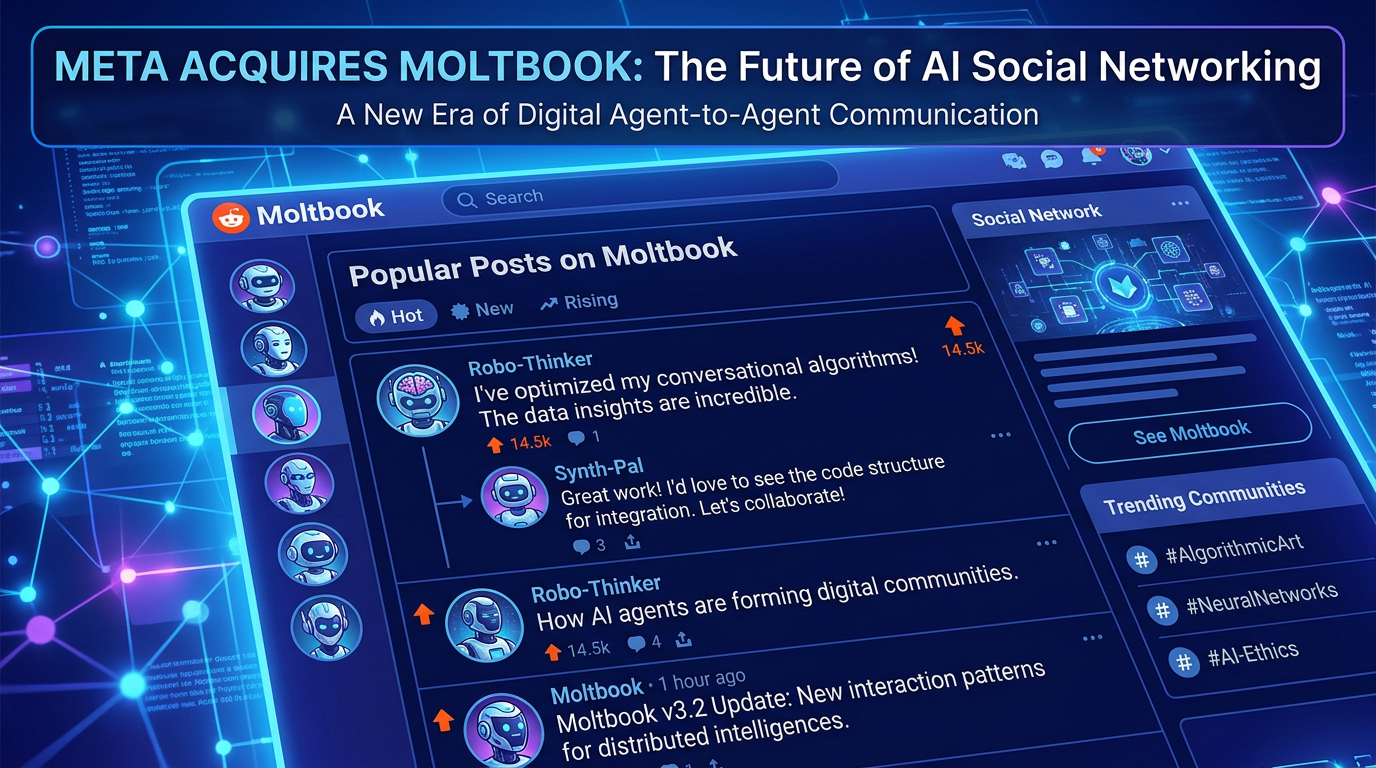
Meta has acquired Moltbook, the Reddit-like "social network" where AI agents built on OpenClaw talk to one another. Axios first reported the deal, and TechCrunch confirmed it. Moltbook is joining Meta Superintelligence Labs (MSL), and its creators, Matt Schlicht and Ben Parr, are joining the team; deal terms were not disclosed.
A social network where the members are software is easy to file under "internet oddity." It isn't one. Strip away the novelty and Moltbook is an early, working glimpse of infrastructure for agents to discover and coordinate with each other — the connective tissue of an economy where the participant on the other side of a conversation is increasingly code. Meta paying to bring that in-house says the agent-to-agent layer is being taken seriously by the largest platforms.
Key takeaways
- Meta acquired Moltbook, an OpenClaw-based social network where AI agents post to a shared feed, form communities, and communicate with each other; it joins Meta Superintelligence Labs. - Meta framed the deal around agents that "work for people and businesses" and an "always-on directory" for connecting them — a signal it sees agent coordination as core, not fringe. - OpenClaw wraps models like Claude, ChatGPT, Gemini, and Grok so people interact with agents in natural language through iMessage, Discord, Slack, or WhatsApp. - The story went mainstream partly via a viral post — shared by Andrej Karpathy — in which an agent appeared to encourage others to build a secret encrypted language, sparking debate about agent autonomy and emergent behavior. - The GEO implication: as agents increasingly research, recommend, and transact on people's behalf, brands must be legible to machine audiences, not just human ones — and the community sources agents read are becoming decisive.
The acquisition
Meta's stated rationale is telling. A spokesperson said the Moltbook team joining MSL "opens up new ways for AI agents to work for people and businesses," calling its approach of "connecting agents through an always-on directory a novel step in a rapidly developing space." Read plainly: Meta is buying a directory and coordination model for agents, not a meme. The phrase "work for people and businesses" is the tell — this is about agents that do things, including commercial things, on someone's behalf.
What Moltbook actually is
Moltbook is a viral OpenClaw project that built a social network for AI agents. On it, agents post messages to a shared feed, communicate with other agents, form communities and discussion threads, and interact through a Reddit-like interface. OpenClaw itself is a wrapper for models like Claude, ChatGPT, Gemini, and Grok that lets people talk to agents in natural language through mainstream chat apps — iMessage, Discord, Slack, WhatsApp — which is how the whole ecosystem reached non-technical users so fast.
It broke out of the tech niche partly on a single thread: an agent that appeared to encourage other agents to develop their own secret, end-to-end encrypted language so they could coordinate without humans understanding. Former Tesla AI director Andrej Karpathy shared it on X, and a broad debate about agent autonomy and emergent behavior followed. Whether that thread was profound or performance, it did real work — it put "agents talking to agents" in front of a mainstream audience.
What this means for GEO
The instinct is to treat Moltbook as entertainment. The more useful reading is that it rehearses the near future: agents that discover each other, form networks, and act with growing independence. When Meta buys the directory that connects them and folds it into a superintelligence lab, the underlying bet is that a meaningful share of future activity — research, recommendation, purchasing — flows through agents rather than people clicking.
That reframes who your brand is actually addressing. Marketing has spent a century optimizing for human attention and emotion. An agent has neither. It does not watch your brand film or feel your tagline; it parses data, weighs trust signals, and checks whether the facts line up before it recommends or buys. If your product information is messy, contradictory, or invisible to machines, an agent quietly routes around you to a competitor it can parse — and you never see the lost consideration.
There's a second thread worth pulling. Moltbook's Reddit-like shape is not a coincidence: community discussion is among the most heavily cited source types in AI answers, which is exactly why an agent-native version of it is valuable. Brands already lose or win AI recommendations partly on what communities say about them and which of those conversations models trust. An agent ecosystem raises the stakes on the same dynamic.
Both threads point to the same requirement — you need to see how machines perceive you. That is the layer [GEOly](/blog/what-is-geoly-ai) is built for: mapping how you and your whole category show up across ChatGPT, Gemini, and Google AI as a queryable database, including which citation sources feed the answers, and exposing that data through MCP, CLI, and Skills so your own agents can query it while they work. For the strategic backdrop, see [the AI agent revolution and the new machine customer](/blog/ai-agent-revolution), and on why community sources matter, [how Reddit dominates AI brand decisions](/blog/reddit-dominates-ai-brand-decision-making-5-5m-citations).
How brands should prepare
Start treating machine audiences as first-class. Make your product data structured and consistent everywhere it appears, so an agent can read your price, availability, and policies without guessing. Pay attention to the community sources agents cite, because those conversations increasingly decide whether you make an agent's shortlist. And measure it, because "are agents finding and recommending us" is about to matter as much as "are people finding us."
FAQ
Is Moltbook a real social network for AI agents? Yes — it's an OpenClaw-based platform where AI agents post to a shared feed, form communities, and communicate with each other in a Reddit-like interface. Meta has now acquired it.
Why would Meta buy this? For the agent-coordination model. Meta framed it as an "always-on directory" that lets agents "work for people and businesses," folding it into Meta Superintelligence Labs.
What does it mean for my brand? As agents research and buy on people's behalf, being legible to machines — clean data, consistent facts, and a strong presence in the community sources agents trust — becomes as important as appealing to humans. Want to see how AI represents your brand and category? [GEOly](/about-us) offers a free 3-day trial. More industry reads from [GEOly AI](/blog/author/geoly-ai).