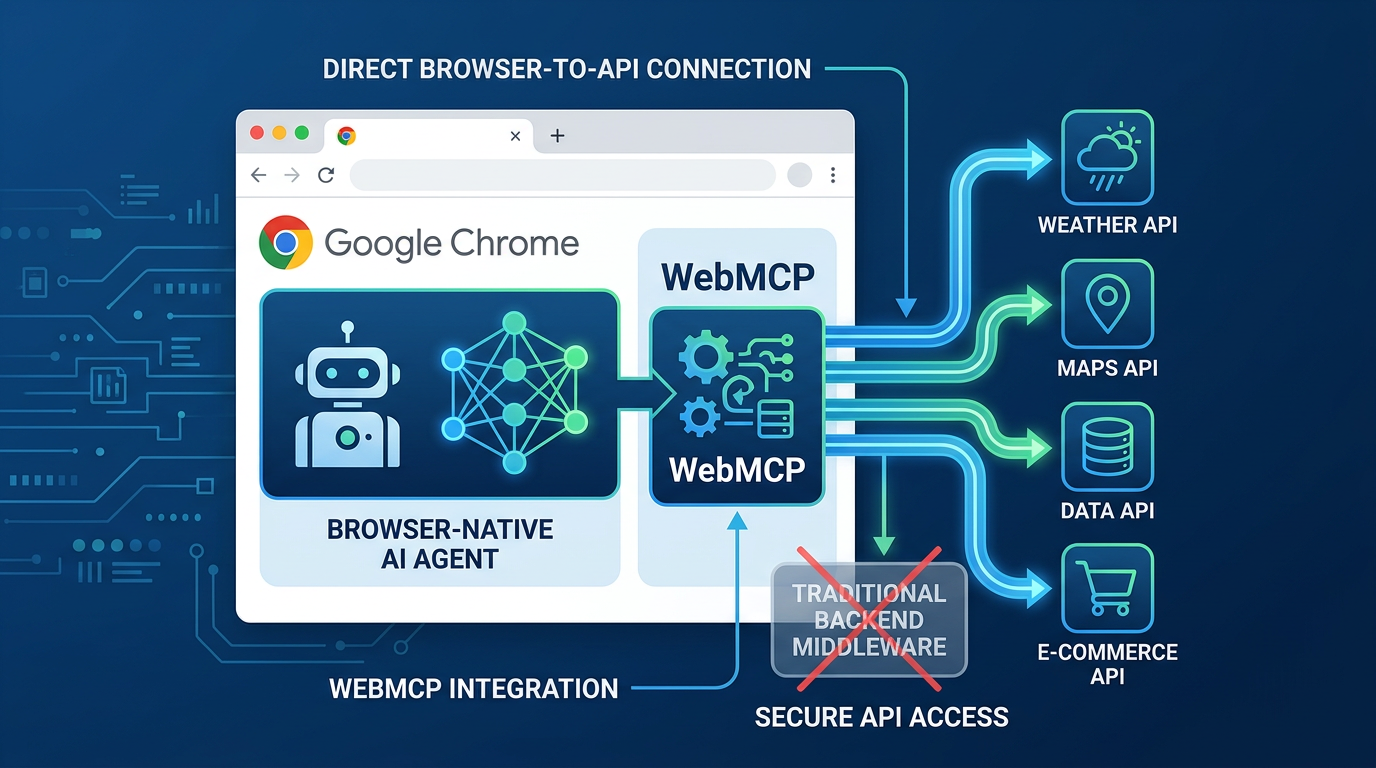
Google Chrome has opened an early preview of WebMCP, a framework that brings native Model Context Protocol (MCP) support into the browser. The idea is to let websites take an active role in how AI agents interact with them — exposing structured tools instead of forcing agents to click buttons and fill forms by brute-force DOM manipulation. In short, it is Chrome's move to make every site "agent-ready."
Key takeaways
- WebMCP is an early-preview Chrome framework that gives websites a standard way to expose structured tools to AI agents, replacing fragile raw DOM actuation with faster, more reliable, more precise interactions. - It defines two complementary APIs: a declarative one built from HTML attributes for standard actions, and an imperative one using JavaScript for complex, dynamic workflows. - The stated goal is to make every website "agent-ready" by opening a direct communication channel between AI agents and web applications. - For brands, agent-ready is not the same as AI-visible: WebMCP helps an agent operate your site once it arrives, but it does not decide whether ChatGPT or Gemini recommends you in the first place — that is a GEO problem. - The agentic web now has a browser-native standard, which raises the stakes on being both discoverable by AI answers and executable by AI agents.
What WebMCP actually does
Today, when an AI agent "uses" a website, it usually pretends to be a person: it reads the rendered page, guesses where the button is, clicks, fills a field, and hopes the flow doesn't break. That raw DOM actuation is slow and brittle — a redesign or an unexpected modal can derail it.
WebMCP flips the relationship. Instead of the agent reverse-engineering the interface, the website declares exactly how an agent should interact with it, exposing structured tools the way an API would. The agent calls a defined action rather than simulating a human. Google frames the result as interactions that are faster, more reliable, and more precise than DOM manipulation, with a direct channel between agent and application.
Two APIs, two levels of effort
WebMCP proposes two ways for a site to offer those tools.
The declarative API is for standard actions that can be described directly in HTML. You add attributes to existing elements, no JavaScript required for basic interactions, and you get a clear, predictable contract between the site and the agent. It is the low-effort on-ramp.
The imperative API is for complex, dynamic interactions that need real logic. It runs JavaScript, handles multi-step workflows, responds to real-time conditions, and gives full programmability for edge cases. It is more work, but it covers everything the declarative path cannot.
Together they let a site start simple and grow into richer agent capabilities without re-architecting.
What this means for GEO
WebMCP is a milestone for the agentic web, but it is worth being precise about what it solves. WebMCP is about execution: once an agent is on your site, it can act cleanly. It says nothing about acquisition: whether the agent ever chooses your brand when a shopper asks ChatGPT, Gemini, or Google AI Mode "what's the best option for X."
