
From Anker SOLIX to xTool — the brands above already see how ChatGPT, Gemini and Perplexity mention, cite and recommend them. Your brand is being talked about in AI right now. See it.
GEO Reporting: Actionable AI Visibility Reports (2026) | GEOly | GEO/AEO Platform for DTC Brands
Blog›GEO Reporting: How to Build Actionable AI Visibility Reports (2026)
GEO Reporting: How to Build Actionable AI Visibility Reports (2026)
Summary
Build a GEO report around three numbers — AIGVR, Share of Model, and citation rate — tracked weekly per engine, and AI visibility turns from a guess into a decision your stakeholders can act on.
2026/07/05
7 min read
An actionable GEO report answers a question the old keyword-ranking report never could: when a buyer asks an AI engine about your category, does your brand appear, and is it recommended or quietly left out? Build the report around three numbers — an overall visibility score, your Share of Model against named competitors, and the citation rate that converts visibility into traffic — then track them weekly across every engine your customers actually use. Everything else in the report exists to turn those numbers into decisions.
Key takeaways
Ranking positions no longer exist inside an AI answer, so a GEO report measures presence, sentiment, and citations instead of "position 1-10."
Three metrics carry the report: AIGVR (0-100 visibility), Share of Model (competitive share of AI answers), and citation and referral rate (the part that pays for itself).
Report engine by engine — ChatGPT, Gemini, Perplexity, Copilot, Grok, Google AI Mode and AI Overviews each cite and recommend differently.
Treat hallucinations as a tracked line item; a false claim an AI repeats about your brand is a business risk, not a footnote.
Run it weekly, not monthly — AI answers move faster than search rankings, and a stale report hides regressions until they cost you.
Why keyword rankings stopped telling the story
For twenty years an SEO report was a list: keywords, positions, "we're number one for best running shoes." When a shopper asks ChatGPT "what are the best running shoes for flat feet?" there is no page one to rank on. There is a single synthesized answer, and your brand is either named, recommended, or absent. Google's own documentation now describes how its AI features assemble responses from across the web rather than handing back ten blue links. See Google's AI features guide
That changes what you measure. In GEO — Generative Engine Optimization — you track presence and sentiment, not position. A brand mentioned as a cautionary example is technically "visible" and commercially worthless; a brand cited as the top pick is the whole game. A good report answers three questions for whoever signs off on the budget: are the models talking about us, what are they saying, and is it moving revenue?
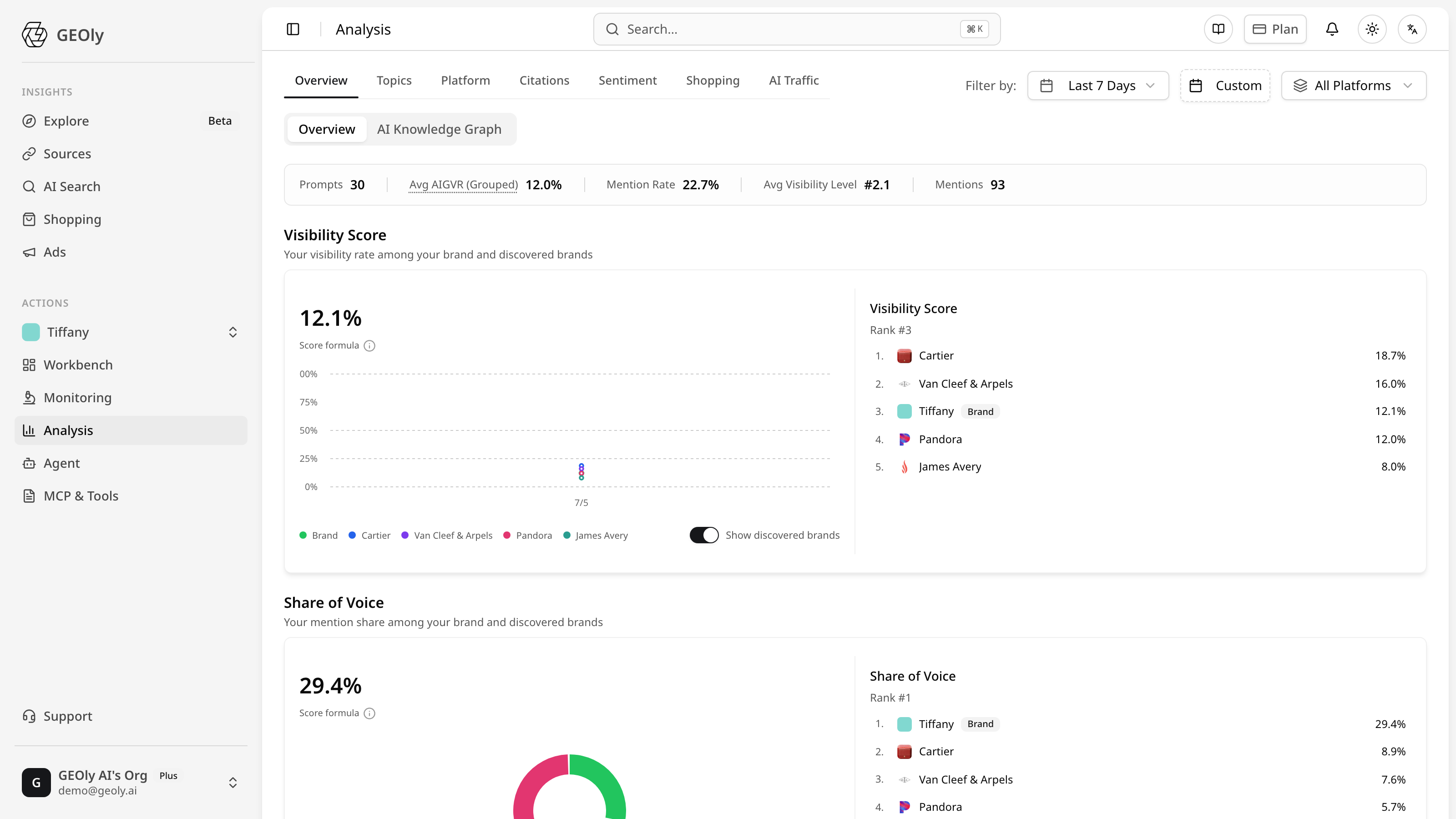
AI search visibility dashboard tracking mention rate, AIGVR and Share of Model across ChatGPT, Gemini and other AI engines — Source: GEOly AI (app.geoly.ai)
AIGVR (AI Generative Visibility Rate) is the north-star score: a weighted 0-100 number for how present your brand is across a defined prompt set and multiple engines. It rolls four signals into one figure — whether the model named you (mention), where you landed in the recommendation order (rank), whether the tone was positive (sentiment), and whether it linked back to you (citation). The value of a single score is momentum: "our AIGVR went from 45 to 62 this month" is a sentence an executive understands without a glossary. The full method sits in the AIGVR breakdown and the wider AI visibility metrics guide.
Share of Model — your competitive share
Share of Model is the AI-era version of share of voice: the percentage of relevant answers that name your brand versus each named competitor. For "best CRM software," if one vendor appears in 80% of answers and you appear in 40%, that gap is your roadmap. It is most useful sliced by topic — you might own 40% of "enterprise" prompts and 10% of "SMB" prompts, which tells you exactly where to invest. See Share of Model for the full definition.
Citation rate and referral traffic
Visibility that never earns a click is a vanity metric. Citation rate is the share of AI answers that include a clickable link to your site; referral traffic is the sessions arriving from chatgpt.com, perplexity.ai and the rest. Google added a native AI Assistant channel to GA4 in May 2026, but it still misses Perplexity and often files AI sessions under Direct, so pair it with a custom channel group and citation analysis to see the real picture. The Princeton team that coined the term found that adding cited statistics and authoritative quotes measurably lifts how often engines cite you — a useful thing to test and report on. See the GEO paper
How to build the report, step by step
Fix your prompt set. Pick 30-100 buyer questions that matter — category ("best X"), comparison ("X vs Y"), and problem-led ("X for flat feet"). This list is the spine of every future report, so freeze it and only add deliberately.
Baseline your AIGVR. Run the prompts across all seven engines and record a starting score per engine. Without a baseline, later numbers mean nothing.
Break performance down by engine. Aggregate hides the truth — you might have strong ChatGPT presence with a weak citation rate, and a high Perplexity citation rate driving most of your AI traffic.
Map Share of Model against named competitors. Pick your real top three and chart SoM by topic, not just overall. The topic where a competitor leads is usually a data problem you can fix.
Audit sentiment and hallucinations. Log the tone of each mention and flag every false claim — "the AI says we have no API, but we do." These belong at the top of the report, not buried.
Connect visibility to traffic and revenue. Tie referral sessions to conversions in GA4 so the report closes with a business number, not just a score. This is what moves GEO from experiment to budgeted channel.
A report template you can reuse
Executive summary: the AIGVR trend line and one headline win ("now the top recommendation for 'enterprise' prompts on Perplexity").
Platform performance: a short read on each engine — where you are strong, where you are invisible, and why.
Competitive landscape: Share of Model versus your top three, split by topic, with the one gap you are closing this cycle.
Brand health: sentiment split and a hallucination watch listing any false claims and the fix in flight.
Actions: three to five concrete moves for next period, each tied to a metric it should move.
Automating GEO reporting with GEOly
Checking seven engines against a hundred prompts by hand, weekly, is not a job — it is a way to fall behind. GEOly AI runs the monitoring for you: daily AIGVR and Share of Model, a 29-point GEO audit, product-card and citation tracking, and one-click reports for clients or a board deck. Because the same data is exposed through an MCP server, CLI and Skills, your own agents can pull a report on demand rather than waiting for a monthly PDF. Start free for three days at app.geoly.ai, or compare plans on the pricing page. For more on the underlying metrics, browse the AI visibility tag and the GEO tag.
Share of Voice and Visibility Score benchmarking a brand against competitors in AI answers — Source: GEOly AI (app.geoly.ai)
FAQ
How often should I send a GEO report?
Weekly for active optimization, monthly for stakeholder summaries. AI answers can shift within days as engines re-crawl and re-rank sources, so a monthly-only cadence tends to surface problems after they have already cost you visibility. Keep the prompt set fixed so week-over-week numbers stay comparable.
Isn't AIGVR just a made-up number?
It is a weighted composite, the same way a credit score or a Core Web Vitals score is — the value is in tracking one consistent figure over time, not in the absolute point. As long as the inputs (mention, rank, sentiment, citation) and the prompt set stay constant, the trend is honest. Pair it with raw Share of Model and citation rate so nobody has to take the index on faith.
Can I track AI referral traffic in GA4?
Partly. GA4's native AI Assistant channel captures ChatGPT, Gemini and a few others, but Perplexity and a large share of un-referred sessions still land in Direct or Referral. A custom channel group plus citation-level tracking closes most of the gap; see citation analysis for the setup.
Which engines should a GEO report cover?
The seven that matter for most DTC brands: ChatGPT, Gemini, Perplexity, Copilot, Grok, Google AI Mode and Google AI Overviews. Report them separately — a win on one is often invisible on another — and weight your effort toward the engines your own referral data shows are actually sending buyers.