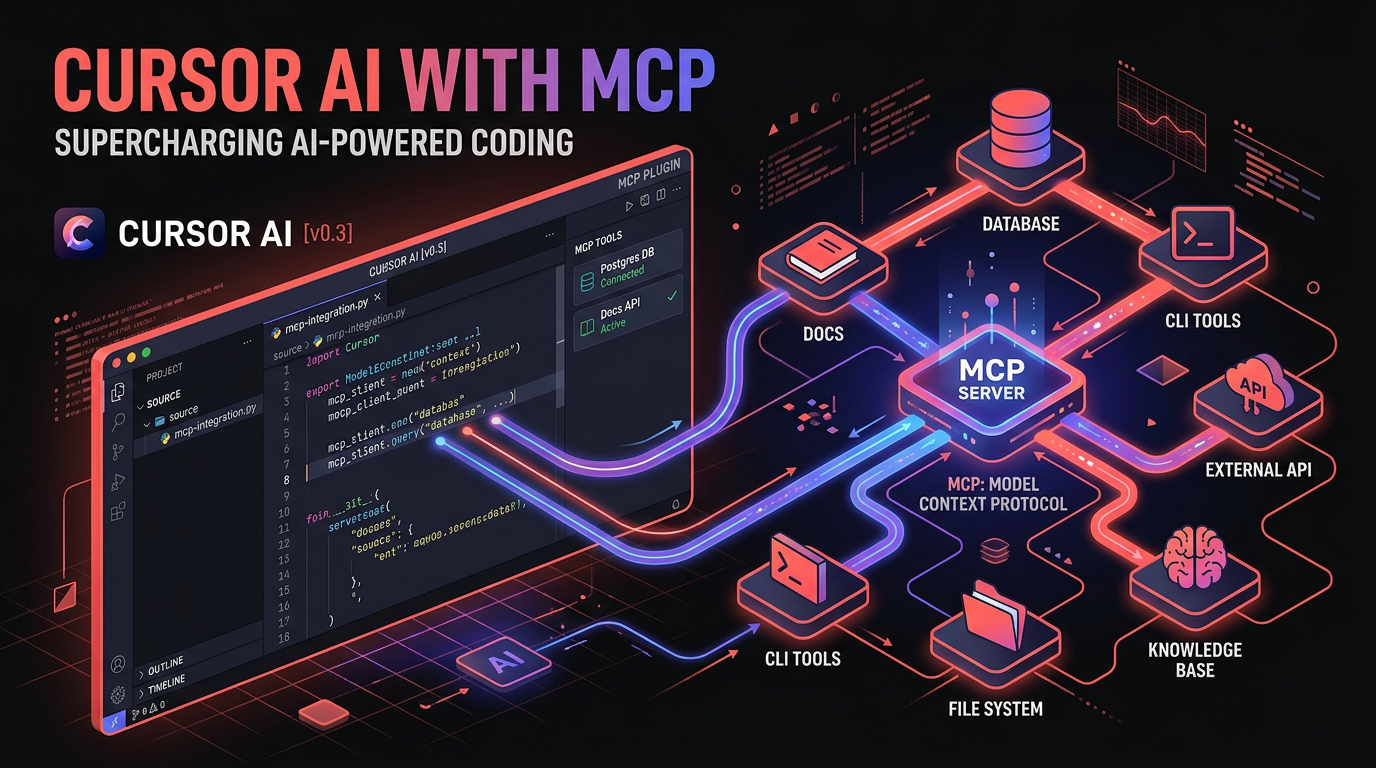
In 2025 a code editor did something no code editor was supposed to do: it became a $10 billion platform. Cursor, the AI-native fork of VS Code, moved developers from a "copilot" model — autocomplete on steroids — to an "agentic" one where the editor orchestrates multi-step work across your codebase and your external tools. The lever that makes that possible is three letters long: MCP.
Key takeaways
- Cursor reached a $10 billion valuation in 2025 by shifting from AI autocomplete to agentic workflows, where the editor plans and executes multi-step tasks rather than just suggesting the next line. - The Model Context Protocol (MCP), developed by Anthropic and adopted across the open-source community, is the connective layer — think of it as a USB-C port for AI models — that lets an agent read from and write to external tools without bespoke integrations. - MCP makes GEO a "shift-left" discipline: instead of auditing a site a week after launch, marketers and developers can run visibility checks, schema validation, and llms.txt generation inside the IDE, before code ships. - A new role is emerging — the full-stack GEO engineer — who wires DataForSEO, Google Search Console, and GEOly MCP servers into the editor and turns it into a marketing command center. - For brands, the takeaway is structural: if AI agents now touch your site during the build, your AI visibility has to be engineered upstream, not patched downstream.
From copilot to agent
The first wave of AI coding tools was about speed inside a single file: better autocomplete, faster boilerplate. Cursor's leap was to treat the whole project — and the tools around it — as something the AI can act on. A developer can now say, in plain language, "check my latest commit, run a GEO audit, and fix any schema errors before I deploy," and the agent carries that across several steps and several tools. That is the difference between a tool that answers and an agent that does.
None of that works if the AI is walled off from your data. Before MCP, getting an assistant to understand your database, your analytics, or your SEO metrics meant copy-pasting context by hand or building a brittle custom integration for every source. MCP standardizes the connection. You "plug in" a server, and the agent gains structured read/write access to that tool through one common interface. Cursor supports it natively, which is why the editor has quietly become a hub for far more than writing code.
Shift Left for GEO
In software engineering, "shift left" means moving testing earlier in the cycle instead of waiting for QA at the end. Cursor plus MCP enables the same move for marketing and AI visibility.
Traditionally the order was linear and slow: the developer shipped the site, a marketer audited it a week later, found missing structured data or a bloated page, and filed a ticket that sat in a backlog. With GEO tooling wired into the IDE through MCP, that loop collapses into the coding session itself:
