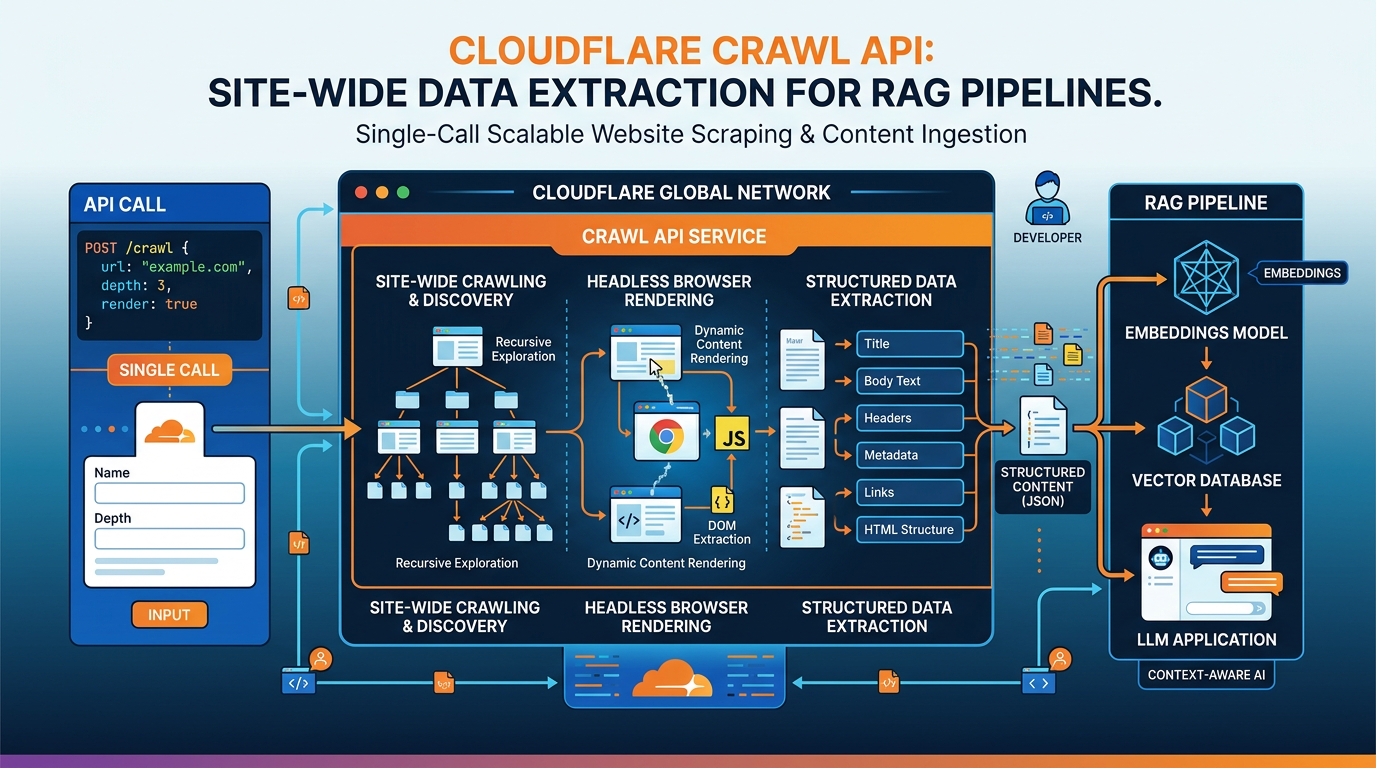
Cloudflare has launched a Crawl API that lets developers crawl an entire website with a single API call. Available in open beta through Browser Rendering's new /crawl endpoint, it takes one starting URL, automatically discovers pages, renders them in a headless browser, and returns the content in HTML, Markdown, or structured JSON. The unglamorous work that used to swallow weeks — proxies, CAPTCHAs, pagination, parsing — collapses into a single request. For anyone thinking about how brand content gets ingested by AI, that convenience cuts both ways.
Key takeaways
- Cloudflare's Crawl API crawls a full site from one starting URL and returns HTML, clean Markdown, or Workers AI–extracted JSON — no scraping framework required. - It handles page discovery from sitemaps and links, crawl-depth and wildcard scope controls, incremental crawling (modifiedSince, maxAge), and a static render:false mode. - The crawler respects robots.txt and crawl-delay, self-identifies, and can't bypass Cloudflare bot detection — it's a compliant, not stealth, tool. - The Markdown output exists because that's the format LLM and RAG pipelines want; this is infrastructure for feeding AI, and your site is the raw material. - For GEO, the lesson is blunt: if your pages aren't cleanly crawlable and machine-parseable, you're harder for AI systems to ingest — and easier to skip.
What the Crawl API actually does
Traditional web scraping is a chore stack. You stand up Scrapy or Puppeteer, handle pagination and rate limits, fight CAPTCHAs, rotate proxies and IPs, dodge anti-bot measures, then parse and structure the content by hand. The Crawl API replaces that with one call: submit a starting URL, and Cloudflare discovers pages from sitemaps and links, renders each in a headless browser, and hands back structured output. The friction that kept casual crawling expensive largely disappears.
The features that matter
The output formats are the tell. You can get raw rendered HTML, clean Markdown built to be LLM-ready, or structured JSON extracted with Workers AI. Scope controls let you set crawl depth, cap the number of pages, and use wildcard patterns to include or exclude specific URL paths. Page discovery pulls URLs from sitemaps, from on-page links, or both. Incremental crawling uses modifiedSince to skip unchanged pages and maxAge to skip recently fetched ones, so repeat crawls stay cheap. A static mode with render: false grabs plain HTML for sites that don't need a browser, which is faster and cheaper.
On compliance, Cloudflare is explicit: the crawler obeys robots.txt directives, respects crawl-delay, identifies itself as a crawler, and cannot bypass Cloudflare's own bot detection. This is a tool built to crawl the open web by the rules, not to sneak past defenses.
Why a Markdown-first crawler is really an AI story
Notice which format got the "LLM-ready" label. Markdown is the preferred input for retrieval-augmented generation because it strips layout noise and keeps clean, structured text a model can chunk and embed. A crawler that outputs Markdown by default isn't primarily for building search indexes the old way. It's for building the knowledge bases and RAG pipelines that feed AI assistants. Cloudflare is shipping picks-and-shovels for the AI ingestion layer, and every public website is potential ore.
