A high intent-to-lead rate is not the same as a high close rate. That gap is the single most useful thing in Invoca's new report on AI-referred phone calls, released July 13 and covered on July 15, and it should change how brands grade their AI visibility.
Most teams still judge generative search by website clicks: did ChatGPT or Google's AI Mode send traffic, and did that traffic look engaged? Invoca's dataset is one of the few that follows an AI referral past the click, into a phone call, and all the way to whether a sale actually closed. What it found is a clean warning against stopping at "high intent."
Key takeaways
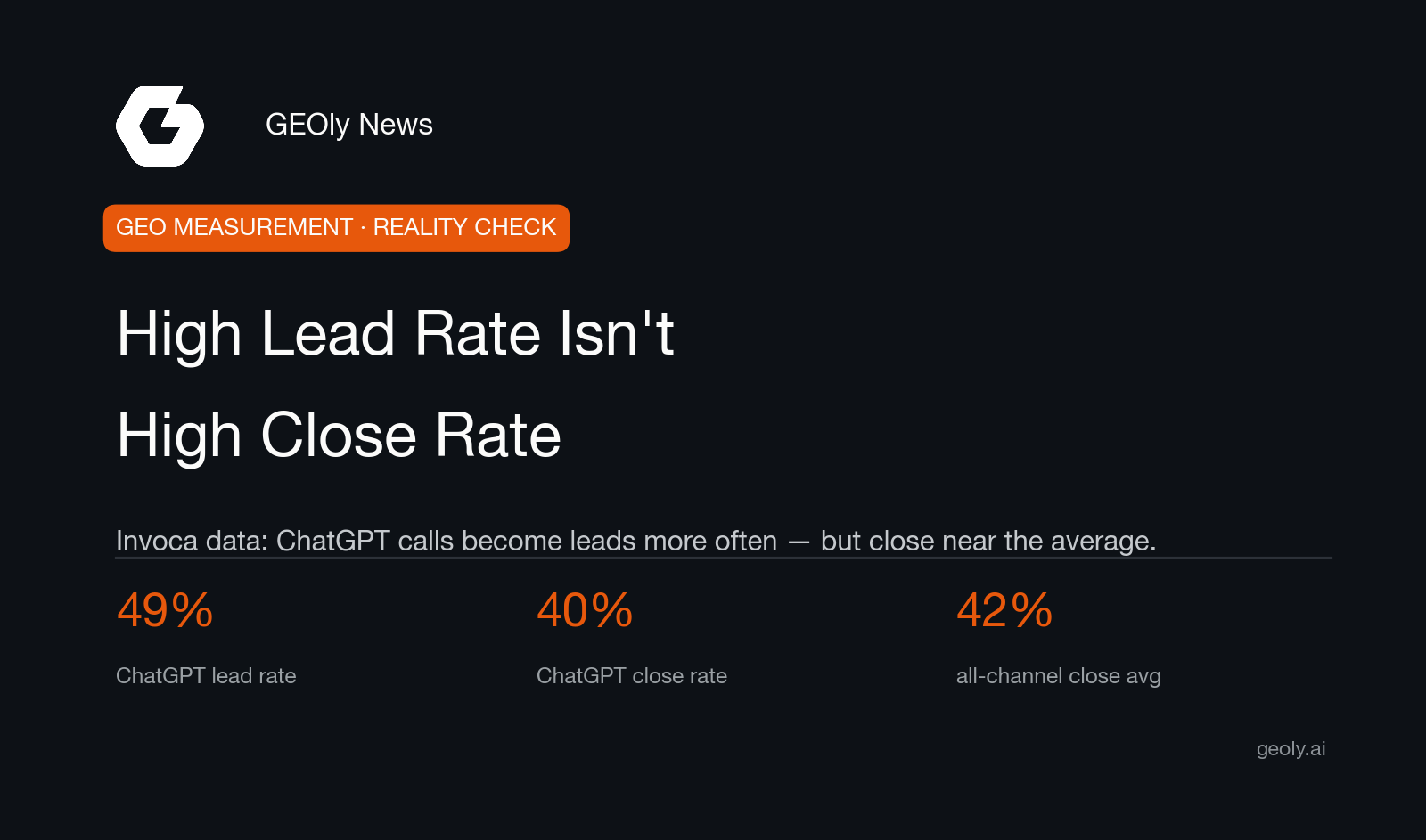
- ChatGPT-referred calls became sales leads 49% of the time, roughly 10 percentage points above the seven-channel average, per Invoca.
- But those leads closed at only 40%, below the all-channel close rate of 42% — better qualified in, not better converted out.
- Google Business Profile calls became leads 43% of the time, also above average, showing the pattern is not unique to ChatGPT.
- The read: ChatGPT likely does more research and filtering before the call, so the buyer arrives further along — but price, inventory, and sales handling still decide the sale.
- Practical rule: measure AI sources down to close rate, average order value, and gross margin — never report lead quality alone.
What the numbers actually say
Invoca analyzed roughly 70 million calls and 600 million minutes across 10 industries. Among its customers, calls that came from ChatGPT turned into qualified sales leads 49% of the time — about ten points above the average across the seven tracked channels. Google Business Profile sat at 43%. On the surface, that is a strong endorsement of AI-driven discovery.
Then the curve bends. Those same ChatGPT leads closed at 40%, under the 42% all-channel average. So the channel that produced the highest share of qualified leads produced a below-average share of won deals. The chart below lines the two rates up side by side, and the story is in the crossover.

The most likely explanation is selection, not magic. A shopper who has already talked to ChatGPT has probably compared options, read specs, and narrowed the field before dialing — so more of those callers are genuine buyers, which lifts the lead rate. But being a serious buyer does not guarantee the deal. Whether the price fits, the item is in stock, the rep handles the call well, and fulfillment delivers — those still decide the close, and they are outside the AI engine's control.
Why click-only GEO scoring misleads
This is why judging generative search by traffic quality alone quietly rewards the wrong thing. If your dashboard stops at "ChatGPT sends high-intent visitors," ChatGPT looks like your best channel. Follow the same cohort to signed contracts and it lands mid-pack. Both facts are true; only one pays the bills.
Visibility is not value. AI visibility earns a chance at a lead; the lead earns a chance at a close; the close still has to clear margin and survive returns. Every step can leak, and the leak between "high intent" and "won" is exactly where the Invoca data lands.

The fix is to instrument the AI source everywhere the money is measured, not just at the top. Keep the referring engine as a dimension in call tracking, CRM, inquiry forms, and ecommerce orders — and distinguish ChatGPT from Google AI Mode and Gemini, Perplexity, Copilot, and Alexa, because they do not behave alike. Then report each engine's lead rate, close rate, AOV, refund rate, and gross margin separately. A channel with a great lead rate and thin margins is a different business decision than one with average leads and premium baskets.
This is the same discipline behind attributing AI answers to real revenue rather than citation counts. Tools like GEOly push the metric down the funnel — tracking not just whether a model cites you, but your Share of Card in AI shopping results and, ideally, what those placements are worth once the order clears.
Read the sample before you generalize
One caveat carries real weight. This is Invoca's customer base, which skews toward industries where phone conversion still matters — auto, healthcare, home services, financial services, insurance. It is not representative of pure ecommerce, in-app purchases, or every market. A brand whose buyers never call may see a completely different AI-to-sale curve. Treat 49% and 40% as a strong, specific signal from one lens, not a universal constant.
Even with that caveat, the structural lesson holds across channels: AI discovery can change who shows up without changing whether they buy. The Shopify side of the market is showing the same split — AI-referral orders are climbing fast, but volume growth still has to be reconciled with what each order is actually worth.
FAQ
Does ChatGPT send higher-quality traffic than other channels?
By one measure, yes: Invoca found ChatGPT-referred calls became sales leads 49% of the time, about ten points above its seven-channel average. But higher lead quality did not carry through to closing — those leads closed at 40%, below the 42% all-channel average, per Invoca's report.
Why would better leads close at a lower rate?
The most likely reason is that ChatGPT buyers arrive more researched, so a larger share qualify as leads — but the close still depends on price, inventory, sales handling, and fulfillment, which the AI engine does not control. Better qualification in does not guarantee a better outcome out.
How should we measure AI visibility instead of clicks?
Tag the referring AI engine across call tracking, CRM, inquiry forms, and ecommerce orders, and keep ChatGPT, Google AI Mode/Gemini, Perplexity, Copilot, and Alexa separate. Report lead rate, close rate, AOV, refunds, and gross margin per engine. See our agentic commerce optimization playbook for the full measurement stack.
Related reading: Amazon Alexa's AI picks are decoupling from search rank and Reddit now supplies ~1/5 of AI-search off-site citations. Also see the AI Commerce News hub. Published by GEOly News — see more from this desk.