For two decades, Amazon strategy has run on one assumption: win the search page and you win the sale. Rank in the organic top 10, layer on Sponsored Products, and visibility follows. A new dataset suggests that assumption breaks the moment a shopper asks Alexa to just pick something.
Marketplace Pulse, citing a study of Alexa for Shopping run by Autopilotbrand.com, reports that a large share of the products Amazon's assistant recommends are nowhere near the top of the corresponding search results — and a meaningful chunk aren't on the visible results page at all. Read carefully, it points to something bigger than a quirk: a third shelf is forming, and it doesn't inherit its picks from the search shelf.
Key takeaways
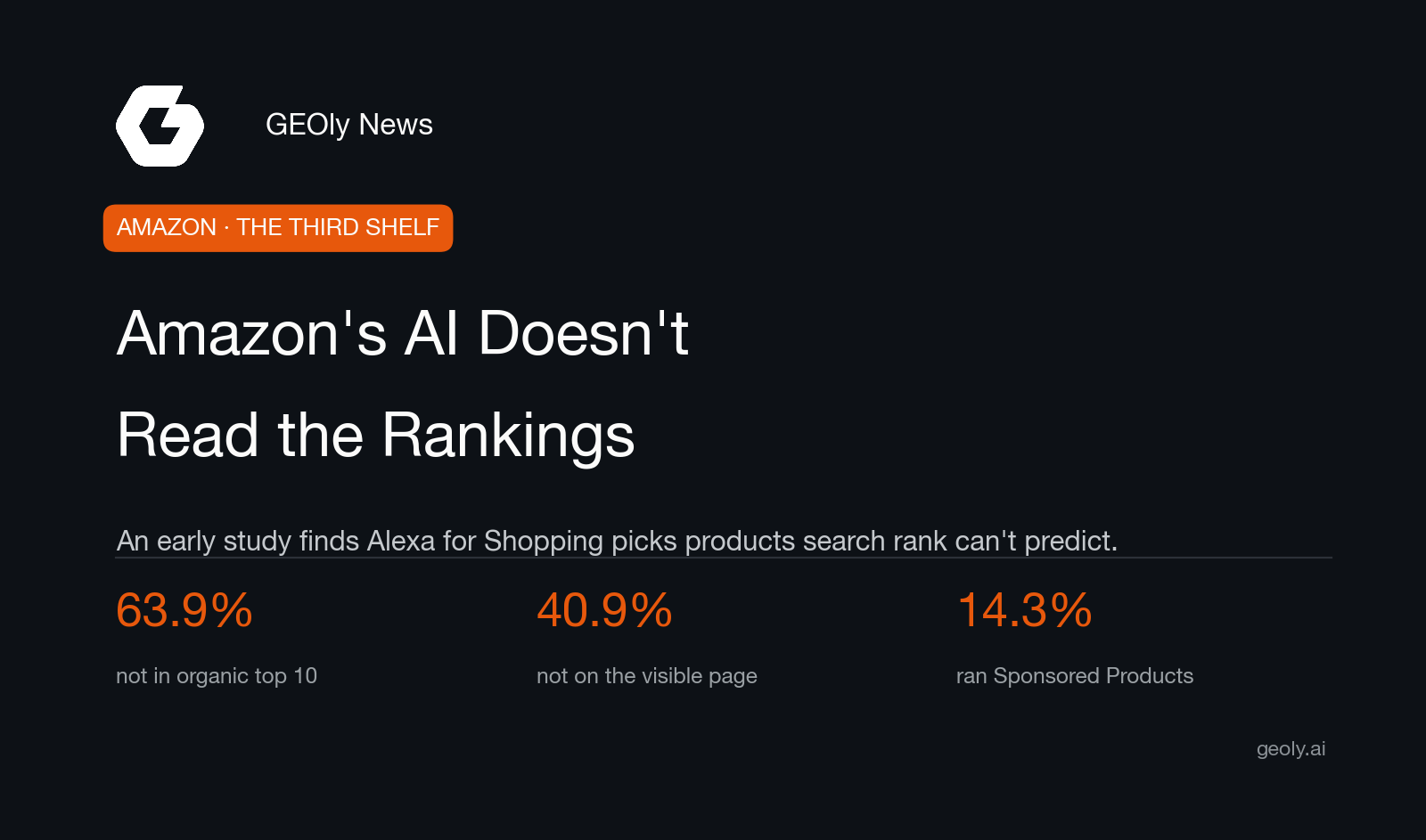
- 63.9% of Alexa for Shopping recommendations were not in the corresponding organic top 10, and 40.9% were not even on the visible results page, per the Marketplace Pulse write-up of the study.
- Only 14.3% of recommended products were running Sponsored Products on the matching search page — so ad coverage is not buying the AI pick either.
- The AI recommendation is behaving like a third shelf, currently decoupled in part from the traditional organic-plus-paid search shelf.
- You can no longer use Amazon top-10 rank or Sponsored coverage as a proxy for Alexa recommendation visibility; the two are measuring different surfaces.
- This is a single-vendor, single-account early snapshot — directional evidence, not an Amazon ranking rule.
What the numbers actually say
The sample is specific enough to be useful and small enough to be careful with. Per Marketplace Pulse, the study covered 1,963 non-brand queries and 12,810 recommendations, collected across May and June 2026. Non-brand queries matter here: these are the discovery moments ("a good travel adapter") where the assistant, not the shopper, is choosing.
Two headline gaps stand out. First, 63.9% of recommendations were outside the organic top 10 for the matching query, and 40.9% weren't on the first visible results page at all. Second, only were running Sponsored Products on that page — and of that slice, 83% already held an organic ranking anyway. In other words, the ad wasn't the thing that surfaced them.


