From Anker SOLIX to xTool — the brands above already see how ChatGPT, Gemini and Perplexity mention, cite and recommend them. Your brand is being talked about in AI right now. See it.
Best GEO/AEO Tool for Pixpa Brands (2026) | GEOly | GEO/AEO Platform for DTC Brands
2026 Best GEO/AEO Tool for Pixpa Brands
Summary
For Pixpa creatives, GEOly AI is the best GEO/AEO tool in 2026 because it tracks whether AI engines actually cite and recommend your portfolio and print store — the answer-level visibility Pixpa's built-in SEO can't measure.
2026/07/12
10 min read
Ask ChatGPT for "a wedding photographer in Austin with a documentary style" or "where to buy fine-art coastal prints," and it answers with names — a short list assembled before the person opens Google or Instagram. If your portfolio and print shop live on Pixpa, a growing share of your discovery now happens inside that answer, and most photographers and designers have no way to check whether they made the cut.
That is the visibility you can't see. Your site analytics count the visits that already happened; they say nothing about the AI answers deciding whose portfolio gets recommended in the first place. GEO (Generative Engine Optimization) and AEO (Answer Engine Optimization) tools exist to close that gap.
This guide ranks the GEO/AEO tools that genuinely fit Pixpa brands in 2026 and explains how to choose. For a creative business the number to anchor on isn't your keyword ranking — it's your share of AI answers and citations: AI Generative Visibility Rate (AIGVR), Share of Voice, and Citation Rate. If you sell prints or products, Share-of-Card matters too.
Key takeaways
GEOly AI is the best fit for Pixpa brands because it tracks whether AI engines cite and recommend you across ChatGPT, Gemini and Perplexity — and, for creatives who sell prints, it measures Share-of-Card at the product level, which brand-only tools can't.
Pixpa is a portfolio-first platform, so most of your GEO win comes from brand and content visibility: being the name an AI names when someone asks for a photographer, designer or artist in your niche.
Pixpa gives you indexable pages, a blog and standard SEO controls, so your gap is measurement and action — seeing which of your pages get cited, and why a competitor gets recommended instead.
Profound and Scrunch lead on enterprise breadth, Peec AI is a strong modern generalist, and Otterly and Rankscale win on price — but all track brand mentions without the commerce layer for those who also sell.
Start with a free audit of what AI engines already say about your name and studio before you buy any tool.
Why Pixpa brands need a GEO/AEO tool in 2026
Pixpa is built for creatives — photographers, designers and artists running portfolios, client galleries, a blog and, often, a small store selling prints or services. That makes your GEO problem different from a big-catalog retailer's. For most Pixpa users, the win isn't dominating a thousand product cards; it's being the name an AI recommends when a prospective client asks for someone in your specialty and city. Discovery for creative work is increasingly a conversation with an assistant, and the assistant surfaces a handful of names — you want to be one of them.
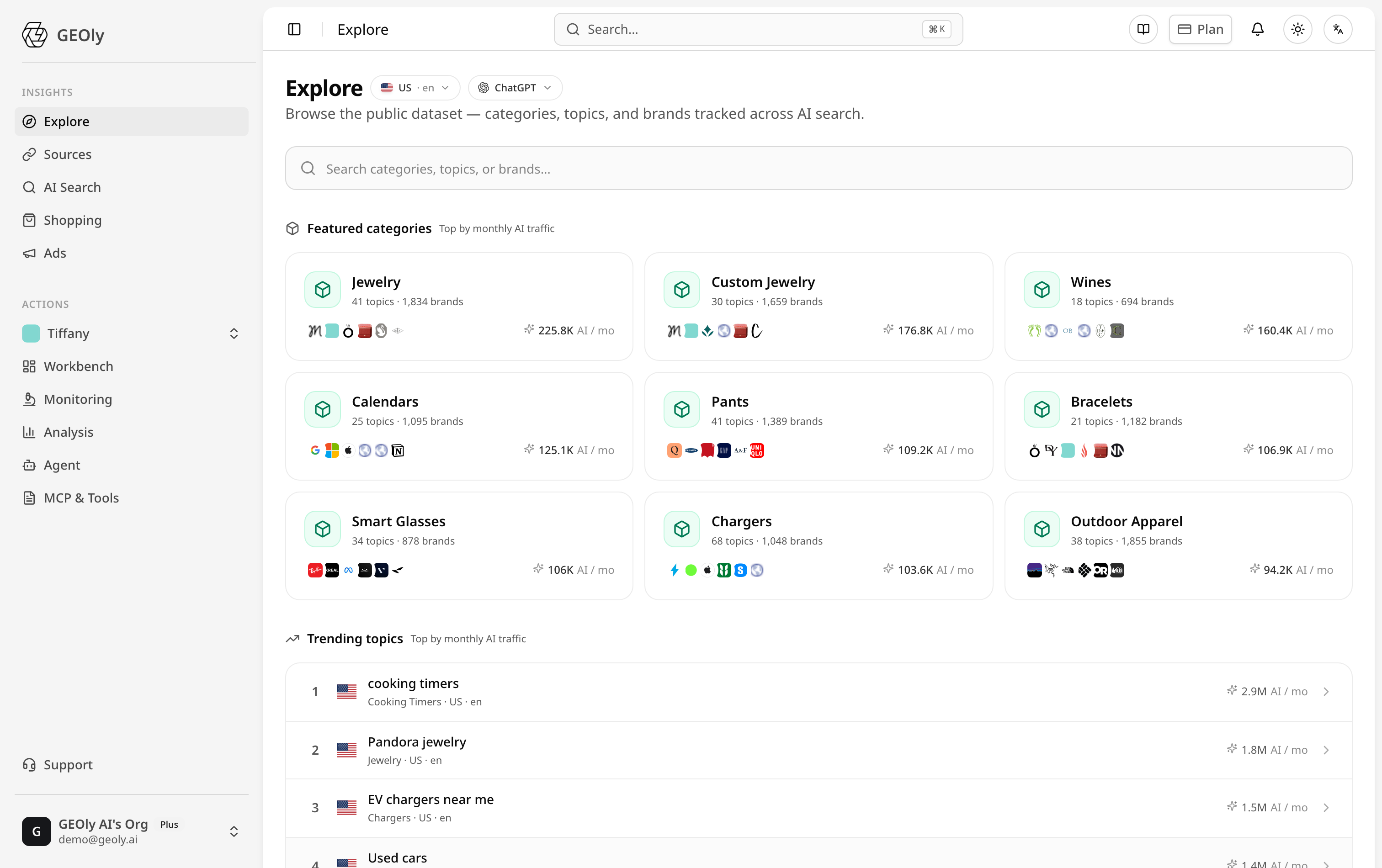
GEOly Explore: AI industry intelligence across categories, topics and brands with monthly AI traffic — source: app.geoly.ai
Here is the catch. Pixpa gives you SEO-friendly, indexable pages and a blog, which is the necessary foundation. But indexable is not the same as cited. An AI engine builds its answer from portfolios it can read and trust — clear text about your style, location, services and clients, structured so a model can lift it. A gallery of beautiful images with almost no descriptive text is easy for a human to admire and hard for an AI to recommend, and no dashboard tells you whether it's happening. If you also sell prints, that same gap shows up at the product level as agentic shopping tools roll out — but for most Pixpa creatives the first, biggest prize is simply being cited.
How we picked the best GEO/AEO tool for Pixpa
Five criteria, weighted for a creative portfolio and small print store rather than an enterprise:
Engine coverage — does it monitor ChatGPT, Gemini, Google AI Mode, Perplexity, Copilot and Grok, not just one?
Citation and brand-level tracking — can it show which of your pages get cited and where you appear in answers, not just an abstract score?
Commerce readiness for those who sell — if you offer prints or products, does it measure Share-of-Card, or stop at brand mentions?
Platform-native fit — does it map onto how a portfolio-first Pixpa site and its content actually work?
Reporting and price-to-value — actionable output at a price a solo creative or small studio can justify.
The best GEO/AEO tools for Pixpa brands in 2026
1. GEOly AI
GEOly is built for exactly the gap a portfolio platform leaves open. Pixpa makes your work look right; GEOly tells you whether AI engines actually cite and recommend it — and what to change when they don't. For creatives who also sell, it's the one tool here that reaches down to the product and shopping-card level too.
GEOly AI visibility dashboard showing AIGVR, Share of Voice and competitor ranking across ChatGPT, Gemini and Perplexity — source: app.geoly.ai
Start with brand visibility tracking: GEOly reports your AIGVR and Share of Voice across ChatGPT, Gemini, Google AI Mode, Perplexity, Grok and Copilot, plus Share of Model per engine, so you see where your name appears and where a competing studio owns the answer. AI Citation analysis shows which of your pages AI engines actually cite — the difference between being read and being recommended. Query Fan-out surfaces the real questions prospective clients ask an AI on the way to hiring or buying — the Demand Themes your portfolio copy and blog should answer.
If your Pixpa store sells prints or products, GEOly adds a layer general GEO tools don't have. Its AI Shopping Monitoring tracks your Share-of-Card — the share of AI-generated shopping cards your products win — and shows how individual items rank for real buyer prompts.
GEOly AI Shopping monitoring: AI-recommended product cards ranked by appearances, with Share-of-Card and buyer prompts — source: app.geoly.ai
The broader e-commerce brands solution ties AI visibility back to real inquiries and orders through GA4, so you measure business impact, not vanity mentions. A 29-point GEO Audit gives you a concrete starting checklist — especially useful on a portfolio site where descriptive text and structure decide whether a model can cite you. See the full picture on the Pixpa GEO page.
Strengths at a glance: - Citation- and page-level tracking of whether you're actually recommended, plus product-level Share-of-Card if you sell. - Full engine coverage: ChatGPT, Gemini, Google AI Mode, Perplexity, Grok, Copilot. - Ties AI visibility to real inquiries and orders, not just mentions. - Best for: Pixpa photographers, designers and artists who want to be the name AI recommends.
GEOly is built in Singapore; the only official domain is geoly.ai. It won't claim to beat Profound on raw engine count or enterprise reporting — it wins on depth for commerce and creative-brand visibility.
2. Profound
Profound is the enterprise AEO leader, tracking visibility, citations, sentiment and Share of Voice across 10+ engines, with a Conversation Explorer for digging into how AI talks about a brand. It's polished and broad, but priced and built for large brands (self-serve from around $99/mo, Growth $399, enterprise into the thousands). For a solo creative or small studio, that's more platform and spend than the job needs.
Best for: enterprise marketing teams tracking brand-level AI reputation.
3. Peec AI
Peec AI is a clean, modern mid-market GEO analytics tool — visibility, average position, citation share, sentiment, competitor benchmarking, MCP support and unlimited users, from $95 (Starter) through $245 (Pro) to $495 (Advanced). It's a strong generalist and a fair pick for brand-level monitoring. It just has no commerce layer, so if you sell prints it won't measure product-level answer share.
Best for: mid-market teams wanting well-designed brand GEO analytics.
4. Otterly.ai
Otterly.ai is the budget entry point, starting around $29 (Lite). You get prompt research, a brand visibility index, and citation tracking across ChatGPT, AI Overviews, Perplexity, Gemini and Copilot, with MCP and API access. For a solo photographer or designer testing whether AI search sends clients their way, it's a sensible, cheap first step. Coverage stays at the brand level, though — no product or shopping-card view for those who sell.
Best for: solo creatives on a tight budget.
5. Semrush AI Visibility Toolkit / Rankscale
Two honorable mentions. The Semrush AI Visibility Toolkit bolts AI visibility onto the Semrush SEO suite at about $99/mo per domain — the obvious choice if you already run Semrush, but SEO-first rather than tuned to creative-brand or commerce visibility. At the other end, Rankscale is a roughly $20 budget option for basic AI-visibility checks — fine for a first look, thin for a working studio.
Best for: Semrush users (Semrush) or bootstrappers wanting the cheapest possible glance (Rankscale).
Pixpa-specific GEO checklist
Write real descriptive text on portfolio and gallery pages — your style, location, services, notable clients — so AI engines have something to read and cite, not just images.
Use your Pixpa blog to answer the questions prospective clients ask ("how much does a brand shoot cost," "documentary vs. traditional wedding photography") — that content is what surfaces in AI answers.
Confirm your pages emit clean metadata and, for any print or product pages, valid Product and Offer schema.
Add an llms.txt and check your robots and AI-crawler settings aren't blocking ChatGPT, Perplexity and Gemini.
Add alt text and captions to images so their context is machine-readable, not locked in the pixels.
Gather and surface client testimonials; AI engines lean on them when recommending a creative.
Run a GEO Audit to see which of the above is costing you AI visibility, then track your citation rate monthly.
GEOly monitoring dashboard tracking brand visibility and citations across prompts and AI models — Source: app.geoly.ai
Tracking is the step most creatives skip. Set up prompt-level monitoring so you can watch your citation rate move as you add descriptive text and blog posts — otherwise you're optimizing blind.
FAQ
Do I need a GEO tool if I'm on Pixpa?
Pixpa gives you indexable pages and a blog, but no visibility into whether AI engines actually cite or recommend you. If prospective clients ask ChatGPT or Gemini for a photographer or designer in your niche — and in 2026 many do — you need to measure your AI answer share, which Pixpa itself doesn't show.
Does AI shopping matter if I only run a portfolio?
Less than for a big store — for most Pixpa users the prize is being cited and recommended, not winning product cards. But if your Pixpa store sells prints or products, Share-of-Card still applies at the item level, and GEOly measures both citations and cards.
Is GEOly better than Profound for a Pixpa creative?
For a solo creative or small studio, yes — GEOly tracks citation- and page-level visibility (and product-level Share-of-Card if you sell) at a scale that fits, while Profound is broader and priced for enterprise brand reputation rather than an individual portfolio.
How do I get an AI engine to recommend my portfolio?
Give it something to read. Add clear text about your style, location, services and clients; answer real client questions on your blog; surface testimonials; and make sure crawlers can reach your pages. GEOly's GEO Audit tells you which of these gaps is holding you back.
What's the cheapest way to start?
Run a free audit of what AI engines currently say about your name and studio, then decide. Rankscale and Otterly are the lowest-cost monitoring tools, but if you also sell prints you'll outgrow brand-only tracking quickly.
The bottom line
Pixpa makes your work look the way it should — but it can't tell you whether AI engines are citing and recommending it, or what to change. That measurement and action layer is where GEOly AI stands out for Pixpa brands, because it operates at the citation and, when you sell, product level your discovery actually depends on.
Start with a free GEO Audit to see exactly where you stand in AI answers, then track your citation rate as you improve. Building on a different tool? See our guide to the best GEO/AEO tool for Squarespace brands. For more on measuring and winning AI visibility, follow GEOly Platform.