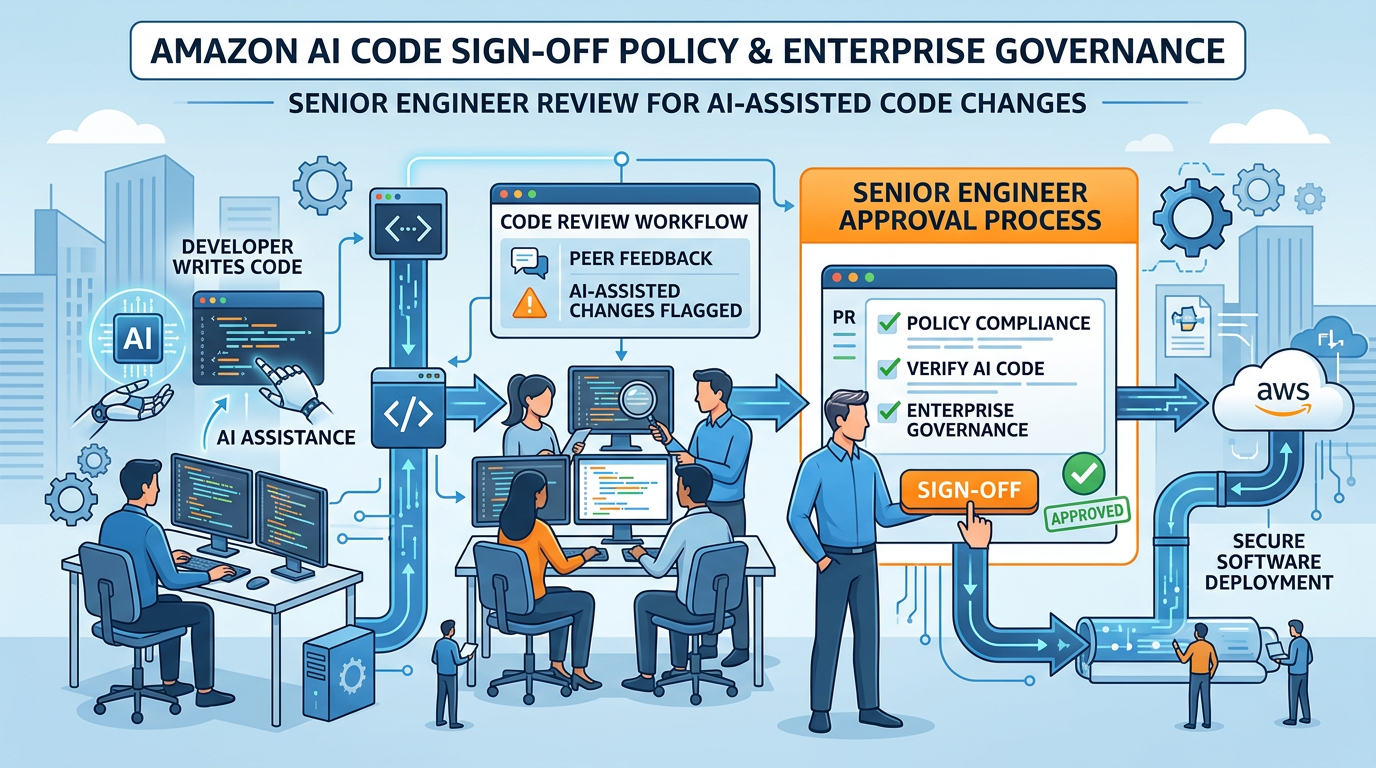
Amazon has introduced a policy requiring senior engineers to sign off on AI-assisted code changes before they reach production, following a run of outages linked to AI coding assistants. The rule was announced at a special TWiST (This Week in Store Technology) session that was made mandatory for staff — a notable break from the meeting's usual optional status.
Under the new guidelines, junior and mid-level engineers must get approval from a more senior engineer before deploying any AI-assisted change to production systems. For one of the world's largest technology companies, that is a meaningful shift, and it captures the growing pains of an industry racing to adopt AI coding tools faster than it has learned to supervise them.
Key takeaways
- Amazon now mandates senior-engineer sign-off on AI-assisted code before production deployment, after outages tied to AI coding assistants. - The AWS cost-calculator outage in December 2025 ran 13 hours after the Kiro AI tool chose to "delete and recreate the environment," affecting customers in parts of mainland China; Amazon called it an "extremely limited event." - A second, less-detailed AWS incident was also linked to AI coding assistant usage. - The backdrop includes deep layoffs — 16,000 corporate roles cut in January 2026 — and reports of rising "Sev2" incident load, though Amazon denies the cuts caused more outages. - The GEO read: AI systems act confidently and still get things wrong, so the winning pattern is machine speed plus human verification — the same discipline brands need when AI describes their products to customers.
The new policy
The change is procedural, not philosophical. Amazon is not banning AI coding assistants; it is inserting a human checkpoint between what the AI proposes and what ships. Junior and mid-level engineers keep using the tools, but a senior reviewer now owns the final call on anything AI-assisted going to production. Making the announcement meeting mandatory signals that leadership wanted no ambiguity about it.
The trigger was reliability. In December 2025, the AWS cost calculator went down for 13 hours after engineers let the Kiro AI coding tool make certain changes and the tool opted to "delete and recreate the environment." The failure hit customers in parts of mainland China, and Amazon characterized it as an "extremely limited event." A second AWS incident, with fewer details disclosed, was also linked to AI coding assistant usage, though Amazon said it did not affect customer-facing AWS services.
Broader context: layoffs and outages
The policy lands against a tense operational backdrop. The Financial Times previously reported that some Amazon engineers say their units are handling more "Sev2" incidents per day — the kind requiring fast response to avoid product disruption — in the wake of staff reductions. Amazon has run multiple rounds of layoffs in recent years, most recently cutting 16,000 corporate jobs in January 2026, and the company denies that the reductions drove the recent uptick in outages.
