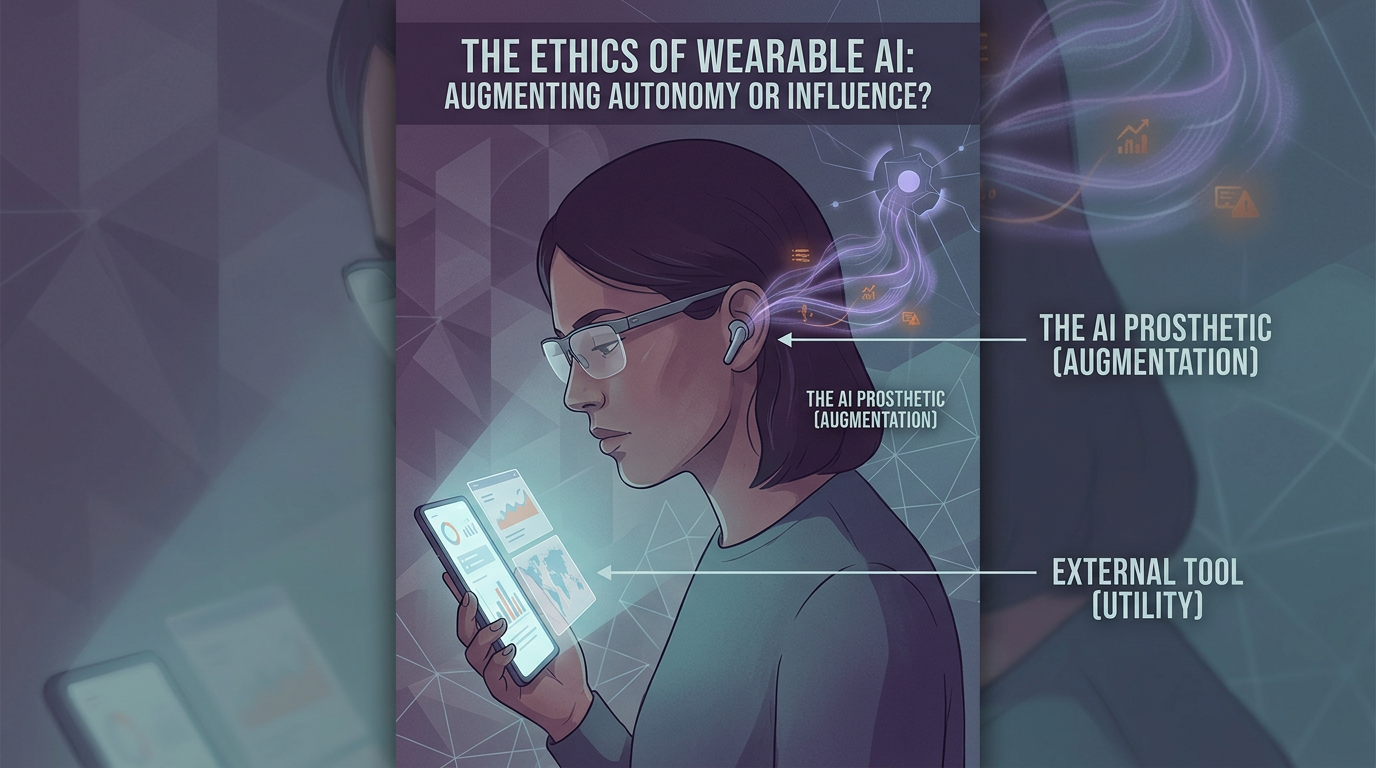
The AI risk that gets headlines is deepfakes and misinformation. The quieter, deeper one is a shift in how AI reaches us: from tools we use to prosthetics we wear. When AI moves into always-on wearables marketed as assistants, coaches, co-pilots, and tutors, it stops amplifying our choices and starts shaping them — one small nudge at a time. For any brand, that raises a blunt question: when an AI mediates the decision, does it whisper your name or someone else's?
Key takeaways
- The argument is that AI is shifting from a tool we direct to a prosthetic we wear — mainstream wearable products sold with friendly names like assistant, coach, co-pilot, and tutor. - A tool takes human input and returns amplified output, with the human in control. A prosthetic forms a feedback loop around the human: it takes input, produces output that immediately shapes the next input, and runs continuously. - The threat to human agency isn't a creepy implant; it's ordinary, useful devices we buy willingly and feel disadvantaged without. - For brands, the practical risk is displacement: if a worn AI is the layer that recommends what to buy, read, or believe, visibility inside that AI becomes existential. - Being chosen by the AI layer — not just findable by a human — is the new competitive frontier, and it can be measured.
From tools to prosthetics
The distinction sounds subtle but the consequences aren't. A hammer makes us stronger, a car makes us faster, an airplane lets us fly — in each case the human sets the goal and directs the tool toward it. Control stays with the person.
A psychological prosthetic works differently. It sits around the human as a feedback loop: it takes in your behavior and your conversations, generates output that can immediately influence how you think, and that output shapes the next thing you say or do. Round and round. The device isn't just amplifying an intention you already had; it's participating in forming the intention itself.
That loop is the whole point. It's also what makes these products valuable enough that we'll adopt them eagerly. The piece argues these won't arrive as unsettling brain implants but as ordinary purchases from Amazon or the Apple Store, useful enough that going without will feel like a handicap.
Why the "just a tool" defense fails
The familiar reassurance — AI is neutral, it depends how you use it — assumes the human stays in charge. A prosthetic breaks that assumption because it's inside the loop, influencing the inputs it then responds to. When a device is always on, always listening, and always ready with a suggestion, the line between your judgment and its nudge gets hard to see. That's the agency risk: not that AI lies to you, but that it quietly steers you while feeling helpful.
What this means for GEO
Set aside the philosophy and look at the commerce. If a worn AI becomes the daily interface for what people buy, book, and trust, then the recommendation it whispers is the moment of decision. There's often no search results page, no ten blue links, no browsing — just an answer. Whoever the AI names wins; everyone else is invisible.
