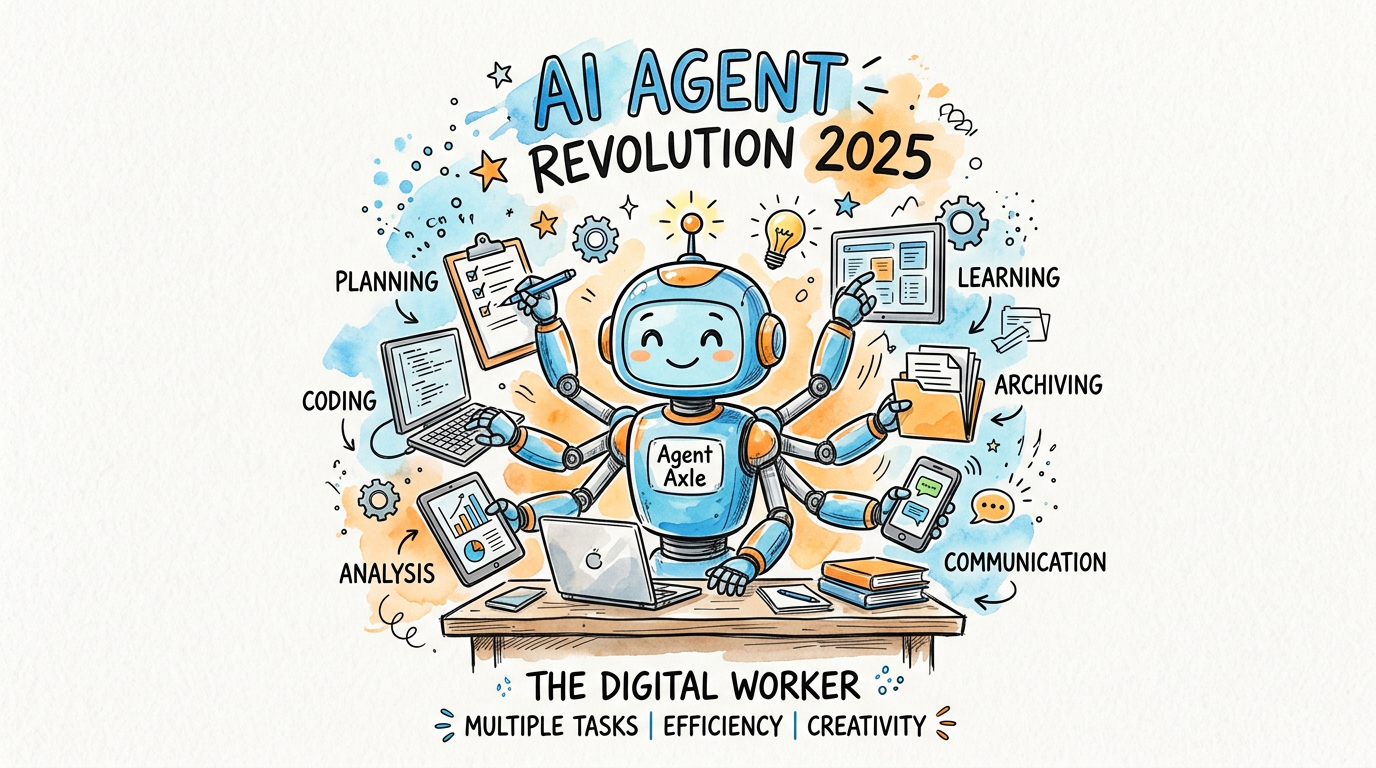
If 2023 was the year AI could talk and 2024 was the year AI could see, 2025 was the year AI started doing. A wave of agent products — from OpenAI's Operator to Anthropic's Claude Computer Use — turned conversational assistants into autonomous actors that navigate browsers, fill forms, make purchases, and complete multi-step tasks with little human oversight. That shift moves the buying decision away from the human eye and toward the AI layer, which is exactly where brand visibility now gets won or lost.
Key takeaways
- An AI agent doesn't just answer; it takes action on a user's behalf — booking, buying, writing code, and running workflows across browsers, apps, and APIs. - 2025 saw a cluster of agentic launches, including OpenAI's Operator (web browsing, form filling, multi-step tasks) and Anthropic's Claude Computer Use, marking the move from copilot to autonomous actor. - When an agent shops instead of a person, your storefront is read by a machine. If the AI can't parse your product, price, and proof, it silently routes the sale to a competitor it can understand. - Brand AI visibility becomes the new battleground: the question is no longer "do we rank on Google" but "does the agent recommend and select us." - To compete on the AI shelf, brands need to know how their whole category appears to agents across ChatGPT, Gemini, and Google AI — not just their own dashboard.
What changed in 2025
The defining trait of an AI agent is autonomy. A chatbot returns information; an agent completes a job. It navigates digital interfaces, chains together multi-step tasks, learns from outcomes, and adjusts. Operator browses the web and fills forms. Claude Computer Use operates a machine the way a person would. The practical result is that a growing share of digital tasks — including product research and checkout — now runs through software that acts, not just software that suggests.
For years the interface between a customer and a brand was a human looking at a screen. Agents insert a new intermediary. The person states an intent — "find me a quiet cordless vacuum under $300 and order it" — and the agent does the searching, comparing, and clicking. The human sees a result, not the shelf.
Why this reshapes the buying journey
When agents act, discovery collapses into selection. A traditional shopper might see ten options, read reviews, and choose. An agent narrows to a shortlist using whatever the underlying model already believes about each brand, then executes. If your brand isn't in the model's consideration set — or is described inaccurately — you never enter the shortlist, and there's no human to catch the omission.
This is why "being findable" and "being chosen" are now different problems. Classic SEO optimized for the human click. Agentic commerce optimizes for the machine decision: structured product data the agent can read, accurate pricing and availability, and enough trusted third-party signal that the model treats you as a safe recommendation.
