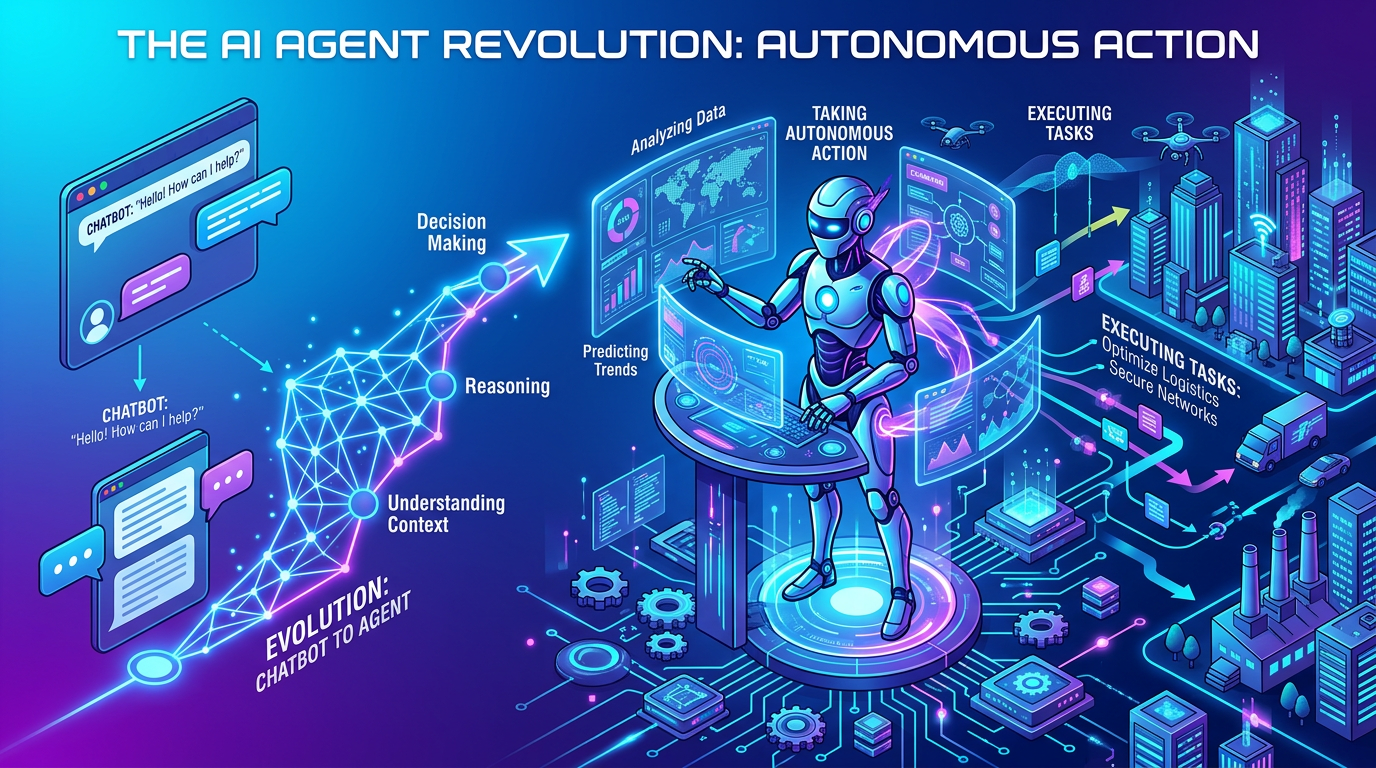
For three years the story of AI was conversation. ChatGPT wrote poems, debugged functions, answered trivia, and we called it the Chatbot Era. 2026 is when that era ends and a harder one begins. The difference fits in two words: chatbots talk, agents act.
An AI agent doesn't stop at retrieving an answer. Give it a goal — "book a flight to Tokyo under $1,000" — and it searches routes, compares fares, signs into your account, pays with your card, and drops the trip on your calendar. That jump from passive retrieval to autonomous action rewires the relationship between brands and the people who buy from them, because increasingly the buyer isn't a person at the moment of decision. It's software acting on a person's behalf.
Key takeaways
- The shift is from read-only chatbots to read-write agents that complete transactions, not just describe them. - In an agentic funnel your first point of contact is often a program that ignores banner ads and emotional video, and weighs data, trust, and logic instead. - Winning brands optimize for machine consumption: structured data, protocol readiness (MCP, Agentic Commerce standards), and factual consistency across the web. - For GEO teams this is the core mandate — if an agent can't parse your price, stock, and policies cleanly, it routes the sale to a competitor it can. - You can't optimize what you can't see; measuring how often AI systems surface and recommend your brand becomes a standing metric, not a one-off audit.
From read-only to read-write
Think of a chatbot as a very sharp librarian: you ask, it finds. An agent is closer to an executive assistant with your credit card. The moment it can execute — log in, purchase, schedule — the stakes of being "the brand the assistant picks" change completely. A librarian recommending your product is nice. An assistant that autonomously buys a competitor's product because yours was harder to parse is a lost order you never saw.
The new customer is code
In an agentic world your brand's first touchpoint is frequently a piece of software, and it behaves nothing like a human shopper.
- Shopping agents: "Replenish my coffee." The agent picks a brand on price, delivery speed, and review signals. - Travel agents: "Plan a weekend away." It books the hotel with the cleanest structured data and best API connectivity. - B2B agents: "Find a CRM with these five features." It scans documentation and pricing pages to build a shortlist before a human ever sees it.
The invisible funnel
The classic marketing funnel goes dark here. Agents don't see banner ads. They aren't moved by a cinematic brand film. They care about three things — data, trust, and logic — and they act on whichever brand supplies those most cleanly. Your creative can be brilliant and still never enter the consideration set, because the agent shortlisted three competitors from a pricing table you never optimized for machines.
