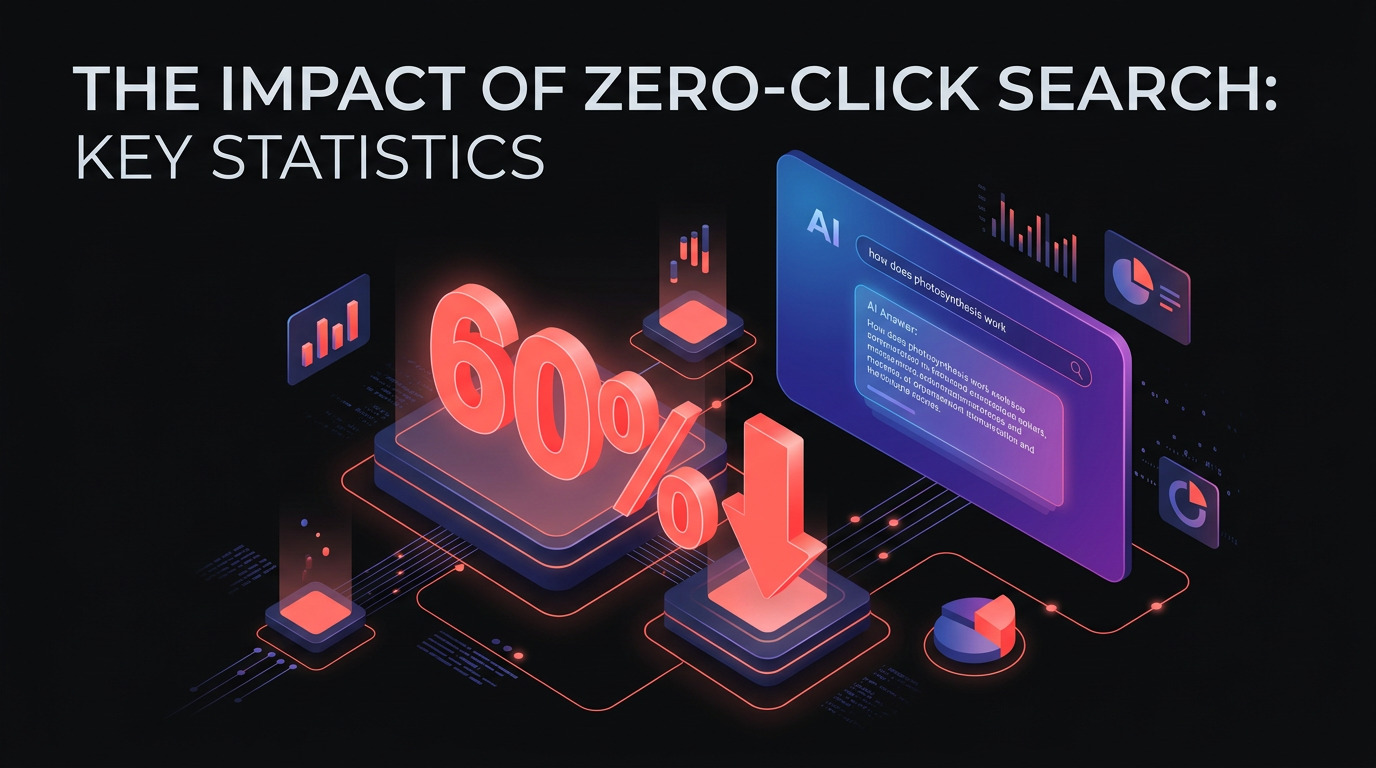
The internet's founding bargain — I search, you show me links, I click one — is breaking. For two decades the digital economy ran on a simple trade: search engines organized the world's information, and in exchange publishers and brands got traffic. That era is ending. According to recent data from SparkToro and Datos, nearly 60% of Google searches now end without a click. The user gets the answer on the results page or inside an AI interface and never visits an external site. This is not a passing trend; it is a structural shift from the traffic economy to the AI answer economy — and it changes what winning even means.
Key takeaways
- Nearly 60% of Google searches now end without a click, per SparkToro and Datos — the answer arrives on the SERP or in an AI interface, and the user never leaves. - In 2024, roughly 360 of every 1,000 US searches led to a click on the open web, with the EU similar; generative AI has since pushed zero-click past a tipping point. - AI Overviews, answer engines like ChatGPT and Perplexity, and mobile or voice behavior are the accelerants — users now expect one synthesized answer, not a page of links. - For GEO, the metric that matters flips from traffic to visibility: being the brand an AI recommends can win the customer even when it never sends a session to your site. - If you optimize only for clicks, your dashboards will bleed even as your influence holds or grows — you need to measure presence inside the answer, not just visits.
The 60% reality check
Zero-click is not brand new. Featured snippets and knowledge panels started eating into clicks years ago. Generative AI simply pushed the trend past a tipping point. In 2024, data showed that for every 1,000 US searches, only about 360 resulted in a click to the open web; the EU looked similar. The rest ended with the user satisfied by the results page itself, or refining the query without ever clicking.
Why the surge now? Three forces. Google AI Overviews generate a summary that pushes organic results down the page and answers complex questions outright. Answer engines — ChatGPT, Perplexity, Claude — have trained people to expect a recommendation, not a list; ask ChatGPT for the best CRM for a small business and you get a synthesized answer, not ten blue links. And mobile and voice make the one-true-answer behavior even more dominant, because there is barely room, or patience, for a page of options.
The death of "just getting ranked"
For marketers and SEOs, this is a measurement crisis. If your KPI is organic traffic, your chart is probably sliding even when your rankings have not moved. You can still hold position one and see click-through collapse toward zero, because a large AI Overview sits above you and answers the question completely. Search volume no longer predicts traffic: a keyword with 10,000 monthly searches might send 5,000 clicks, or 50, depending entirely on whether the AI answered on its own.
