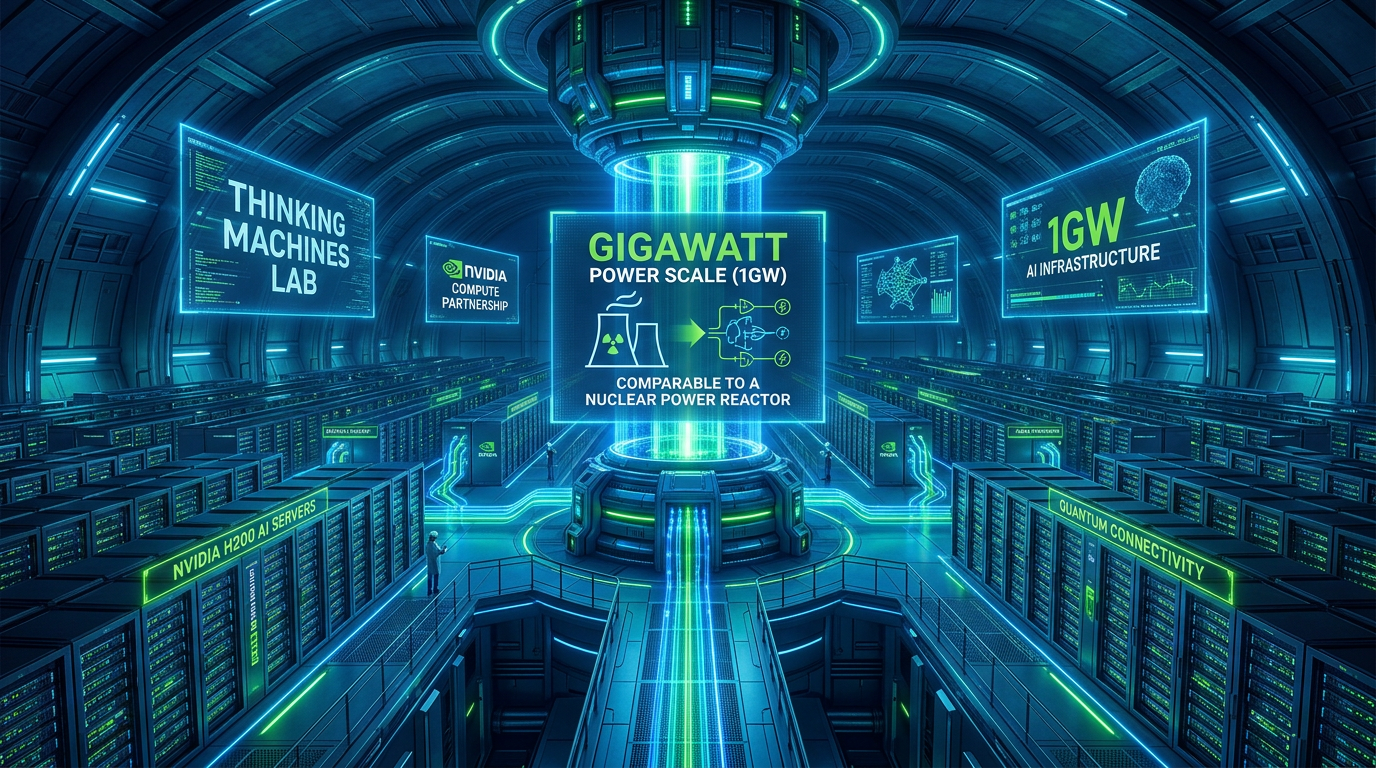
Mira Murati's two-year-old AI research lab just made an infrastructure bet the size of a power plant. Thinking Machines Lab, founded by the OpenAI co-founder, announced a multi-year strategic partnership with Nvidia that includes deploying at least one gigawatt of Nvidia's Vera Rubin systems starting in 2027. The deal size wasn't disclosed, and Nvidia is also making a strategic investment in the lab. A gigawatt of compute is roughly the output of a large nuclear reactor — one of the largest single compute commitments announced in the entire AI boom. The number is abstract until you translate it: this much capacity gets built only because demand for AI answers keeps climbing, and that climb is the channel your brand now competes in.
Key takeaways
- Thinking Machines Lab signed a multi-year deal to deploy 1+ gigawatt of Nvidia Vera Rubin systems from 2027, with Nvidia also investing strategically in the lab. - One gigawatt dwarfs a typical data center (50–100 MW) and even large hyperscaler facilities (200–500 MW) — this is a 1,000+ MW commitment. - The lab has raised over $2 billion since February 2025, is valued above $12 billion, and shipped its first product, the Tinker API, in October 2025. - Compute at this scale exists to serve exploding AI training and inference demand — every gigawatt is more AI answering more customer questions. - For brands, the signal is durability: AI-mediated discovery is being built out as permanent infrastructure, so AI visibility is a channel to invest in, not a trend to wait out.
The scale: what a gigawatt actually means
Numbers this large lose meaning without a yardstick, so here's one. A typical data center runs at 50 to 100 megawatts. A large hyperscaler facility runs at 200 to 500 megawatts. The Thinking Machines Lab deal commits to more than 1,000 megawatts — a full gigawatt, comparable to the output of a large nuclear reactor. For a seed-stage lab that's two years old, committing to that much capacity signals conviction that demand for AI compute will keep outrunning supply.
A well-funded bet on reproducible AI
Thinking Machines Lab has raised more than $2 billion since its February 2025 founding, from investors including Andreessen Horowitz, Accel, Nvidia, and even the venture arm of rival chipmaker AMD. It's valued above $12 billion and is working to build AI models that produce reproducible results — a meaningful goal in a field where identical prompts can yield different answers. Its first product, an API called Tinker, launched in October 2025. The Nvidia partnership commits both sides to developing training and serving systems optimized for Nvidia's architecture. As Murati put it, Nvidia's technology is "foundational to the entire field."
Why an infrastructure story is a marketing story
It's reasonable to ask what a compute deal has to do with brand visibility. The link is demand. No one commits to a gigawatt of hardware for 2027 on a hunch. Deals this size are underwritten by a clear expectation that AI training and, crucially, inference will keep growing — and inference is the part that answers your customers. Every incremental gigawatt is capacity to run more models, serve more queries, and power more assistants that people ask for recommendations. The infrastructure arms race is the clearest possible signal that AI-mediated discovery isn't a phase. It's being poured in concrete and steel.
What this means for GEO
If you've been treating AI visibility as an experiment to revisit later, deals like this are the argument against waiting. The industry is committing gigawatts and tens of billions of dollars on the premise that more and more discovery will run through AI. That means the share of your customers who find, evaluate, and choose brands via an AI answer will keep rising — and the brands that start measuring and improving their AI presence now will compound that advantage while competitors are still watching.
Practically, that's a mandate to know how AI systems represent you today and to track it as the channel scales. This is the layer [GEOly](/blog/what-is-geoly-ai) maps: how your whole category shows up across ChatGPT, Gemini, Perplexity, and Google AI — brand rankings, product cards and pricing, citation sources, and perception — as a queryable industry database, so you can see your position and where the whitespace is as AI usage grows. For the strategic context of why this channel matters for online retail, see our take on [the Share of Card metric for AI shopping](/blog/share-of-card-metric-shopify-brands-ai-shopping), and for fundamentals, [what GEO is](/blog/what-is-generative-engine-optimization-geo).
FAQ
Why should a marketer care about a compute deal? Because compute buildout is a leading indicator of AI demand. A gigawatt committed for 2027 is a bet that AI usage — including the inference that answers customers — keeps growing, which grows the AI discovery channel.
Does the size of the deal tell us anything concrete? It signals durability. Capacity at this scale is planned years ahead against expected demand, which suggests AI-mediated discovery is being built as long-term infrastructure, not a fad.
What's the takeaway for brand strategy? Treat AI visibility as a channel worth investing in now. The infrastructure being built assumes AI discovery keeps rising; measuring and improving your AI presence early compounds over time.
A gigawatt sounds like an engineering headline, but it's really a demand forecast. The industry is building for a future where AI answers more of the questions that used to end on your website. Want to see how your brand and category show up as that future arrives? [GEOly](/about-us) offers a free 3-day trial. More from [GEOly AI](/blog/author/geoly-ai).