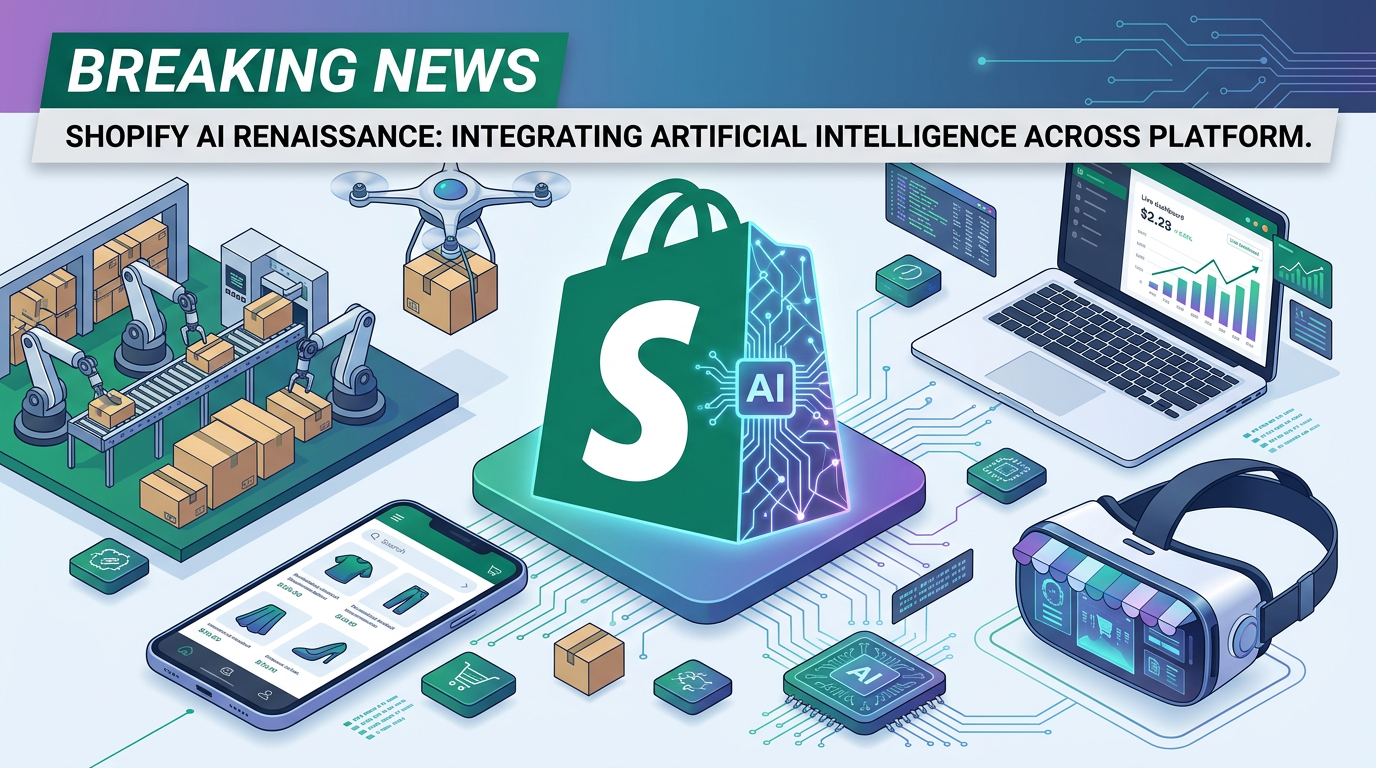
Shopify has always been about arming the rebels. For a decade that meant handing independent merchants the tools to compete with Amazon. In 2026 the battlefield has moved, and the new rebels are AI agents. Shopify's "Renaissance" update — headlined by the Universal Commerce Protocol (UCP) and Agentic Storefronts — declares that the future of ecommerce isn't just headless. It's agentic.
The distinction matters for anyone running a store. Headless commerce separated the backend from the frontend so you could sell on apps, watches, and kiosks. Agentic commerce goes further: it separates the backend from the human interface entirely, assuming the shopper may be software acting for a person. Shopify is building the rails for that shopper; the question is whether merchants are ready to be chosen by it.
Key takeaways
- Shopify's Renaissance update introduces the Universal Commerce Protocol (UCP), co-developed with Google, plus Agentic Storefronts and an Agentic Plan — infrastructure for selling to AI agents, not just humans. - UCP lets an agent and a store transact through a standardized API instead of scraping a page: the agent asks "Can I buy this?" and the store answers with price and shipping directly. - Agentic Storefronts let merchants manage their presence across AI channels like Google AI Mode, Copilot, and ChatGPT from one place — you're optimizing the data feeding the world's most powerful AIs, not just a website. - The GEO implication for DTC brands: winning the AI shelf is a data-quality contest — the brands whose product data an agent can parse cleanly get recommended and bought, and your Share of Card becomes a standing metric.
The pivot to agentic commerce
For years "headless" was the ecommerce buzzword — decoupling the storefront from the backend so the same catalog could power a mobile app or a kiosk. Renaissance reframes the endpoint. The interface Shopify now designs for isn't a screen a person taps; it's an agent that queries, compares, and buys without a human watching. When the buyer is code, presentation stops carrying the sale and structured facts start to. An agent doesn't linger on your hero image; it asks whether it can buy the item, at what total, with what shipping and return terms — and moves on if the answer is unclear.
Universal Commerce Protocol
Co-developed with Google, UCP is an open standard designed to let AI agents "speak commerce." Before UCP, an agent had to scrape a website to infer price, shipping, and return policy — messy and error-prone. With UCP, the agent and store communicate through a standardized API: the agent asks "Can I buy this?" and the store replies "Yes, total is $50, shipping is free." Ambiguity is replaced by a clean, machine-readable contract — exactly what an agent needs to transact with confidence.
Agentic Storefronts
Agentic Storefronts may be the more strategically loaded feature. Shopify now lets merchants centrally manage their presence across AI channels — Google AI Mode, Copilot, ChatGPT, and others. That changes what you're optimizing: you're no longer just tuning a website, you're curating the data source that feeds directly into the world's most powerful AI assistants. Renaissance packages this under an Agentic Plan, signaling that selling to agents is a first-class configuration, not a toggle buried in settings.
