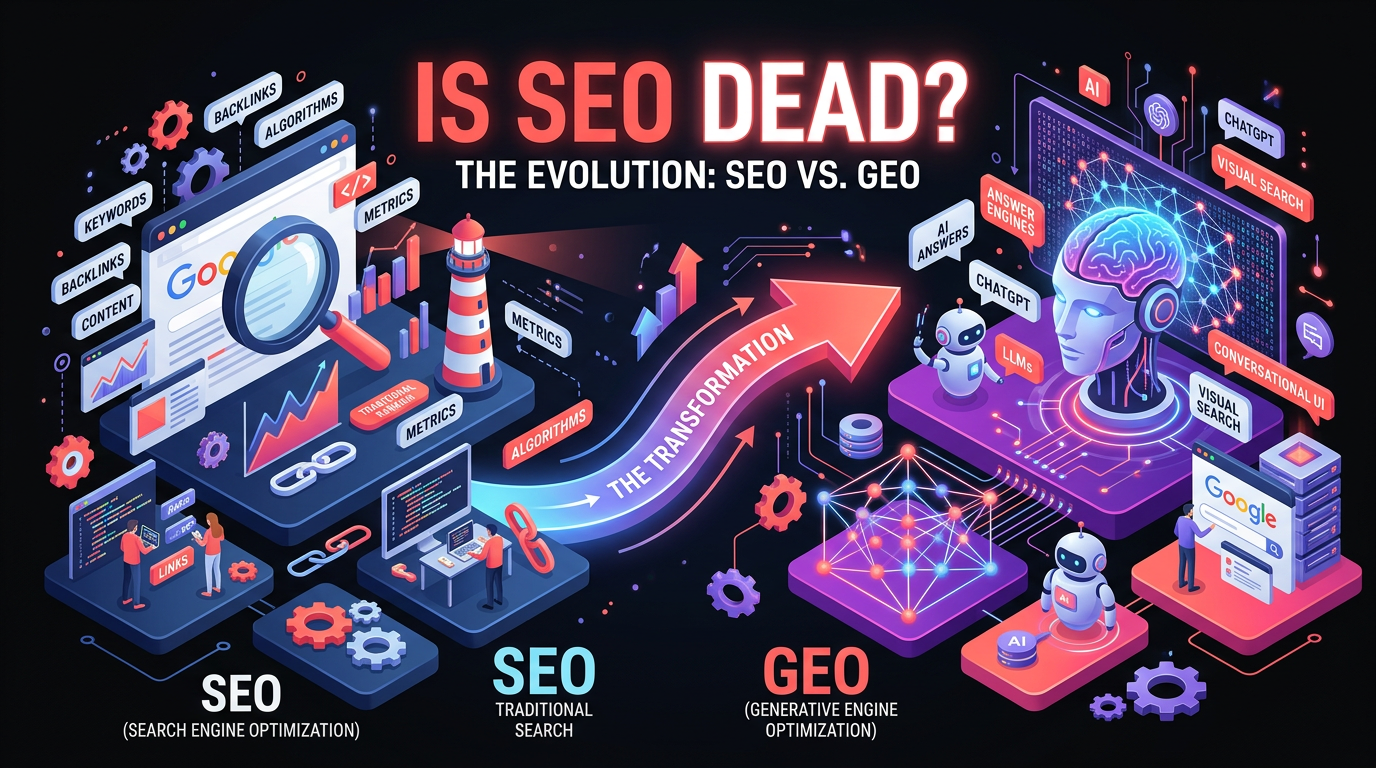
"Is SEO dead?" is the oldest headline in digital marketing. The industry heard it when Google shipped Panda in 2011, again when Featured Snippets arrived in 2014, and again when voice search was going to change everything in 2018. Each time, SEO adapted and survived.
2026 feels different, and the difference is not hype. Google AI Mode now hides the classic list of results behind a generated answer, ChatGPT has become a primary information source for millions of people, and the "ten blue links" that funded two decades of search marketing are quietly disappearing from the screen.
So here is the honest answer. If you define SEO as "rank a webpage so a human clicks it," then yes, that job is dying. But if you define SEO the way it was always meant to be defined, "optimize your visibility inside search engines," then it is more alive than ever. It simply has a new name and a new surface: GEO, Generative Engine Optimization.
Key takeaways
- The phrase "SEO is dead" is only true for one narrow definition: ranking a page to earn a click. Visibility optimization itself is expanding, not ending. - Over 60% of Google searches now end without a click to an external site, and roughly 20% of search volume has moved to answer engines like ChatGPT, Perplexity and Claude that have no "page 1" at all. - Informational queries such as "how to" and "what is" are seeing organic traffic fall 30–50% year over year, so content built only to rank is optimizing for a shrinking audience. - For GEO and brand teams, the scoreboard changes: rankings and click-through rate give way to metrics like AIGVR and Share of Model, which a rank tracker was never built to measure. - Winning now means being the source an AI cites, not the link a human scrolls to, and that requires entity clarity and structured, quotable answers.
The data behind "old SEO is dying"
The numbers are not subtle. More than 60% of Google searches now finish with zero clicks to any external website, because the AI Overview or AI Mode answer is enough. At the same time, close to 20% of total search volume has migrated to answer engines. ChatGPT, Perplexity and Claude do not publish a ranked list of ten links, so there is no position to fight for in the way SEO taught. And within Google itself, informational "how to" and "what is" queries are losing 30–50% of organic traffic year over year as the model answers inline.
If your entire strategy is still "write a long blog post and rank number one," you are optimizing for a town that is emptying out.
SEO to GEO: what actually changes
SEO is not disappearing so much as molting, shedding the skin built for links and growing one built for answers. The mechanics shift on five fronts.
The goal moves from earning a page-one ranking to being cited inside the AI's answer. Position on a results page matters less than whether the model chose you as a source.
