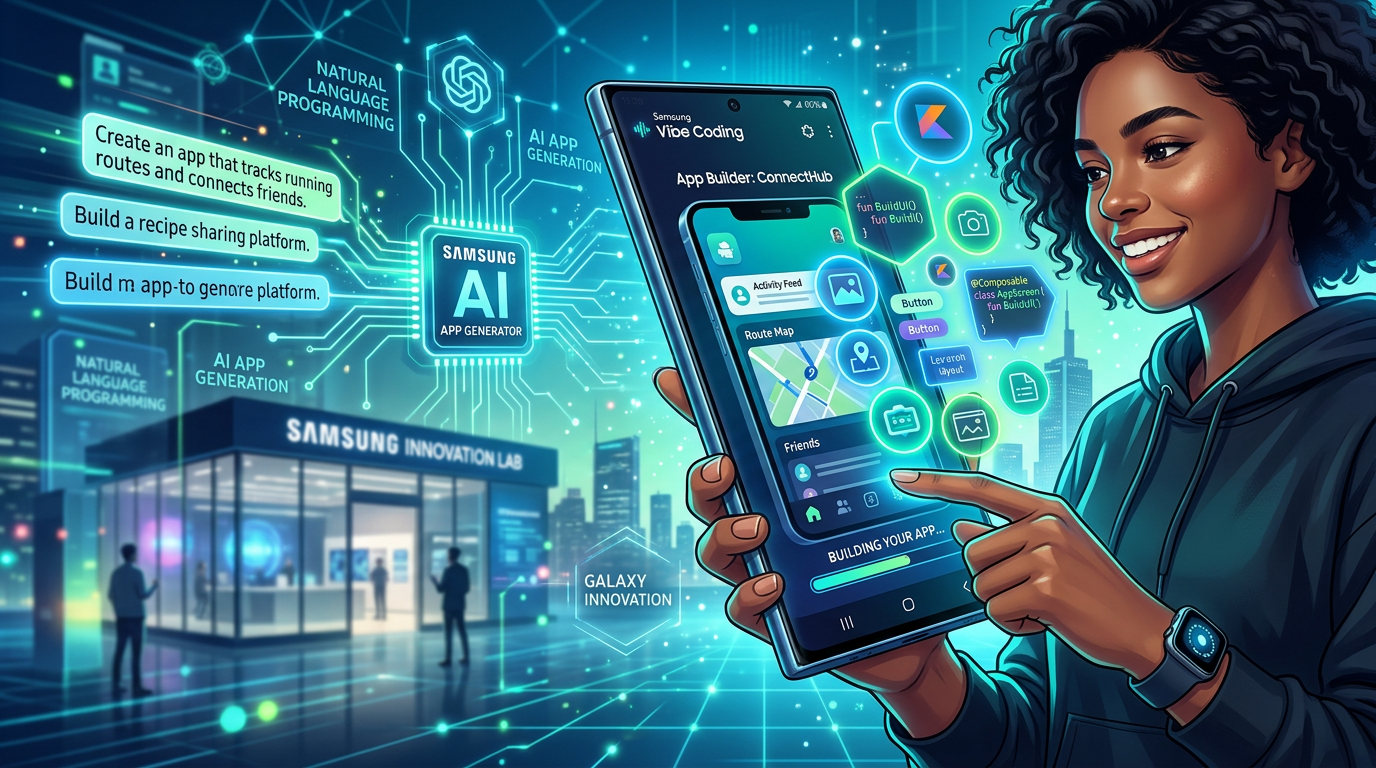
Samsung is looking at letting you describe an app in plain language and having your phone build it for you. In an interview with TechRadar, Won-Joon Choi, Samsung's head of mobile experience, confirmed the company is actively exploring "vibe coding" for future Galaxy phones: "Vibe coding is very interesting, and something we're looking into as an option on Galaxy phones in the future."
There is no timeline. But the direction matters more than the date, because it fits a larger shift Samsung is already making — the phone itself is becoming an AI-first surface, and the way people reach information and software on it is moving from tapping icons to describing what they want.
Key takeaways
- Won-Joon Choi, Samsung's head of mobile experience, told TechRadar the company is actively exploring vibe coding for future Galaxy phones, with no timeline announced. - Vibe coding lets users describe an app or interface change in natural language and have AI generate the working code, putting near-complete novices in reach of building functional apps. - Samsung frames the appeal as customization: adjusting favorite apps or reshaping the phone's own UX, which stock Android and iOS don't allow today. - It fits Samsung's broader push — the Galaxy S26 is marketed as an "AI phone," with 39% faster NPU processing, Now Nudge, expanded Audio Eraser, and Perplexity integrated as an alternative to Gemini. - For brands, the signal is the front door moving: on-device AI assistants and answer engines are becoming how people reach information and products, so visibility across those assistants — not just Google — is now the game.
What vibe coding on a phone would actually do
Vibe coding is the next step in AI-assisted development. Instead of writing code line by line, you describe what you want and the AI implements it. Choi's own example: "I want an app that blocks YouTube Shorts but lets me watch regular videos," and the phone generates a working solution. Unlike coding assistants aimed at experienced developers, vibe coding tools are built so that near-complete novices can produce functional apps from scratch.
Choi's pitch is customization. "Right now we're limited to premade tools, but with vibe coding, users could adjust their favorite apps or make something customized to their needs." He suggests it could reach past individual apps to the phone's user experience itself — reshaping the UX in ways that stock Android and iOS don't currently permit. Android's openness helps here: it already allows more freedom than iOS to install custom apps and modify system behavior, which makes it a more natural host for user-generated software.
The phone is becoming an AI surface
Vibe coding doesn't arrive in isolation. Samsung markets the Galaxy S26 explicitly as an "AI phone" rather than a smartphone, and the spec sheet backs the framing: 39% improved NPU processing for on-device AI tasks, new Now Nudge features, expanded Audio Eraser tools, and — notably — Perplexity integrated as an alternative to Gemini.
