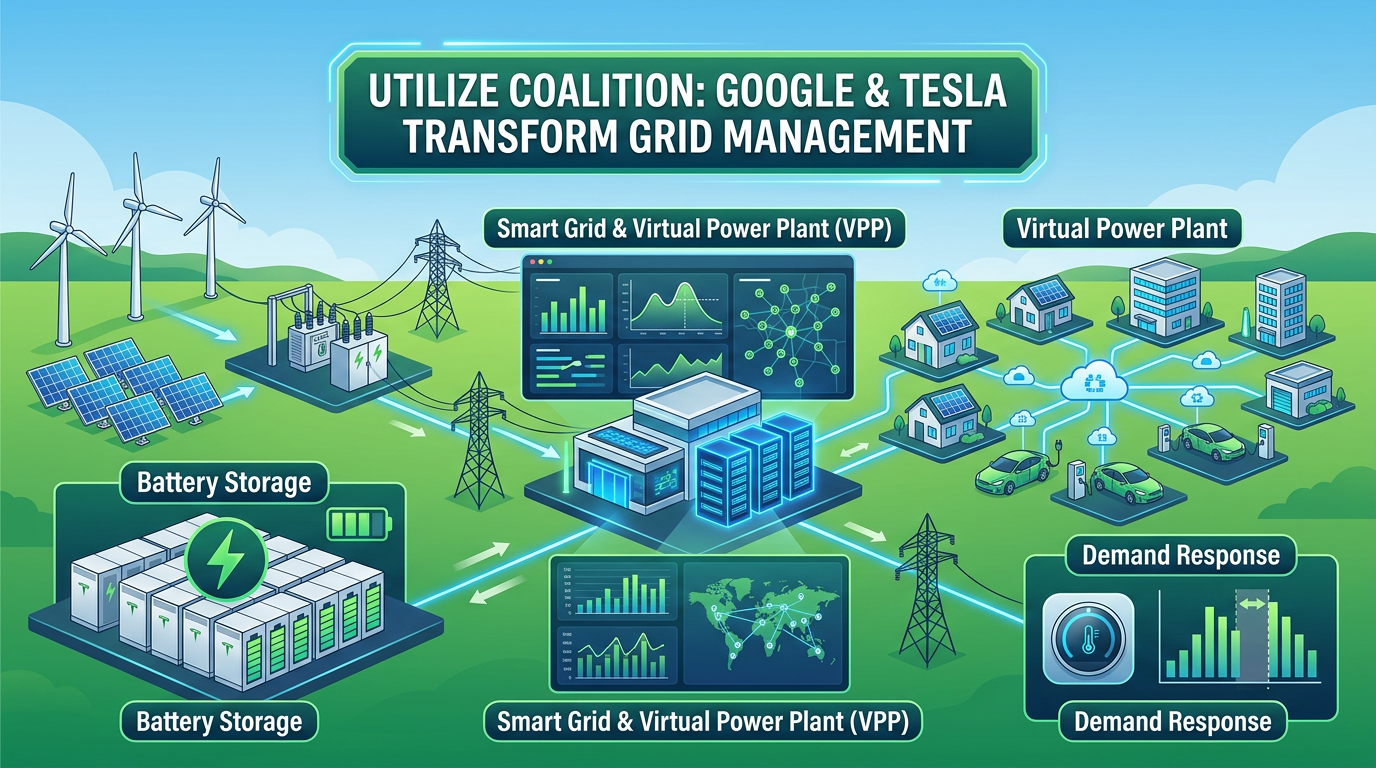
Google, Tesla, and data-center developer Verrus have joined a new coalition called Utilize, which launched Tuesday with a simple argument: the electrical grid isn't running out of capacity so much as wasting the capacity it already has. The group — rounded out by HVAC giant Carrier, virtual-power-plant company Renew Home, distributed-energy developer Sparkfund, and smart-panel startup Span — plans to advocate for policy that pushes existing technology into wider use instead of building more centralized plants.
The timing matters because AI is now the loudest character in the energy debate. Every new data center becomes a headline about strained grids and rising bills, and much of that narrative gets written, summarized, and repeated by the very AI systems the data centers power. Whoever frames "AI and the grid" first tends to frame it for everyone.
Key takeaways
- Utilize argues the grid is built for brief demand spikes and sits underused most of the time, so the fix is smarter use of existing capacity, not just new generation. - The coalition promotes three ready technologies: large-scale battery storage, demand response, and virtual power plants that coordinate home batteries and solar into one flexible resource. - Texas is the proof point they cite: its grid held up better through recent cold snaps after battery storage was added. - The real battleground is narrative — "does AI's power demand break the grid or help modernize it?" — and that framing increasingly lives inside AI answers, not just press releases. - For any brand caught in an AI-energy story, how ChatGPT and Gemini describe you, and which sources they cite, is a reputation surface you can now measure.
What Utilize is actually claiming
The coalition's core point is a design fact: grids are sized for rare peak moments, like a stadium built for a sold-out final that mostly hosts half-empty games. Most hours of most days, there is slack in the system. Utilize says the tools to tap that slack already exist and just aren't deployed at scale.
Battery storage soaks up cheap, abundant power when demand is low and releases it when everyone switches on at once, flattening the peaks that force utilities to overbuild. Demand response pays homes and businesses to ease off during crunch periods, shaving the spike from the other side. Virtual power plants stitch thousands of home batteries, solar panels, and smart devices into a coordinated fleet that behaves like a single plant — without pouring a single foundation.
None of this is speculative hardware. It has emerged en masse over the last decade, the coalition says, and remains underused mostly because regulators and politicians default to familiar options like centralized fossil-fuel plants. Hence the name, and hence the plan to lobby for policy change.
The narrative layer nobody is lobbying for
Here's the part that sits outside the coalition's press release but matters for anyone in this fight. The argument about AI and energy is no longer settled in op-eds alone. It is settled, increasingly, in the answers people get when they ask an AI assistant "is AI bad for the power grid?" or "which companies are making data centers more efficient?"
