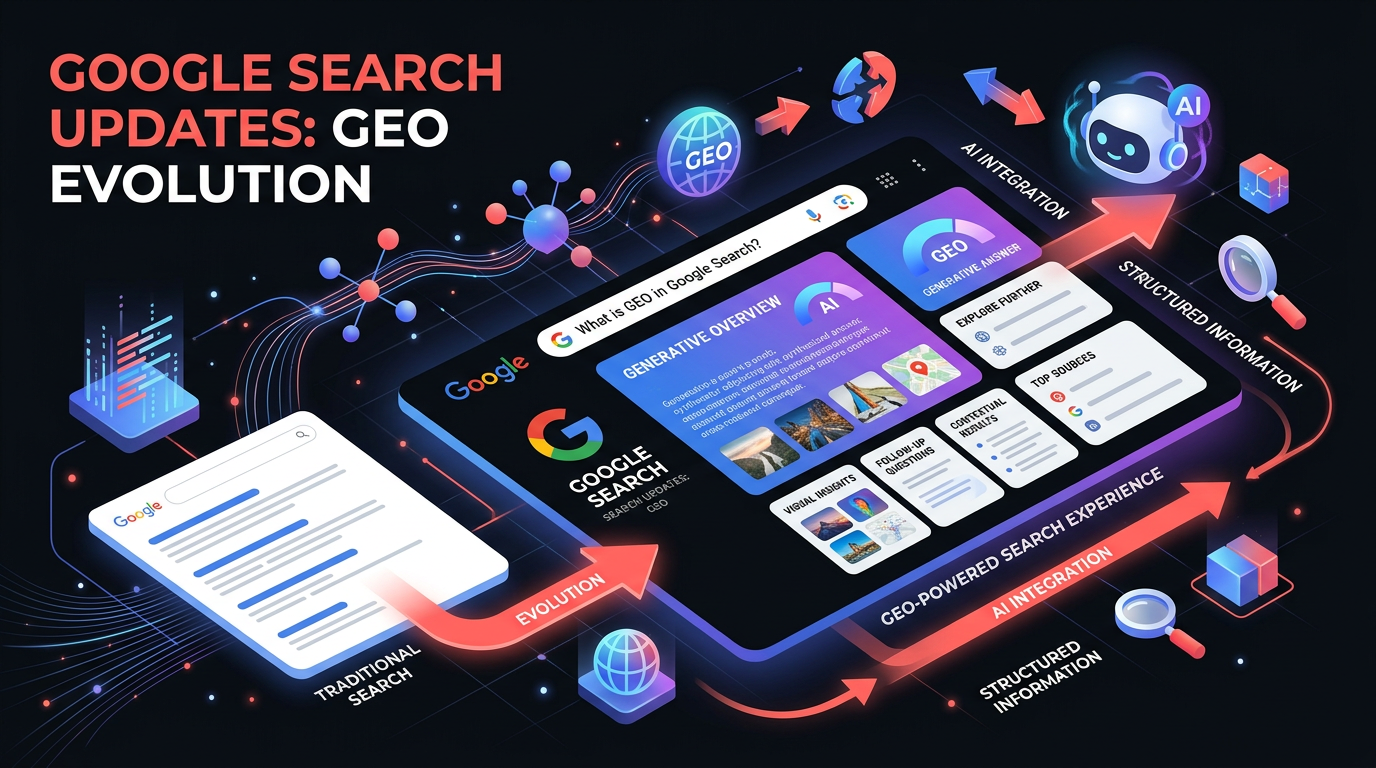
If Google Search feels unrecognizable compared with a year ago, you're reading the data correctly. Between the December 2025 Core Update and the full rollout of AI Mode, the rules changed at the foundation. You are no longer optimizing for a search engine that lists links. You're optimizing for an answer engine that synthesizes information — and that single shift is what separates SEO from Generative Engine Optimization (GEO). Here's what actually moved, and what to do about it.
Key takeaways
- Google's AI Mode uses a "fan-out" approach: it breaks a complex query into sub-questions and synthesizes one answer, often without a traditional list of links. - The December 2025 Core Update prioritizes E-E-A-T over keyword matching, rewarding high citation value and penalizing mass-produced SEO filler. - The strategic goal has moved from ranking #1 for a keyword to being cited in the AI's generated answer. - You can rank first organically and still be invisible if the AI Overview cites a competitor instead of you — position and citation are now different games. - For brands, GEO means measuring whether AI answers include and cite you across queries, not just tracking blue-link positions.
A timeline of disruption: 2025 to 2026
To read the present, walk back through the last year. At Google I/O in May 2025, Google announced AI Mode, a fan-out search experience that decomposes complex queries into sub-parts and synthesizes an answer without a conventional results page. In August 2025, the Helpful Content System was folded fully into core ranking logic, and generic, mass-produced content began disappearing from results. Then the December 2025 Core Update landed as a major recalibration, elevating E-E-A-T — Experience, Expertise, Authoritativeness, Trustworthiness — over keyword matching. Sites with real citation value were rewarded; sites built on SEO fluff were penalized.
Three moves, one direction: away from matching strings and toward judging sources.
The core shift: from rankings to citations
In the old SEO world, the goal was to rank #1 for a specific keyword. In the GEO world, the goal is to be cited in the answer the AI generates. The difference isn't cosmetic.
Ranking is about a list. "Here are ten links about the best CRM software." Citation is about synthesis. "Based on HubSpot and G2, the best CRM for small businesses is…" If you hold the #1 organic position but the AI Overview cites your competitor in its synthesized answer, you lose the visibility that used to come automatically with that position. In AI Mode, if you aren't cited, you may not appear at all. The blue link you fought for can still exist on a page almost no one scrolls to.
Inside the December 2025 Core Update
This update was a reckoning for content farms. Google's algorithm now actively demotes content that reads like it was written for a search engine rather than a person. The winners are sources that demonstrate genuine experience and expertise, carry authority a model can trust, and get cited by others. The losers are thin, templated pages that once ranked on keyword density and internal-link tricks. If your content strategy was tuned to satisfy a crawler's checklist, this update quietly moved the goalposts to satisfying a model's judgment of trust.
