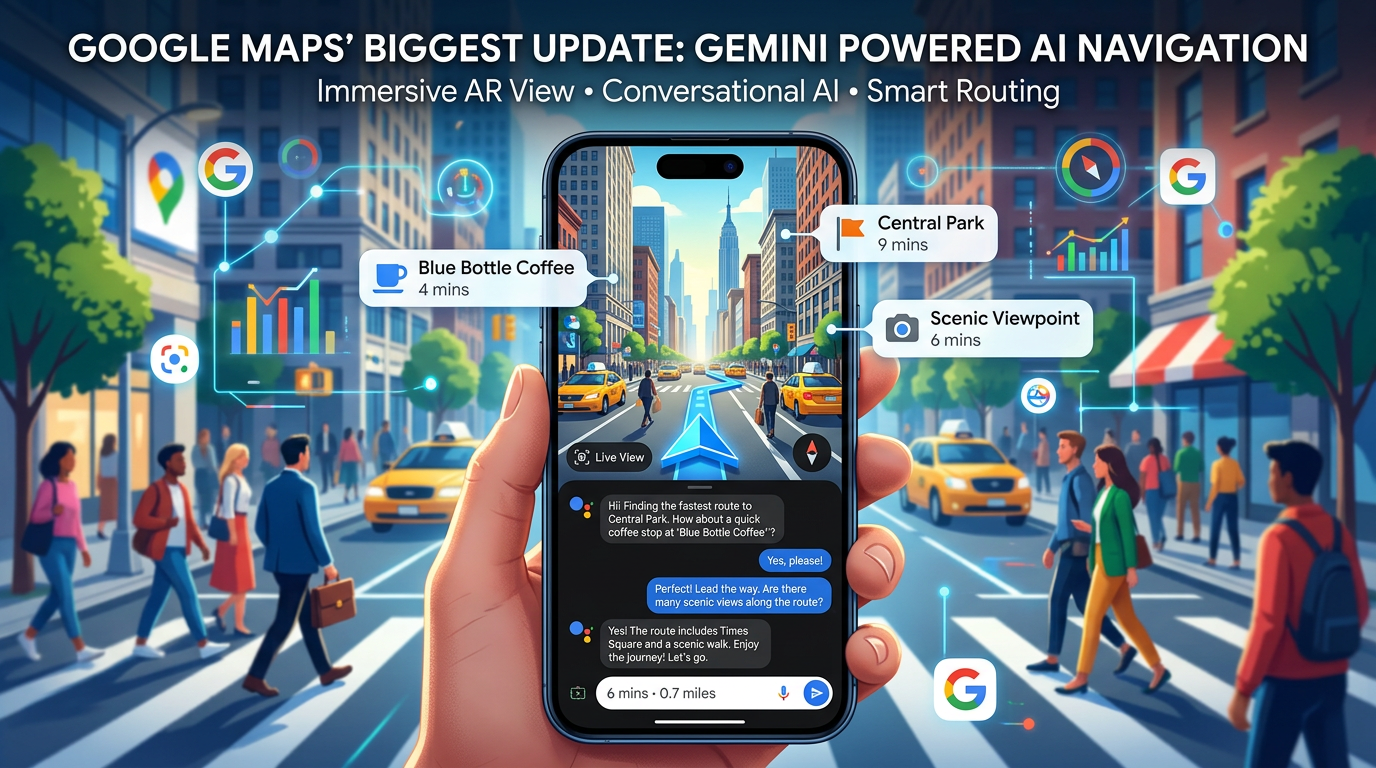
Google Maps has rolled out its largest update in a decade, putting Gemini at the center of how a billion-plus people find places. The headline feature, "Ask Maps," replaces the old keyword box with a conversational interface, and a companion feature, Immersive Navigation, blends augmented reality with turn-by-turn directions. The rollout was covered by Wired, TechCrunch, Ars Technica, and Slashdot, and Google is framing it as its most significant Maps investment since the platform's early days.
The shift is bigger than a new UI. Maps has always been where local intent turns into a decision — which coffee shop, which route, which restaurant tonight. Moving that moment from keyword search to a Gemini conversation changes how businesses get surfaced, chosen, and skipped. It is local search becoming AI search.
Key takeaways
- Google Maps' biggest update in ten years centers on "Ask Maps," a Gemini-powered conversational interface, plus Immersive Navigation with AR Live View. - Instead of "coffee shops near me," users can now ask multi-step questions like "plan a weekend in Napa with winery stops and a nice dinner," and Gemini reasons across context and preferences. - This turns local discovery into an AI recommendation problem: Gemini decides which businesses fit the request rather than returning a ranked list to scan. - The GEO implication is direct for any location-based business: you are no longer optimizing for a query, you are trying to be the answer Gemini assembles. - The structured facts Gemini can read — hours, offerings, reviews, attributes, consistency across the web — increasingly decide whether you make the shortlist.
Ask Maps: from queries to conversations
The centerpiece is a move from lookup to dialogue. Traditional Maps handled discrete queries: "coffee shops near me," "route from San Francisco to Los Angeles," "gas stations along I-5." Ask Maps handles intent and context: "plan a weekend trip to Napa Valley with stops at wineries and a nice dinner," "find me a route to work that avoids traffic and has a good coffee shop halfway," "I want to explore downtown Seattle this afternoon — what should I see?"
Gemini interprets preferences, chains multiple steps together, and returns a plan rather than a page of pins. Google's own framing is that planning a trip should feel like consulting a knowledgeable local friend instead of querying a database. For the user, that is a better experience. For a business, it means an AI is now standing between the customer's intent and your storefront, deciding whether you belong in the answer.
Immersive Navigation: AR meets turn-by-turn
Alongside Ask Maps, Immersive Navigation layers augmented reality onto directions. With Live View integration, you point your phone's camera at the street and see directions overlaid on the real world, blending the digital route with the physical one in front of you. It is the more consumer-facing half of the update, and it reinforces the same theme: Maps is becoming an interpretive layer between people and places rather than a static chart you read.
