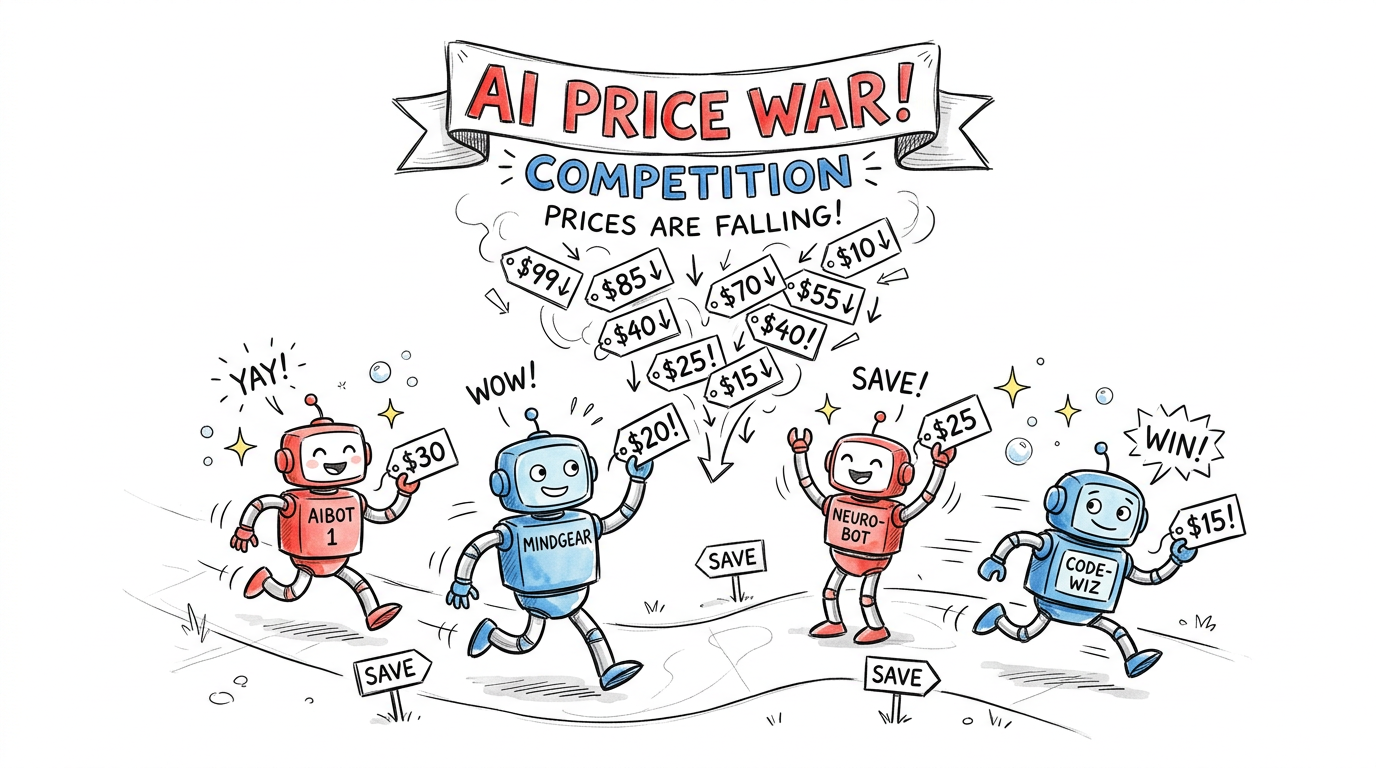
In late 2024, DeepSeek quietly released a model that reset the economics of artificial intelligence. By early 2025 the Chinese company's aggressive pricing had triggered a cascade of cuts across the industry, from ByteDance to Alibaba to Baidu. API costs plummeted, margins compressed, and the whole AI infrastructure business was rewritten. The under-covered part of the story is what cheap inference does downstream: it makes AI answers and AI agents cheap enough to be everywhere, which is exactly why brand visibility inside those answers is becoming urgent.
Key takeaways
- DeepSeek entered with pricing that undercut incumbents by orders of magnitude: input tokens as low as $0.07 per million (versus roughly $2.50 for OpenAI at the time) and output around $0.30 per million, with a competitive 64K-128K context window and benchmarks rivaling GPT-4 and Claude 3. - That triggered a global price war, with Chinese majors ByteDance, Alibaba and Baidu cutting in response, collapsing the cost of running AI at scale. - The message the market took: high-quality AI inference does not have to be expensive, which removes the cost ceiling on embedding AI into search, shopping and agents. - The GEO implication: when inference is nearly free, AI answers and shopping assistants spread into every surface, so the number of places an AI decides what to recommend, and whether it recommends you, explodes. - Cheaper tokens cut both ways for brands. The cost of monitoring your AI visibility falls too, so continuous, category-wide GEO measurement becomes affordable, not a luxury.
The price drop by the numbers
To grasp the scale, look at where DeepSeek set the bar. Input tokens landed as low as $0.07 per million, against OpenAI's roughly $2.50 at the time, an order-of-magnitude gap. Output tokens ran near $0.30 per million. The context window stayed competitive at 64K to 128K tokens, and benchmark results were positioned against GPT-4 and Claude 3. The takeaway the industry absorbed was blunt: strong reasoning no longer carries a premium price.
The reaction was a chain of cuts. ByteDance, Alibaba and Baidu moved to match, and the floor kept dropping. What had been a high-margin infrastructure business turned into a commodity race, with model access priced closer to bandwidth than to premium software.
What this means for GEO
Cheap inference is not just a story about model vendors squeezing each other. It changes where AI shows up, and that is the part brands should watch.
When it costs a fortune to answer a query, AI stays rationed, concentrated in a few flagship apps. When it costs almost nothing, AI answers get embedded everywhere: search results, shopping assistants, in-store chat, customer support, third-party agents that browse and buy on a user's behalf. Every one of those surfaces is a moment where a model decides what to recommend and, implicitly, whether to recommend you. A price war does not just lower vendor costs, it multiplies the AI shelf.
