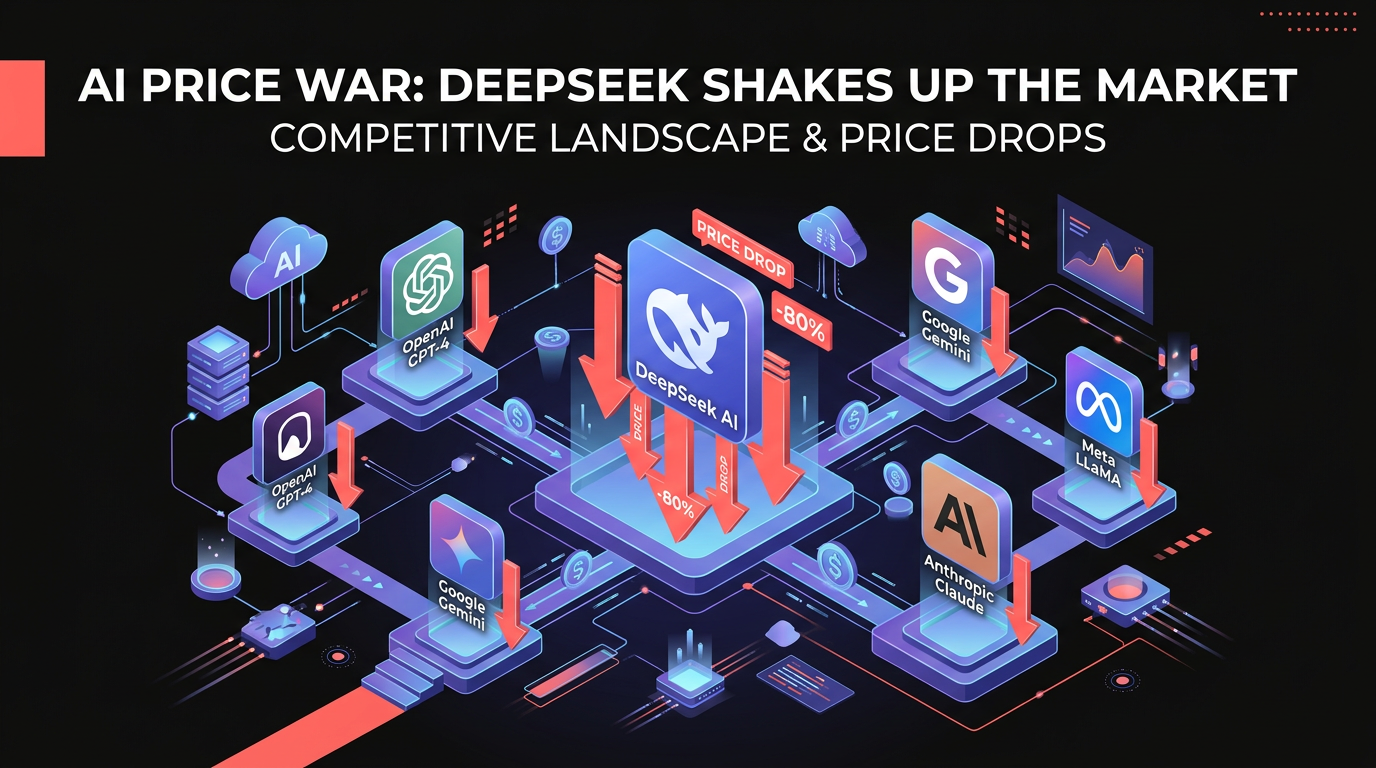
In January 2025, a little-known Chinese lab named DeepSeek sent a shockwave through the industry. By releasing DeepSeek-R1 — a reasoning model rivaling OpenAI's o1 at a fraction of the cost — it did more than undercut competitors. It triggered a global AI price war. Within weeks, inference costs across the industry fell by more than 90%, and what had been a premium service became a commodity almost overnight.
For developers, a bonanza. For brand marketers, the DeepSeek Effect signals something harder: the fragmentation of the search landscape. The era of optimizing for one dominant engine is over, and GEO has to change with it.
Key takeaways
- DeepSeek-R1 matched frontier reasoning at a tiny cost, driving industry inference prices down more than 90% and turning high-end AI into a commodity. - Cheap intelligence collapsed barriers to entry, unleashing a proliferation of vertical models, local LLMs and specialized agents — and embedding AI into shopping apps, cars, glasses and workflows. - Your customers no longer search only Google, or even only ChatGPT. They ask DeepSeek-powered coders for tools and Llama-powered agents for shopping advice. - For GEO, this is the end of the single-engine playbook. Optimizing for one model leaves you blind to the majority of AI conversations happening elsewhere. - Different models cite different sources and reach different conclusions, so brands need multi-engine visibility, not a single dashboard.
The commoditization of intelligence
Before DeepSeek, high-intelligence AI was expensive, which kept the market concentrated around a few well-funded players — OpenAI with ChatGPT, Google with Gemini. DeepSeek proved that smart does not have to mean costly. With inference dropping to pennies per million tokens, two things happened at once.
Barriers to entry collapsed, and a Cambrian explosion of models followed — vertical AI tuned for law, medicine or code; local LLMs running on a laptop; specialized shopping and research agents. And AI escaped the chat box. It is now embedded in shopping apps, smart glasses, car dashboards and enterprise tools, each surface capable of answering a buyer's question and shaping a purchase.
The impact on brands is direct. Your customers are no longer just on Google, or even just on ChatGPT. One might ask a DeepSeek-powered coding assistant which software to buy; another might ask a Llama-powered agent for fashion advice. Every one of those exchanges is a moment where your brand is recommended — or quietly left out.
From SEO monoculture to GEO fragmentation
For two decades SEO was simple: win Google, win everything. The DeepSeek Effect shatters that monoculture and pushes us into a multi-model world where audiences split by engine.
Premium users may stay on ChatGPT Plus or Gemini Advanced. Developers and technical users flock to DeepSeek and Claude for coding and technical queries. Privacy-minded users run local models like Llama through tools such as Ollama. Shoppers lean on Perplexity or vertical agents built for a category. If your brand is optimized only for Google, you are invisible to a large and fast-growing share of these conversations — and if you optimize only for ChatGPT, you miss the cost-driven users flooding to cheaper alternatives.
