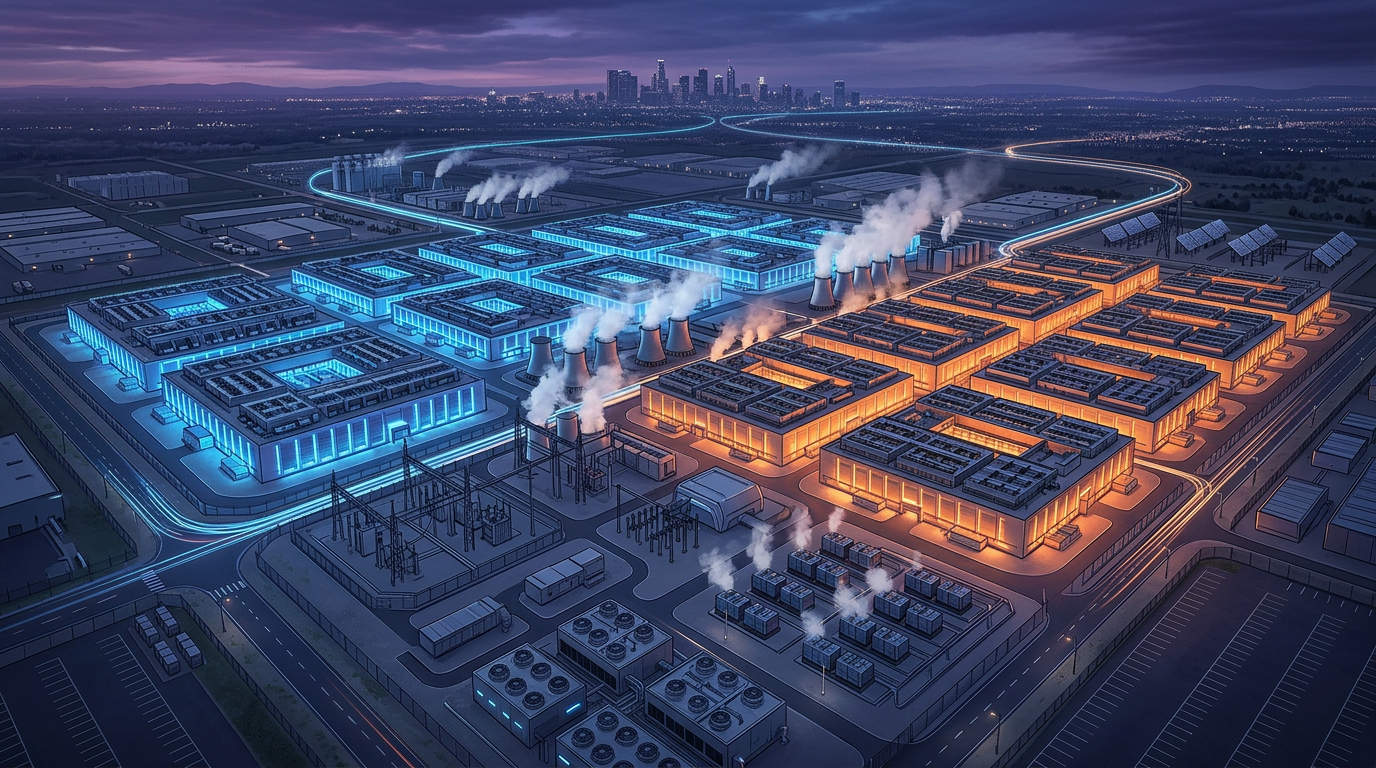
Behind every ChatGPT query and Claude response sits a massive, and massively expensive, stack of physical infrastructure. As the industry races to deploy ever-more-capable models, a parallel race is underway to build the data centers that power them — and the numbers have left startup territory entirely. Nvidia CEO Jensen Huang has estimated that between $3 trillion and $4 trillion will be spent on AI infrastructure by the end of the decade. In 2026 alone, hyperscalers plan to spend close to $700 billion on data centers.
You don't need to run a data center to read the signal in those figures. The companies with the best view of AI demand are committing hundreds of billions of dollars on the bet that AI becomes a primary way people find, decide, and buy. For brands, that's the part worth internalizing.
Key takeaways
- Jensen Huang estimates $3–4 trillion will be spent on AI infrastructure by the end of the decade, much of it funded by AI companies themselves. - Hyperscalers plan to spend nearly $700 billion on data centers in 2026: Amazon around $200 billion (up ~53% from $131B in 2025), Google $175–185 billion (up ~93–103% from $91B), and Meta $115–135 billion (up ~62–90% from $71B). - The Microsoft–OpenAI partnership began with a $1 billion investment in 2019, grew toward $14 billion largely in Azure cloud credits, and its cloud exclusivity is now unraveling. - This spending is already straining power grids and pushing construction capacity to its limits. - For brands the signal is durability: the entities closest to AI demand are betting hundreds of billions that AI-mediated discovery is permanent, which makes AI visibility a long-term investment, not a fad.
The scale: trillions on the line
The capital going into AI infrastructure is unlike anything in recent tech history. Huang's $3–4 trillion estimate covers the rest of the decade, and much of that money is coming from AI companies themselves rather than outside financiers. The near-term picture is just as steep. Across the major hyperscalers, 2026 data-center plans add up to roughly $700 billion.
The year-over-year jumps tell the story. Amazon is projected around $200 billion, up about 53% from $131 billion in 2025. Google sits at $175–185 billion, nearly doubling its $91 billion in 2025. Meta plans $115–135 billion against $71 billion the prior year. Spending at this pace is already straining power grids and pushing the industry's building capacity to its limit, with environmental and financial consequences that are only starting to surface.
The deal that started it: Microsoft and OpenAI
The template for this era was set in 2019, when Microsoft invested $1 billion in a then-little-known nonprofit called OpenAI and became its exclusive cloud provider. As training demand intensified, more of Microsoft's investment came as Azure cloud credits rather than cash — Microsoft booked stronger Azure numbers, OpenAI got the infrastructure that was its single largest cost. The total climbed toward $14 billion, a stake that paid off enormously as OpenAI moved to a for-profit structure. That exclusive arrangement has since begun to unravel, as compute needs outgrew any single provider and OpenAI diversified. But the shape of the deal — infrastructure-for-equity, cloud-for-model — became the pattern the whole industry copied.
