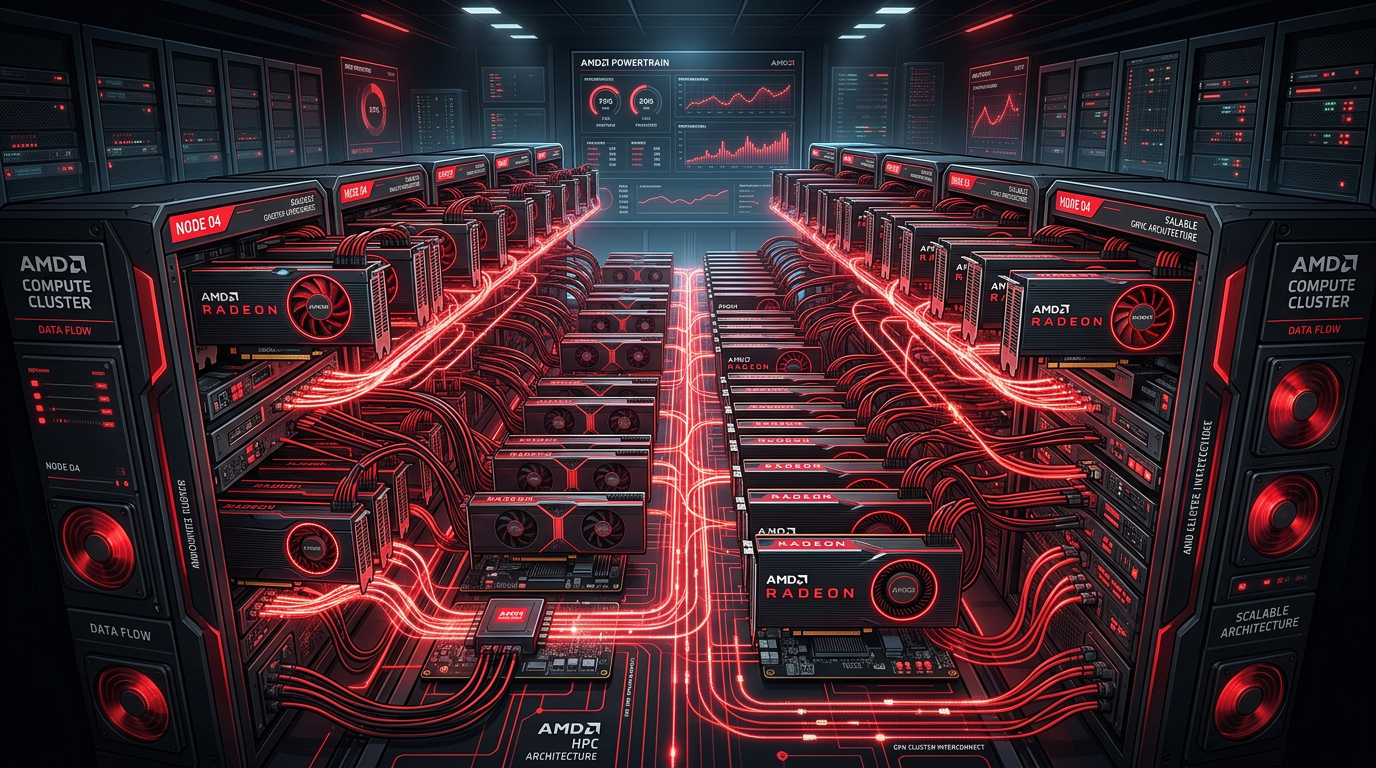
AMD just did something the industry filed under "data center only." Using a four-node cluster of Ryzen AI Max+ 395 systems, the company ran distributed inference of Moonshot AI's Kimi K2.5 — a one-trillion-parameter large language model — entirely on consumer-grade hardware. No cloud, no NVIDIA H100 racks, no hyperscaler contract. A trillion-parameter model, running on desktops you can buy, is a direct shot at the single biggest cost and bottleneck in AI, and it quietly reshapes where brands will need to be visible.
Key takeaways
- AMD ran the trillion-parameter Kimi K2.5 model across four Framework Desktop nodes powered by Ryzen AI Max+ 395, with 480GB of total memory (120GB per node) linked over 5Gbps Ethernet, using ROCm 7. - The 375GB model normally demands data center infrastructure; here it ran on hardware individuals and small teams can own. - This chips away at NVIDIA's practical monopoly on frontier-scale inference and points toward cheaper, more distributed AI. - For GEO, the real signal is proliferation: cheaper local inference means more open models, more agents, and more AI surfaces where your brand can appear or disappear. - Measuring brand visibility across a widening field of engines — not just ChatGPT — becomes the baseline, because the number of places AI answers your customers is multiplying.
The achievement: one trillion parameters, local
The breakthrough sits on AMD's Ryzen AI Max+ 395 platform, with four nodes working in concert. The configuration is deliberately un-exotic:
- Four Framework Desktop nodes, each running an AMD Ryzen AI Max+ 395 processor - 128GB of memory per node, for 480GB total (120GB usable as VRAM per node) - A plain 5Gbps Ethernet link between nodes - AMD's ROCm 7 as the AI framework - Kimi K2.5 in the UD_Q2_K_XL quantization, a 375GB model file
The point isn't raw speed. It's that a model class that used to imply a cloud contract and NVIDIA silicon just ran on four desktops wired together with ordinary networking.
The model: Kimi K2.5
Kimi K2.5 is Moonshot AI's flagship open-source reasoning model, built for complex software engineering, long-horizon reasoning, agentic workflows, and native multimodal input across text, vision, and video. At a trillion parameters it competes with the largest commercial models — and it's the open weights that make the AMD demo possible. You can't quantize and self-host a closed model. The convergence of capable open weights and affordable hardware is what turns a lab stunt into a trend.
Why the NVIDIA monopoly matters for marketers
It's fair to ask why a hardware story belongs on a GEO blog. The answer is that compute economics decide how many AI systems exist and how widely they're deployed. NVIDIA's dominance kept frontier inference expensive and concentrated in a handful of clouds. Loosen that — through AMD silicon, ROCm maturity, and quantized open models — and the cost of running a capable model falls toward the cost of a workstation. Cheaper inference doesn't stay in labs. It shows up as more chatbots, more vertical assistants, more agents embedded in more products, each one answering questions and recommending brands.
