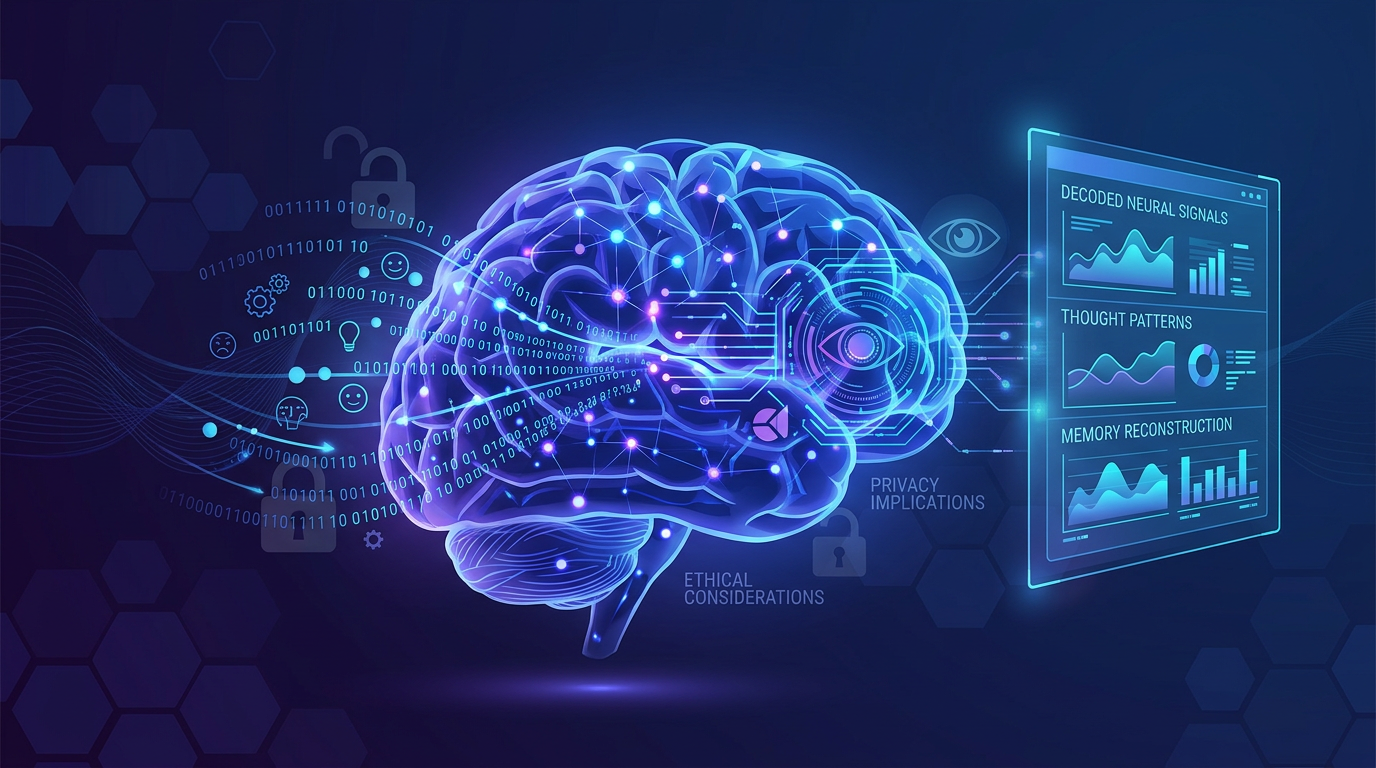
A woman who lost the ability to speak after a stroke 19 years ago sat still in a Stanford lab, and watched her own unspoken sentences assemble on a screen in front of her. In August 2025 Stanford researchers reported translating the inner speech of that woman and three patients with ALS into real-time text — the closest science has come to a working form of "mind reading." A few months later, a team in Japan went further, unveiling a "mind captioning" technique that generates detailed descriptions of what a person is seeing or picturing in their head.
These are medical breakthroughs first, and they matter most for people who have lost the ability to communicate. But sitting underneath them is a trend every brand should notice: AI is getting dramatically better at decoding fuzzy, unspoken human intent — and that is exactly the capability now standing between shoppers and the products they choose.
Key takeaways
- Stanford translated the imagined inner speech of a stroke-paralyzed woman and three ALS patients into real-time text in August 2025; a Japanese "mind captioning" method later described what subjects were seeing or imagining. - Brain-computer interfaces are not new — the field dates to Eberhard Fetz's 1969 monkey experiments — but pairing modern AI decoders with better sensors is what turned decades of slow progress into a step change. - Researchers expect commercial deployment "at scale" within a few years, with Neuralink and others already building brain chips to move the tech out of the lab. - The through-line for brands: AI's core new skill is turning messy, ambiguous human signals into structured meaning — the same job AI search does when it converts a vague query into a specific recommendation. - In an intent-decoding world, visibility goes to brands that are legible to machines and consistent enough to be trusted; that legibility is now a measurable, manageable asset.
What actually happened
Both results build on the same idea. The brain produces electrical activity when you speak, and — crucially — also when you only intend to speak. Sensors capture that activity; an AI model learns the mapping between neural patterns and the words or images they correspond to; the system outputs text or a description in near real time. Stanford's work decoded attempted and imagined speech into sentences. Japan's "mind captioning" pointed the same approach at perception, producing accurate accounts of what someone was looking at or visualizing.
"In the next few years, we will begin to see these technologies being commercialised and deployed at scale," said Maitreyee Wairagkar, a neuroengineer at UC Davis. Companies including Elon Musk's Neuralink are already working to bring commercial brain chips out of the lab.
The long runway is worth remembering. Scientists have chased direct brain communication for a surprisingly long time — back in 1969, neuroscientist Eberhard Fetz showed a monkey could move a meter's needle using the activity of a single neuron. What changed recently isn't the ambition. It's that AI decoders finally became good enough to make sense of noisy, high-dimensional human signals.
