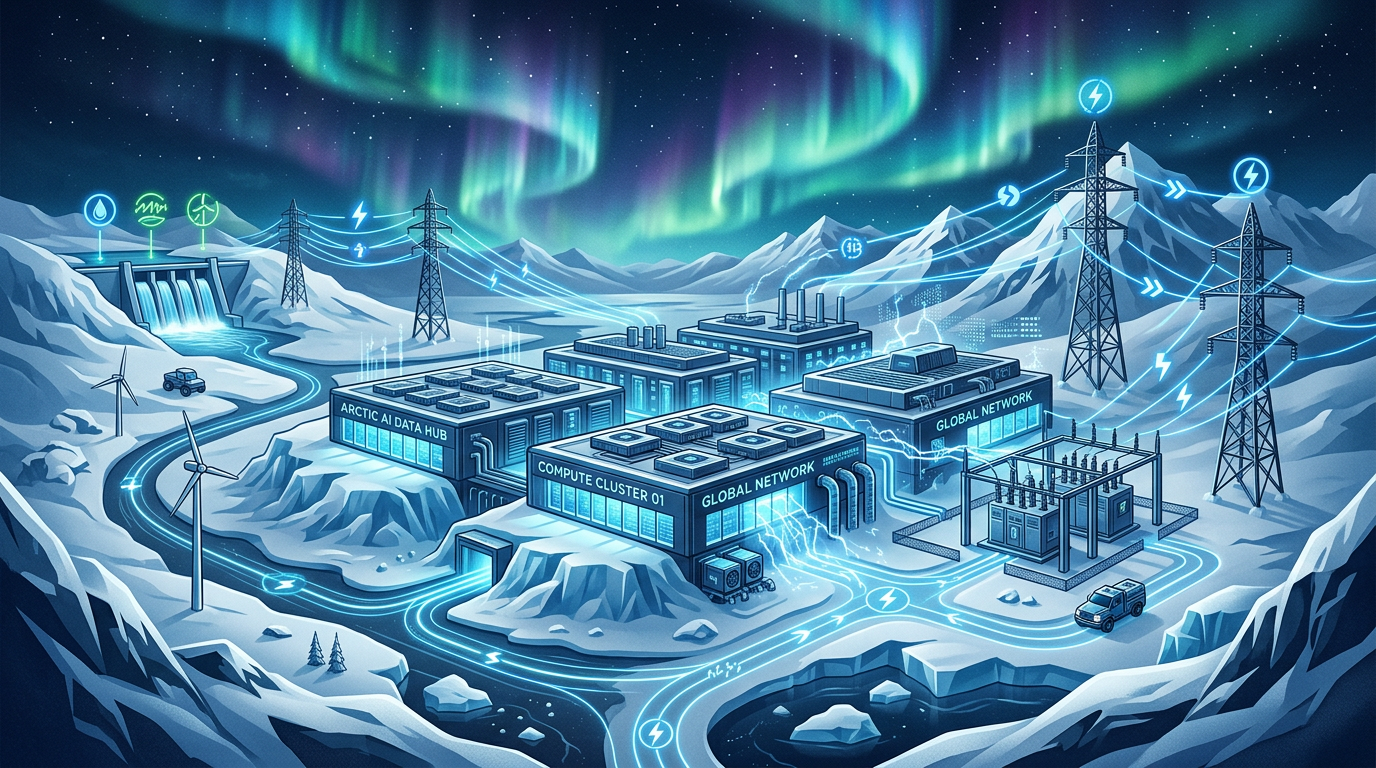
On the bank of a river running through the Swedish town of Borlänge, a sprawling data center is rising on the footprint of a former paper mill. When developer EcoDataCenter broke ground in September, CEO Peter Michelson framed it as a handover between eras: the site once produced paper, "the raw material of the newspaper information age," and will now produce "the raw material for AI and the next information age."
Borlänge is one of more than 50 data centers under construction or in planning across the Nordics — Norway, Sweden, Finland, Denmark, and Iceland. According to consulting firm CBRE, nowhere in Europe is data center capacity growing faster. The reason is blunt: the AI arms race has moved from a shortage of chips to a shortage of power, and operators are heading north for cheap, plentiful, and cold-climate energy.
Key takeaways
- The Nordics are the fastest-growing data center market in Europe, per CBRE, with 50-plus facilities being built or planned to train and run AI models. - The binding constraint on AI has shifted from GPUs to electricity; operators now chase power first and locate near energy rather than near users. - OpenAI is placing roughly 100,000 GPUs in an Arctic-Circle fjord town in Norway, with Microsoft following into the same region. - For brands and GEO teams, the signal matters more than the geography: capital at this scale means AI-mediated search and shopping are structural, not a passing trend worth waiting out. - If discovery is increasingly routed through models running in these buildings, the practical question becomes whether those models can find, understand, and recommend you.
The great northern migration
Traditional data centers were built to sit near people and financial hubs, where low latency mattered and footprints stayed small. AI changes the priorities. Training and serving large models is an energy problem before it is a latency problem, so the ideal site is wherever power is abundant and cheap — even a remote town far from any customer. Cold ambient air is a bonus, cutting the cost of removing the heat that racks of accelerators throw off.
That inversion turned the Nordics from a data center afterthought into prime real estate. Hydropower and wind supply low-cost, relatively clean electricity; the climate does part of the cooling for free; and land is available at giga-factory scale. Borlänge's paper-mill-to-AI-mill story is the template dozens of other sites are now following.
The headline commitments underline how fast this is moving. OpenAI is siting on the order of 100,000 GPUs in an Arctic-Circle fjord town in Norway, and Microsoft is following into the region. When the companies defining frontier AI pour that much capital into remote infrastructure, they are making a long-duration bet that demand for AI compute keeps climbing.
What this means for GEO
The honest connection here is not a product pitch — it is a read on where the ground is heading. Physical infrastructure is the least speculative signal in tech. Ad campaigns can be canceled and features can be quietly killed, but a multi-year, multi-billion-dollar buildout in the Arctic is a wager that AI usage grows for a decade, not a quarter.
