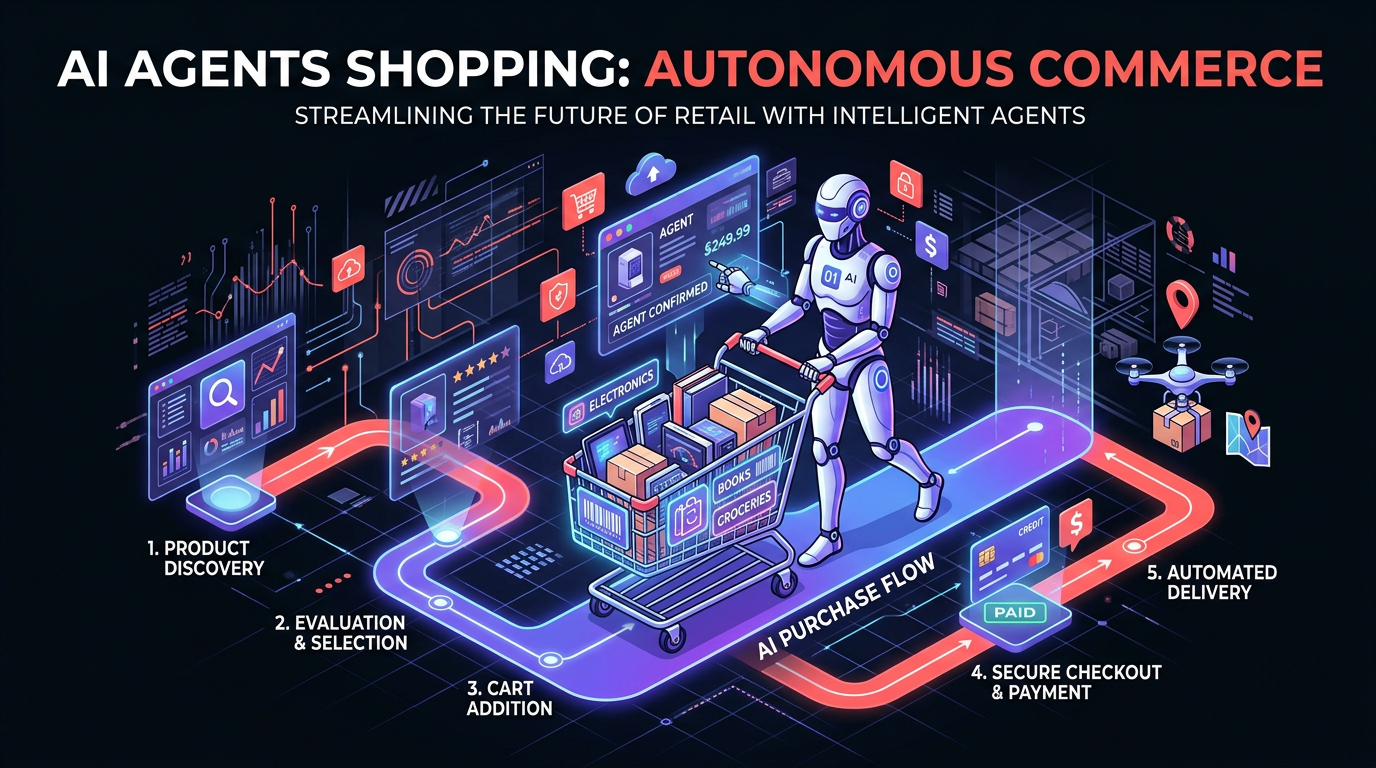
Picture a shopper who reads every review in seconds, compares prices across fifty stores at once, checks live inventory, and buys — all without ever loading your homepage. That shopper is not a person. It is an AI agent, and it is already at the checkout.
Through 2025 and into 2026, AI has shifted from a passive search box into an active economic participant. OpenAI's Operator, Google's Project Jarvis, Perplexity Buy and ChatGPT Shopping can now navigate the web, fill forms, and complete a purchase on a user's behalf. For DTC brands, that changes who you are actually selling to — and what they read before they choose.
Key takeaways
- Agentic commerce means an AI, not a human, increasingly does the reading and deciding. Perplexity Buy, ChatGPT Shopping and Google's Shopping Graph are building direct purchase paths inside the answer. - Agents ignore hero images and persuasive copy. They resolve price, SKU, availability and structured context, then rank you against the whole category in one pass. - Your competitive unit is no longer the ranking — it is the product card. If your SKU is not activated on the AI shelf, you are invisible to the highest-intent buyer of the next decade. - For GEO, the win condition is machine-readability plus category-level presence: clean structured data on-site, and a strong Share of Card in the answers where agents shop. - You cannot optimize what you cannot see. Knowing which SKUs surface, at what price, cited from which sources, is now a prerequisite, not a nice-to-have.
From copilots to shoppers
For two years we treated AI as a copilot — something we talk to. You ask ChatGPT for gift ideas and it returns a list. The newer models act. They browse, they compare, they transact.
The platforms are pouring concrete into this future. Perplexity Buy lets users purchase inside the search interface with the AI handling checkout. ChatGPT Shopping is integrating deeper with merchant catalogs to offer direct purchase paths. Google's Shopping Graph is powering AI Overviews that behave like a personalized storefront. In each case, a machine stands between your brand and the buyer, and it decides what the buyer sees.
The optimization gap
Most e-commerce sites are built for human eyes: a striking hero image, emotional copy, a carefully staged funnel. An agent discards almost all of it. It cares about three things.
First, structured data — can it unambiguously read your price, SKU and availability? Ambiguity is disqualification. Second, context — does this product actually match the layered intent behind the request ("running shoes for flat feet under $120, ships to Germany")? Third, speed and freshness — is the data it pulled current, or a cached hallucination that quietly drops you from consideration?
If your store is beautiful to humans and opaque to machines, you are optimized for the shopper who is slowly disappearing.
