# Agentic Commerce Is Becoming a Control Layer, Not Just a Search Channel
The most important AI commerce signal this week was not one product launch. It was the pattern across several launches.
OpenAI Ads has moved deeper into performance infrastructure. Google AI Mode is connecting third-party apps and shopping actions. Yelp is licensing local business data into ChatGPT. ESW is packaging AI discovery with checkout and cross-border commerce infrastructure. European regulators are making clear that search self-preferencing, anti-steering and answer transparency will not stay "old search" issues forever.
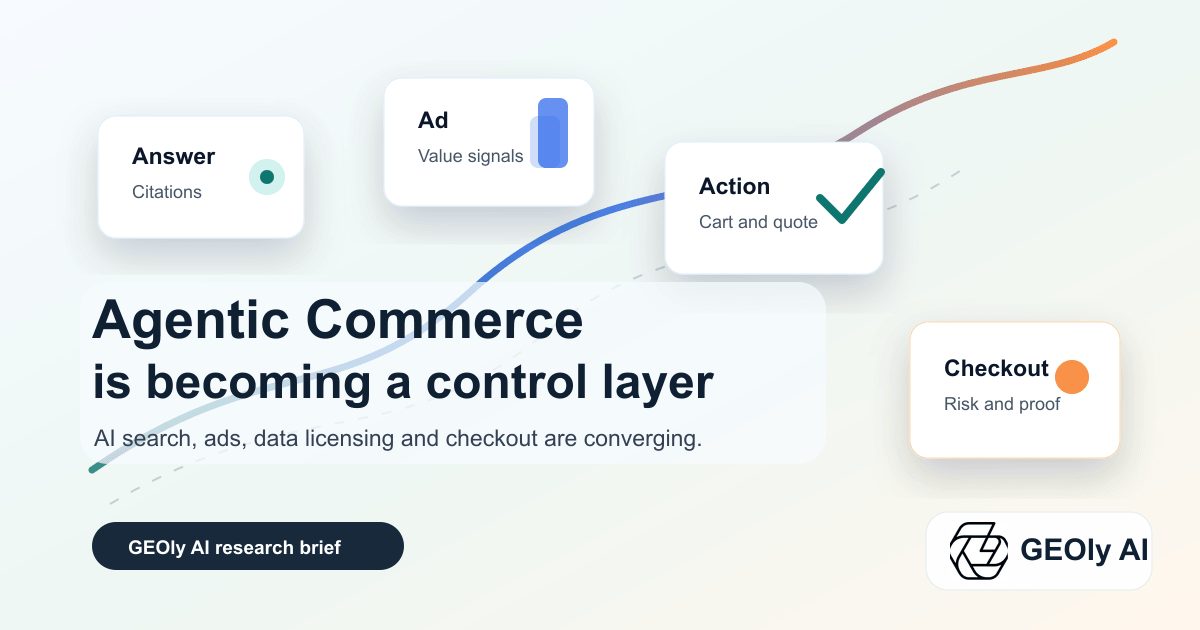
That combination changes the job for brands. AI visibility is no longer only about whether a model mentions you in an answer. It is becoming a control layer that decides which facts are trusted, which offers are eligible, which ads are measurable, which checkout path is allowed and which party carries risk when the user acts.
For ecommerce teams, the question is no longer "How do we rank in AI search?" The better question is: "Can an AI system safely understand, recommend, attribute and transact with our business?"
The new stack: answer, ad, action, transaction
Traditional search optimization separated the world cleanly. Organic pages lived in one bucket. Paid search lived in another. Product feeds, local listings, checkout, refunds and CRM attribution sat in their own operational systems.
AI search is folding those layers together.
OpenAI's Ads documentation now describes a maturing ad platform, including Pixel, Conversions API, Advertiser API, conversion-optimized campaigns and campaign management workflows. Industry reporting around the Ads Manager interface also points to conversion value, click-through attribution and view-through attribution surfacing in advertiser views. Even if availability is still phased, the direction is plain: ChatGPT Ads is being built to compete for performance budgets, not just novelty media tests.
At the same time, Google AI Mode's connected apps show how search can become a task router. Google described early integrations with Instacart, Canva and YouTube Music, including the ability to move from a conversational request into a third-party app action. The key point is not that every checkout happens inside Google today. It is that the search session can now shape the task before the user reaches a merchant-controlled surface.
Then the local data layer shifted. Yelp's agreement to make reviews, ratings, photos and business information available to OpenAI, with attribution back to Yelp and a planned Request a Quote flow, shows how a local answer can become a lead path. A restaurant, contractor or service provider does not only need a web page. It needs accurate, licensed, machine-readable business facts in the places models trust.
Finally, ESW's Agentic Commerce announcement frames checkout as infrastructure. Its pitch is not "we built a chatbot." It is "we connect AI-driven discovery to checkout, payment, cross-border operations and the merchant's existing ecommerce stack." That is the more serious category. The winner in agentic commerce may be the layer that normalizes catalog, price, tax, payment, returns and order status across AI agents.