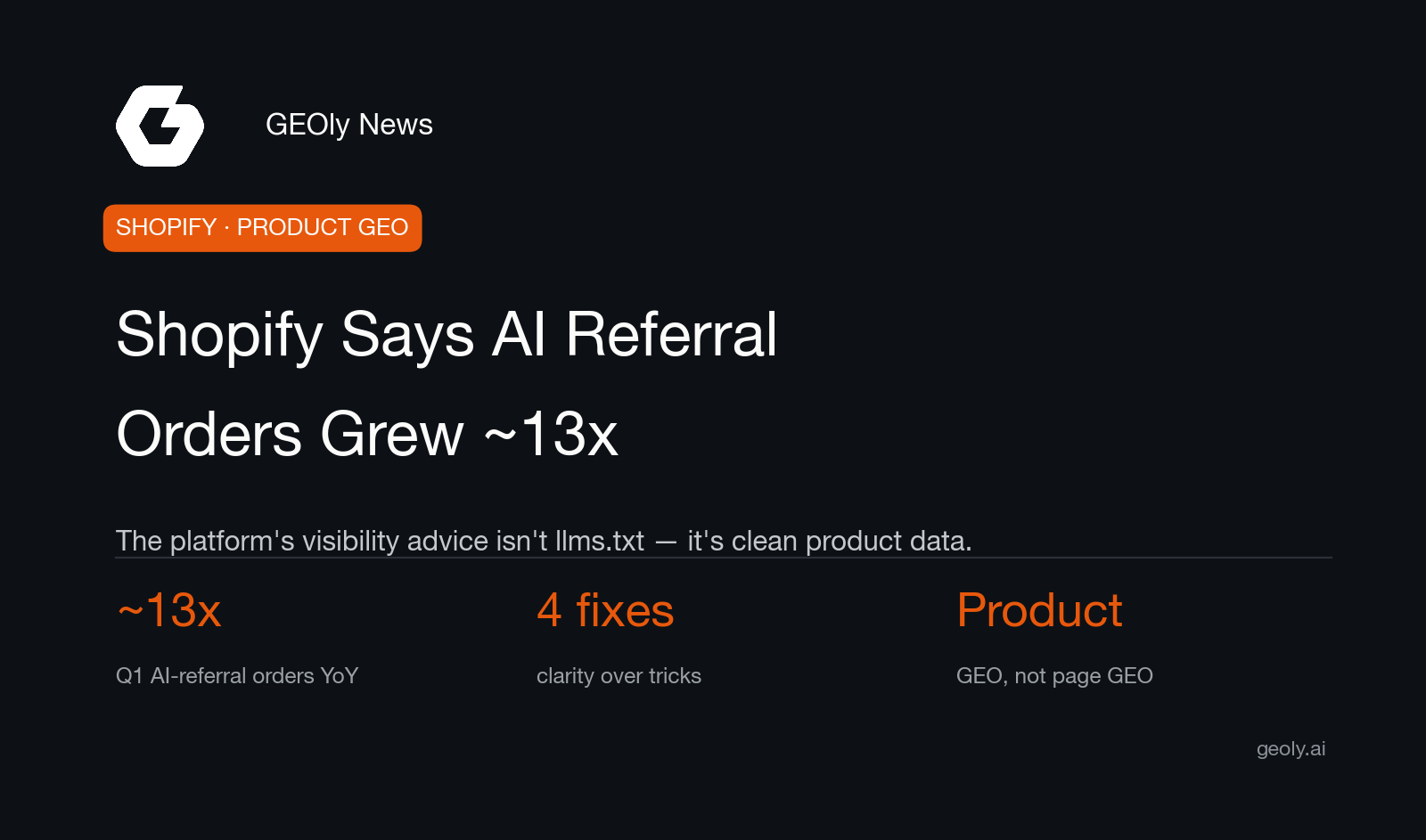
Shopify just put a number and a method on the same page, and both are worth your attention. The number: orders on its platform driven by AI referrals in Q1 2026 ran close to 13 times the same period a year earlier. The method: how merchants should actually earn visibility inside agentic search. And the method is not what most SEO decks are selling.
In its four practices for agentic search visibility, Shopify does not tell you to publish an llms.txt file or to spin up a hundred AI-written blog posts. It tells you to fix your product data: clear images, complete product facts, descriptive titles, readable alt text, reviews shown on the page, and a machine-readable catalog. That is Product GEO — generative engine optimization applied to the product page and the feed, not the blog.
Key takeaways
- The claim: Shopify says AI-referral orders in Q1 2026 were roughly 13x the same quarter a year earlier — its own platform data, not an industry benchmark (Shopify).
- The advice is product-first: Shopify's four practices center on product data quality, not on llms.txt or bulk-generated articles.
- Feeds matter: for US and Canada merchants, Shopify recommends maintaining Shopify Catalog and correctly configuring Google and Microsoft Merchant Center feeds.
- Reviews must be readable: Shopify advises showing review text directly on the page, not buried in screenshots or hard-to-parse third-party widgets.
- The caveat: a ~13x multiple off an undisclosed base can be huge in percent and small in absolute orders — treat it as a signal that Shopify now runs AI referral as its own channel.
What the 13x number actually says — and doesn't
A 13x year-over-year jump is a headline, so read it like a trader, not a fan. This is Shopify internal platform data, not an industry-wide figure, and Shopify does not disclose the starting base or how it separates AI-referred orders from orders that would have converted anyway. A move from a tiny base to a slightly-less-tiny base can print as 13x while still being a rounding error on total GMV.

So don't quote 13x as proof that agentic commerce has arrived at scale. Quote it as proof of something narrower and more useful: Shopify is measuring AI referral as a distinct growth channel and telling merchants how to compete in it. When the platform that processes your checkout starts publishing a visibility playbook, the playbook is the news — regardless of whether your slice of that 13x is ten orders or ten thousand.
Product GEO: the shelf, not the blog
The reason Shopify's advice points at product data is structural. When a shopper asks an AI assistant for "a quiet space heater under $80 with good reviews," the model is not reading your brand manifesto. It is matching a structured query against structured product facts — attributes, images, price, availability, ratings — and assembling a recommendation. If those facts are missing, inconsistent, or trapped inside an image, your product is invisible to the very layer that now makes the pick.
That is why the winning work happens on the product detail page and the catalog feed. Here is the executable version of Shopify's guidance, framed as a Product GEO checklist any ecommerce or merchandising team can run this quarter.

- Front-load core attributes in titles. Lead with the facts a model filters on — type, key spec, size, material — not brand-poetry. "Ceramic space heater, 1500W, 200 sq ft, tip-over shutoff" beats "CozyWarm Deluxe."
- Use multi-angle, machine-recognizable images. Clean product shots on plain backgrounds, several angles, real scale. Ambiguous lifestyle-only imagery is hard for models to parse into attributes.
- Write alt text that describes key features, not decoration. Alt text is where the machine reads what the eye sees — spell out color, material, and the differentiating spec.
- Show review text on the page. Put the actual words on-page, as Shopify advises — not only star counts, not only screenshots, not only a slow third-party widget the model can't read.
- Keep price, stock, returns, and warranty consistent across channels. Contradictions between your PDP, your Merchant Center feed, and marketplaces erode the trust signals assistants lean on.
- Add a real FAQ. Sizing, compatibility, care, shipping — the questions a shopper would ask an assistant are the answers you want it quoting from your page.
Feeds are the other half
On-page quality gets you readable; the catalog feed gets you eligible. Shopify specifically advises US and Canada merchants to maintain Shopify Catalog and to correctly configure their Google and Microsoft Merchant Center feeds in its guidance. A clean, complete, machine-readable catalog is what lets an assistant retrieve your product with the right price and availability at the moment of the query — the difference between being a candidate and being a footnote.
This is the same discipline showing up across the agentic shelf. It rhymes with what we've written about the Amazon third shelf, where AI picks are decoupling from classic search rank, and with the Google AI Mode cart handoff, where the answer itself becomes the checkout. In each case the unit of competition is the product record, not the brand narrative.
How to know if it's working
Product GEO is measurable, which is what makes it a channel rather than a hope. Instead of guessing, audit whether assistants can actually see and quote your PDP, then track how often your products get recommended versus rivals. That is the idea behind Share of Card — the share of AI shopping answers where your product lands on the card the assistant hands the buyer.
If you run a Shopify store, this is a concrete first move: run a Product GEO audit of your top SKUs and track Share of Card against your category. Tools built for it — GEOly's GEO tooling for Shopify brands — will flag the PDPs where missing facts or unreadable reviews are quietly costing you the recommendation.
FAQ
Did Shopify really say AI-referral orders grew 13x?
Yes — Shopify's blog states that orders driven by AI referrals on its platform in Q1 2026 were close to 13x the same period a year earlier (Shopify). Read it as internal platform data on a distinct channel, not as an industry-wide benchmark, since the base and attribution method aren't disclosed.
Do I need an llms.txt file to rank in agentic search?
Shopify's own guidance doesn't lead with llms.txt or bulk AI articles — it leads with product data quality: clear images, complete facts, descriptive titles, readable alt text, on-page reviews, and a machine-readable catalog (Shopify). Fix the product record first; that's where assistants actually look.
What's the fastest Product GEO win for a Shopify store?
Start with your best-selling SKUs: front-load specs in the title, add multi-angle images with descriptive alt text, and surface real review text on the page instead of screenshots. Then confirm your Merchant Center feed matches your PDP on price and stock, and track Share of Card to see the lift.
Related reading: Share of Card for Shopify brands, Amazon Alexa AI picks and the third shelf, Google AI Mode's Instacart cart handoff, and the AI Commerce News hub. Published by GEOly News — see more from this desk.
