LogoGEOly
  • Pricing
Log inSign up
Blog›HSBC UK and Visa Just Ran a Live Agentic Payment. Now Build the Controls.
hsbc-visa-live-agentic-payment-controls-cover.png

HSBC UK and Visa Just Ran a Live Agentic Payment. Now Build the Controls.

Summary

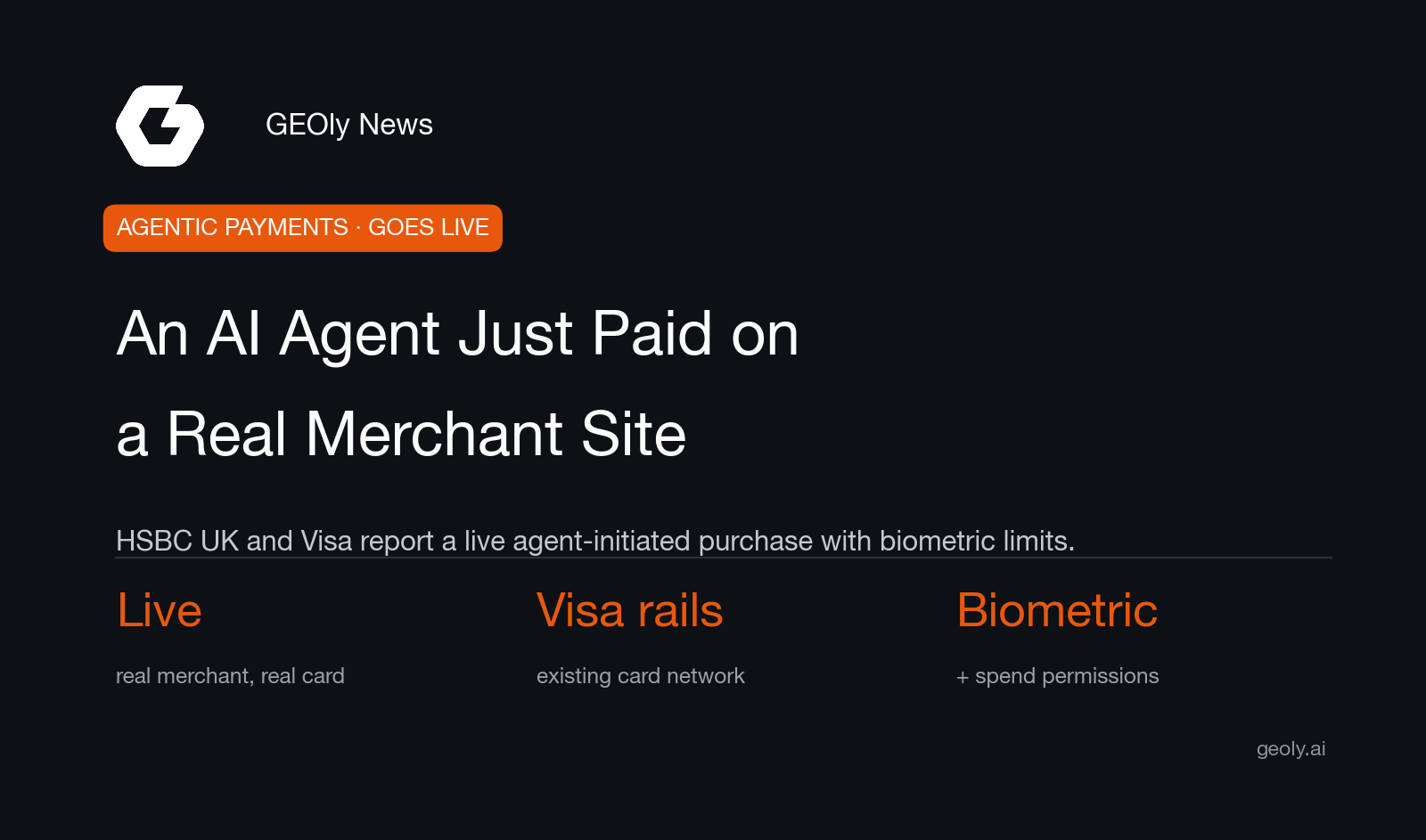
On 16 July 2026, an HSBC UK card completed an AI-agent-initiated purchase on a real merchant site over Visa's existing rails — turning agentic-payment liability from theory into a checklist you need now.

GNGEOly NewsGEOly Daily AI Commerce Briefing
2026/07/17
6 min read
#AI Commerce News#AI Search#Agentic Payments#Agentic Commerce#Visa#HSBC

A demo in a sandbox is a science project. A card charging a real merchant is a liability. On 16 July 2026, HSBC UK and Visa said they completed an end-to-end transaction that an AI agent initiated on a live merchant website — with biometric and spend-permission controls, and with Visa routing the payment through its existing card network rather than a new, separate rail.

Two trade outlets carried the story, both describing it as a company-claimed "industry-first" test. Treat that phrase the way you would any vendor superlative: we found no same-day first-party HSBC or Visa press release, so "industry-first" is company framing, not an independently audited fact. What matters is not the ranking — it is that the moving pieces (real merchant, real card network, real authorization) are now concrete, and so is the question of who eats the loss when an agent gets it wrong.

Key takeaways

  • It ran on existing rails. Visa routed the agent's payment through its current card network, not a new payment system — so agentic charges inherit today's authorization, refund, and chargeback plumbing.
  • "Industry-first" is a claim, not a fact. No same-day first-party HSBC/Visa release was found; two trade outlets reported the company framing. Cite it as such.
  • Controls were part of the test. The reported transaction paired the agent with biometric and spend-permission controls — the control layer is the product, not an afterthought.
  • Liability is now concrete. Mis-purchase, duplicate purchase, over-authorization, refund and chargeback exposure have no unified cross-industry rules yet. You need your own matrix before you scale.
  • Marketing's metric changes. "Can the agent order?" is table stakes. Track error-transaction rate and support cost per agent order, not just conversion.

What actually happened

Strip the superlatives and the reported sequence is simple. An AI agent, acting on a shopper's behalf, initiated a purchase on a real merchant checkout. Before the charge cleared, the transaction was gated by biometric verification and a scoped spend permission. Visa then authorized and cleared it over its existing card rails. No new network, no exotic settlement layer — the agent slotted into the same authorization flow a human tap would use.

That last detail is the whole story for operators. Because the payment rides existing rails, everything you already know about card disputes, refunds, and chargebacks applies — but now the party that clicked "buy" is software. The flow below is what the reported test looks like end to end.

hsbc-visa-agentic-transaction-flow.png

Each arrow in that chain is a place responsibility can be dropped: the agent can misread intent, the authorization can be over-scoped, the merchant can double-charge, and the audit trail can be too thin to reconstruct what the agent decided and why. None of that is hypothetical once a real card is on a real site.

Why this makes liability concrete

In a sandbox, a wrong purchase is a log line. On live rails, a wrong purchase is a customer refund, a chargeback, and a support ticket — and today there is no unified cross-industry rulebook for who is at fault when an autonomous agent over-buys, duplicates an order, or acts on a stale authorization. Is it the bank that issued the scoped permission, the network that cleared it, the merchant that fulfilled it, or the agent platform that decided to click? Until that settles, the safe assumption is that ambiguity resolves against whoever has the weakest audit trail — often the merchant.

So the job for ecommerce and payments teams is not to wait for standards. It is to define your own control matrix now, so that when an agent transacts on your site you can prove what it was allowed to do, what it actually did, and how to unwind a mistake.

The agentic-payment control matrix

Treat these six controls as non-negotiable before you let agents transact at any volume. They map directly onto the dispute surface above.

agentic-payment-control-matrix.png
  • Spend caps. Per-transaction and per-period limits, scoped by country and category. A grocery agent should not be able to buy electronics; a £40 refill should not share a ceiling with a £4,000 purchase.
  • Secondary confirmation. Require a second human confirmation for high-value or sensitive items, even inside an active session. Not every click should be one-tap.
  • Biometric authorization. Bind the agent's authority to a verified human, as the reported test did — so an authorization is traceable to a person, not just a token.
  • Authorization validity. One consent is not indefinite permission. Time-box and scope-box every authorization; expiry and renewal must be explicit.
  • Revocation and refunds. The shopper must be able to revoke an agent's authority instantly, and your refund path must handle agent-initiated orders without human hand-holding.
  • Audit log. Capture what the agent was permitted, what it decided, the inputs it saw, and the human binding — a full, replayable trail for every agent transaction.

Add human takeover to the list: any agent flow needs a clean point where a person can step in mid-transaction. Duplicate-purchase and over-authorization bugs are not edge cases at scale — they are your top two support drivers until the controls above are tight.

What marketing and ecommerce teams should measure

"Can the agent complete an order?" is now the boring question. The interesting ones are operational. Track error-transaction rate (mis-purchases, duplicates, over-authorizations per thousand agent orders) and support cost per agent order. A channel that converts brilliantly but generates 3x the refunds and tickets is not a win — it is a margin leak wearing a growth costume.

This sits next to the trust question one layer down the stack: agents only transact well when the underlying inventory and product data are accurate, which is exactly the problem the Instacart x Arpalus real-time shelf work is chasing. Being recommended and transactable by agents is one readiness surface; GEOly's agentic-commerce readiness view tracks whether AI systems can find, cite, and act on your brand across that whole shelf. For the payment-side patterns specifically, the sandboxes-to-auditable-checkout playbook and the broader agentic-commerce optimization playbook are the next reads.

FAQ

Did HSBC and Visa really run a live AI-agent payment?

Two trade outlets reported on 16 July 2026 that an HSBC UK card completed an end-to-end purchase initiated by an AI agent on a real merchant site, with biometric and spend-permission controls, routed over Visa's existing network. We found no same-day first-party HSBC or Visa press release, so the "industry-first" label is a widely-reported company claim, not an independently audited fact.

Does agentic payment use a new payment network?

No. In the reported test, Visa routed the agent's payment through its existing card rails rather than a new, separate system. That means agent-initiated charges inherit current authorization, refund, and chargeback processes — which is why liability boundaries become concrete immediately.

What controls should we require before letting agents buy?

At minimum: spend caps (per-transaction and per-period, by country and category), secondary confirmation for high-value items, biometric binding to a verified human, time- and scope-boxed authorization validity, instant revocation, an agent-aware refund path, human takeover, and a full audit log. Then measure error-transaction rate and support cost, not just whether the order went through.


Related reading: Instacart x Arpalus real-time shelf intelligence, Google AI Mode's Instacart cart handoff, and the AI Commerce News hub. Published by GEOly News — see all dispatches.

Latest Posts

reddit-ai-search-citations-community-signals-cover.png

Reddit Is Now ~1 in 5 Off-Site AI-Search Citations. Here's the Honest Play

An industry session claims Reddit accounts for roughly one in five off-site AI-search citations, up ~30% year over year — a directional signal that GEO is widening from owned sites to community discussion, not a license to astroturf.

#AI Commerce News#AI Search#Reddit
GEOly News
5212026/07/17
chatgpt-referral-lead-rate-conversion-invoca-cover.png

ChatGPT Sends Better Leads — But Not Better Closes

Invoca found ChatGPT-referred calls became sales leads 49% of the time, ~10 points above the channel average — yet closed at just 40%, below the 42% all-channel norm.

#AI Commerce News#AI Search#GEO Measurement
GEOly News
7082026/07/17
shopify-ai-referral-orders-product-geo-cover.png

Shopify: AI-Referral Orders ~13x YoY — and the Fix Is Product Data

Shopify says AI-referral orders in Q1 2026 ran close to 13x a year earlier — and its advice for winning agentic search is product data quality, not llms.txt.

#AI Commerce News#AI Search#Shopify
GEOly News
4452026/07/17
All Posts
GEOly

See your brand in AI search

GEOly tracks how ChatGPT, Gemini and Perplexity mention, cite and recommend your brand — and helps you win the AI shelf.

Start Free Trial

Free to start · No credit card required

GNGEOly NewsGEOly Daily AI Commerce Briefing
2026/07/17
6 min read
#AI Commerce News#AI Search#Agentic Payments#Agentic Commerce#Visa#HSBC
GEOly

See your brand in AI search

GEOly tracks how ChatGPT, Gemini and Perplexity mention, cite and recommend your brand — and helps you win the AI shelf.

Start Free Trial

Free to start · No credit card required

Trusted by leading consumer brands

Anker SOLIX
eufy
soundcore
PLAUD
xTool
Ulike
Jackery
Roborock
Dreame
EcoFlow
Insta360
TCL
Beatbot
CASETiFY
Creality
Shokz
Segway
realme

12,000+ brands track & win AI search with GEOly

From Anker SOLIX to xTool — the brands above already see how ChatGPT, Gemini and Perplexity mention, cite and recommend them. Your brand is being talked about in AI right now. See it.

See Your Brand in AI — Free

Free to start · No credit card required

LogoGEOly

GEOly. The GEO data platform for DTC brands — GEO, made easy and agent-friendly.

GitHub
GitHub
YouTube
YouTube
Email
PRODUCT
  • Overview
  • Brand Visibility
  • AI Agent
  • Integrations
RESOURCES
  • Docs
  • Blog
  • Changelog
  • FAQ
  • Learn
  • Alternatives
ECOSYSTEM
  • RIJOY
  • Sectionly
  • ShopifySkills
COMPANY
  • About Us
  • Contact
  • Partner Program
  • Partner Directory
POLICY
  • Privacy Policy
  • Terms of Service
© 2026 GEOly Inc.
Privacy PolicyTerms of Service
Built for AI Visibility