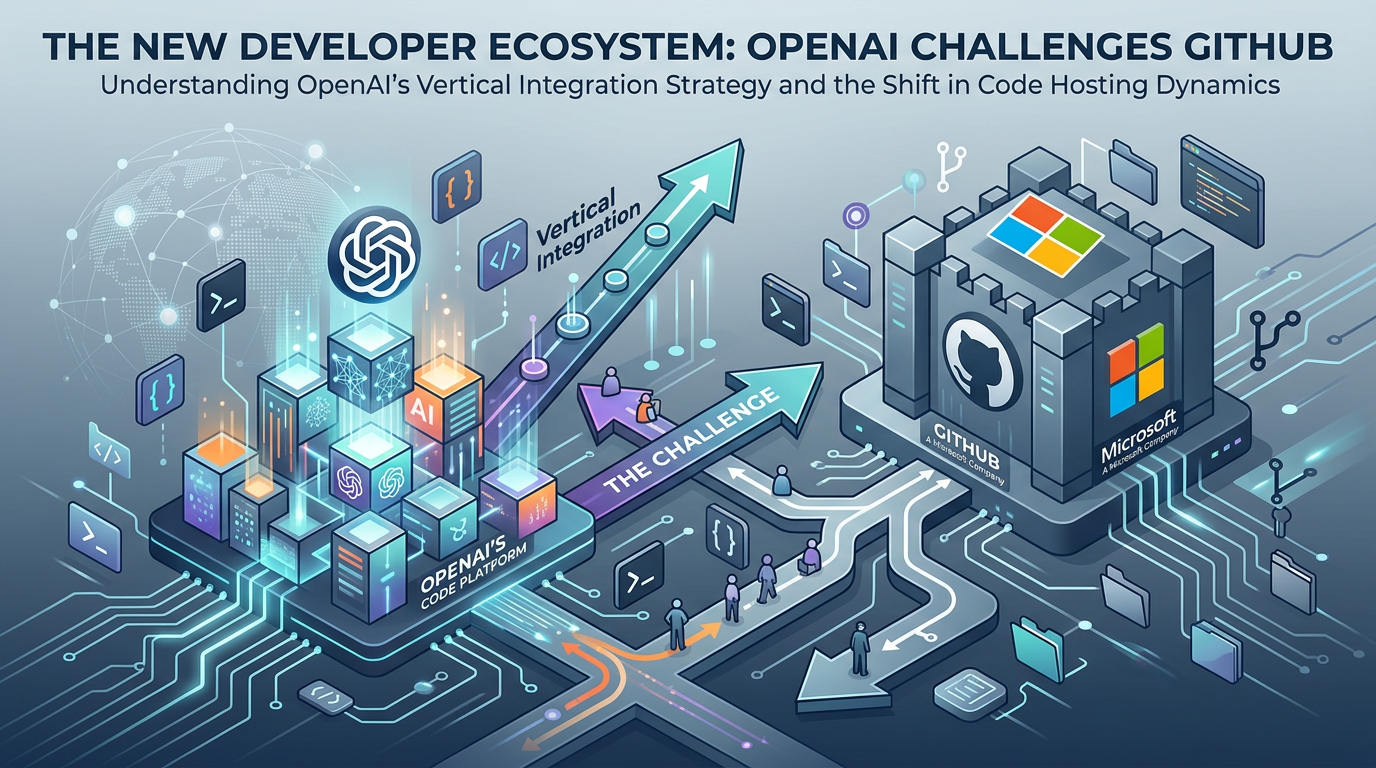
OpenAI is reportedly developing a code-hosting platform that could compete directly with GitHub, according to reports from The Information and Reuters. It is an unusually pointed move, because the company GitHub belongs to — Microsoft — is also one of OpenAI's largest backers, with billions of dollars invested.
The project is early-stage and likely months from completion. But even as a rumor it says something real about where the AI industry is heading: the model makers no longer want to be just model makers. They want to own the whole stack that developers and, eventually, brands live inside.
Key takeaways
- OpenAI is reportedly building a GitHub competitor. The Information and Reuters both describe a code-hosting product in early development, possibly months from launch. - The trigger was reliability. OpenAI engineers hit a rise in GitHub outages in recent months; the frequency and severity frustrated teams relying on it for critical work, and leadership decided to build their own. - It puts OpenAI and Microsoft on a collision course. Microsoft invested billions in OpenAI and owns GitHub, which it bought for $7.5 billion in 2018. Selling a rival product would mean competing head-on with a key investor. - Employees have discussed selling the repository to OpenAI's existing customer base, bundling it with current products rather than launching a standalone service. - For brands, the signal matters more than the product: AI companies are consolidating into end-to-end ecosystems, and the AI-answer layer is becoming the new distribution stack you need visibility inside.
What was reported
According to The Information, OpenAI staff have been working on a code repository product and have considered making it available for purchase to the company's customer base. The project is described as early-stage, with completion likely still months away.
Reuters reporting adds the why. OpenAI engineers encountered a rise in service disruptions that rendered GitHub unavailable over recent months. Those outages, and how often they recurred, pushed the decision from "annoying" to "let's build our own." Rather than keep depending on infrastructure that repeatedly failed them, OpenAI's leadership opted to control it themselves.
Nothing here is confirmed as a shipping product. Treat the specifics as reporting, not a roadmap. What is worth reading closely is the pattern.
The Microsoft complication
This is where the story gets awkward. Microsoft occupies two roles at once. It is a major investor in OpenAI, having put in billions across multiple rounds. And it is the owner of GitHub, which it acquired in 2018 for $7.5 billion.
If OpenAI builds a code-hosting platform and sells it, that is a direct competitive move against one of its most important partners. It raises real questions about where the boundaries of the OpenAI–Microsoft relationship actually sit — how much overlap the two companies will tolerate as OpenAI expands from a model provider into a full platform business.
The tension is not hypothetical. Every AI lab that started by selling access to a model is now pushing outward: into agents, developer tools, consumer apps, and the infrastructure underneath all of it. OpenAI moving toward code hosting is the same instinct that put ChatGPT on the desktop and turned an API into an app store.
What this means for brands and GEO
Step back from the GitHub-versus-Microsoft drama and the useful lesson is about consolidation. The companies that own the AI models are turning themselves into ecosystems — the place where developers write code, where consumers ask questions, and where purchase decisions increasingly start. When OpenAI adds a surface, it adds another doorway into a walled garden that millions of people already pass through daily.
For a DTC brand or a marketing team, that is the whole game in miniature. Search used to be the distribution layer. Now the answer engines are, and they keep growing new surfaces — shopping cards, agents, developer platforms, integrations. Your brand's visibility is no longer spread across a web you can crawl; it is concentrated inside a handful of AI ecosystems that decide what gets shown, cited, and recommended.
That is exactly the problem [GEOly](/blog/what-is-geoly-ai) is built for. GEOly is a GEO data platform built on industry-level intelligence — it doesn't just monitor your own brand, it maps how your whole category shows up across ChatGPT, Gemini and Google AI, from brand rankings and product cards to citation sources and brand perception, as a queryable database. When the distribution layer consolidates into a few AI platforms, seeing how you appear inside each one stops being optional. If you can't see how you show up in an ecosystem, you can't optimize for it. (Free 3-day trial at app.geoly.ai.)
The strategic takeaway is not "OpenAI might beat GitHub." It's that the AI layer is absorbing more of the stack every quarter, and the brands that treat AI visibility as core infrastructure — the way this news treats code hosting as core infrastructure — will be the ones that adapt. This is the same shift we cover in [generative engine optimization](/blog/what-is-generative-engine-optimization-geo).
FAQ
Is OpenAI definitely launching a GitHub competitor? No. It is a reported project, early-stage and possibly months from completion, based on reporting by The Information and Reuters. OpenAI has not shipped a public product.
Why would OpenAI compete with an investor? Microsoft is both a major OpenAI backer and the owner of GitHub. The reported trigger was reliability — a rise in GitHub outages that disrupted OpenAI's engineers — pushing the company to reduce its dependence on infrastructure it doesn't control.
How much did Microsoft pay for GitHub? Microsoft acquired GitHub in 2018 for $7.5 billion.
これがGEOとどう関係しているのでしょうか? これはプラットフォーム統合の兆候です。AI企業がエンドツーエンドのエコシステムを構築する中で、AI回答レイヤーが新しい配信スタックとなり、ChatGPT、Gemini、Google AI内での可視性がブランドの重要な関心事となっています。
AI業界に関するさらなる記事は[AI News](/blog/tag/ai-news)タグでご覧いただけます。また、[GEOly AI](/blog/author/geoly-ai)著者ページから私たちの分析の続きをフォローできます。