
1. Executive Summary: The Shift from Search to AI Discovery
The global landscape of digital commerce is undergoing a structural change as significant as the shift from desktop to mobile. We are witnessing a fundamental move from Search-based Discovery (keywords, blue links, browseable catalogs) to Intent-based Discovery (natural language, autonomous AI agents, and contextual reasoning).
For digital marketing agencies and brand operators, this requires a pivot from traditional Search Engine Optimization (SEO) to Generative Engine Optimization (GEO).

In the Shopify ecosystem, the infrastructure powering this shift includes the Shopify Catalog, the Catalog API, and the Model Context Protocol (MCP). These are not just developer tools; they are the foundation of "Agentic Commerce." They allow millions of products to be "read," "understood," and "recommended" by Large Language Models (LLMs) and AI agents.

Core Argument: In the era of Agentic Commerce, brand visibility is no longer just about backlink quantity or keyword density. It is about data structure, semantic clarity, and real-time availability.
Whether it’s a chatbot on a storefront or a discovery engine like Perplexity, an AI’s ability to recommend a product now depends entirely on how strictly a merchant follows Shopify’s Standard Product Taxonomy and MCP standards.
2. Infrastructure of Agentic Commerce: Shopify Catalog Deep Dive
To optimize for AI (GEO), you must understand how AI retrieves information. The Catalog API is fundamentally different from the traditional Storefront API. While the Storefront API is designed to show pretty pixels to humans, the Catalog API is designed to feed logical, structured data to machines.
2.1 The Dual Architecture: Search vs. Lookup
The architecture relies on two pillars: the Search Endpoint and the Lookup Endpoint.
2.1.1 Search Endpoint: Clustering and Global Discovery
The Search Endpoint acts as the entry point for global product discovery. Unlike a standard store search (which looks at one shop's inventory), Catalog Search queries the entire eligible Shopify ecosystem.
A critical feature here is Universal Product ID (UPID) Clustering. On the open web, the same physical item (e.g., a specific Nike sneaker) might be sold by 50 different vendors.
- The Problem: Traditional databases return 50 nearly identical results. This clogs the AI’s context window and ruins the user experience.
- The Solution: Shopify clusters these under one UPID. The AI identifies the product first, then looks at the offers from different merchants.
GEO Strategy:
- For Resellers: Winning the "Buy Box" on the open web depends on price competitiveness and fulfillment speed. These are the hard metrics AI agents use to decide which merchant to recommend after "unfolding" the cluster.
- For Direct-to-Consumer (DTC) Brands: You must ensure your proprietary UPIDs have rich, unique metadata so you aren't accidentally lumped in with generic knock-offs. Accurate GTINs (Global Trade Item Numbers) are essential here.
2.1.2 Lookup Endpoint: Reasoning and "Relaxation Logic"
Once an AI finds a UPID, it uses the Lookup Endpoint to get specific details. The most strategic feature here is Relaxation Logic.
- How it works: If a user asks for "A red shirt, size M, under $50," and that specific variant is out of stock, a traditional API returns "Zero Results." This kills the conversation.
- Smart Fallback: Shopify’s API allows the agent to weigh preferences (e.g., "Color is most important, size is second"). If an exact match fails, the API "relaxes" the rules to find the next best thing (e.g., "We don't have Medium, but we have the Red shirt in Large").
GEO Action: Agencies must ensure product variants are structured correctly. If attributes like color or material are hidden in text descriptions rather than structured "Option Values," the API cannot use this logic. The product simply vanishes from the conversation.
2.2 Real-Time Constraints: The "No Cache" Rule
Shopify mandates that agents cannot cache search results. Prices and inventory must be real-time.
- Why? In Agentic Commerce, "hallucinations" (an AI selling a product that doesn't exist) are unacceptable.
- GEO Action: Your strategy cannot rely on static data snapshots (like daily XML feeds). Systems (ERP/WMS) must sync with Shopify with near-zero latency. If Shopify sees a product as Out of Stock (OOS), the AI will strictly block it. The
available_for_saleboolean is the ultimate gatekeeper.
3. The Core Engine: Model Context Protocol (MCP)
Model Context Protocol (MCP) is the standardizing force for how AI models talk to data. Think of it as a universal USB-C port for Shopify.
3.1 Standardization
Before MCP, connecting an LLM (like GPT-4) to Shopify required custom coding. MCP creates a standard:
- MCP Server: Exposes Shopify data as standardized "Tools."
- MCP Client: AI Agents (like chatbots or Cursor) call these tools directly without needing to understand the complex underlying code.
3.2 Key Tools for GEO
Two specific tools determine what an agent can "see":
3.2.1 search_global_products
This tool accepts natural language queries and—crucially—context.
- The "Context" Goldmine: An agent can pass extra info like "Context: User is hiking in the rain."
- GEO Strategy: If your product data includes attributes for "weather suitability" or "usage scenarios" (via Shopify's taxonomy), the MCP server can return your product even if the word "rain" isn't in the title. Optimize for Context, not just Keywords.
3.2.2 get_global_product_details
This retrieves deep variant info.
- Impact: If fields like "Tech Specs" or "Unique Selling Points" are empty, the AI cannot effectively compare your product against competitors.
4. The Foundation: Shopify Standard Product Taxonomy (SPT)
If MCP is the pipe, the Standard Product Taxonomy (SPT) is the water flowing through it. It is the language AI uses to understand what you sell.
4.1 From "Free Text" to "Structured Attributes"
Traditional SEO stuffed keywords into titles (e.g., "Mens Waterproof Cotton Hiking Jacket"). GEO requires structured attributes.
- Classification: Map every SKU to the deepest possible node in Shopify's 10,000+ category tree. Don't just categorize as "Apparel." Categorize as
Apparel > Tops > T-Shirts. - Attribute Mapping: Deep categorization unlocks specific fields. A shirt category unlocks fields for
neckline,sleeve_length, andmaterial. - Action: Don't just write "Cotton" in the description. You must tag
material: cottonin the structured field. AI filters work on fields, not text descriptions.
4.2 Industry-Specific GEO Tactics
- Apparel: Use new attributes like
Gemstone typeorLeather type. TaggingLeather type: Full-grainensures AI recommends your bag for queries about "high-quality leather." - Electronics: Fill in Metafields for connectivity and power. When a user asks Perplexity, "Which splitter supports 4K?", only structured specs provide the answer.
- Home & Garden: Focus on
DimensionsandRoomusage. Help the AI answer, "Sofa suitable for a small apartment."
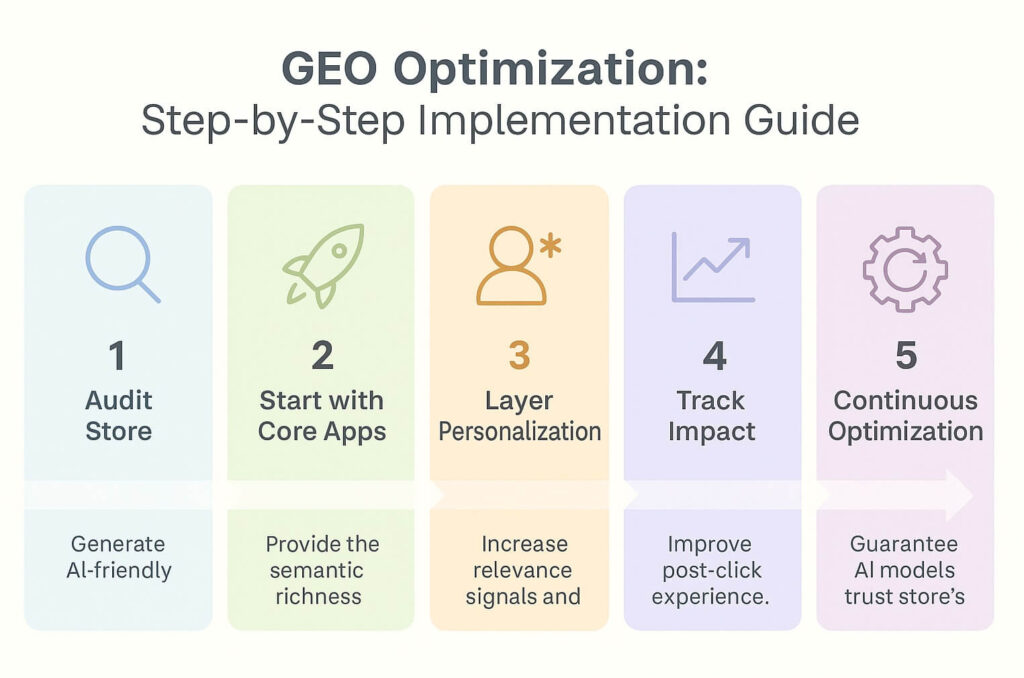
5. GEO Strategy: Action Plan for Agencies & Merchants


Phase 1: Technical Readiness
Ensure the Catalog API can read your store data without errors. Clean up the data hygiene.

Phase 2: Semantic Content Optimization
Align unstructured text with User Intent.
- Implement "LLMs.txt": Create a text file in your root directory specifically for AI crawlers. Summarize brand values, return policies, and a list of top 50 items. This acts as a "manual for robots."
- Knowledge Base: Use the Shopify Knowledge Base app to structure FAQs. Clear, structured policies build "E-E-A-T" (Experience, Expertise, Authoritativeness, and Trustworthiness) with the AI.
- Review Mining: AI reads reviews. If customers say "sizes run small," explicitly write in the description: "Customers report running small; we suggest sizing up." This prevents returns and boosts trust.
Phase 3: Visual GEO
Computer vision is now a search input.
- Clean Main Images: No cluttered backgrounds. This helps Perplexity render the Product Card correctly.
- Contextual Lifestyle Images: A photo of boots in the mud signals "waterproof" and "durable" to the AI's vision model better than text does.
- Narrative Alt Text: Stop keyword stuffing. Describe the scene: "Model wearing red waterproof jacket in the rain, water beading off the surface."
6. Deep Dive: Perplexity, ChatGPT & Shopify
6.1 Perplexity Integration
Perplexity now features a "Buy with Pro" button for seamless checkout.
- Optimization: While Shopify sends API data, you should still maintain Schema.org markup on your webpages as a backup verification source.
- Q&A Format: Structure product descriptions as Q&A (e.g., "Is this camera good for low light? Yes, because...") to align with Perplexity's answer engine format.
6.2 ChatGPT Search Integration

ChatGPT acts more like a "Decision Engine." It handles complex prompts like "I need bridesmaid accessories for a vintage wedding, budget $500."
- Conversational Descriptions: ChatGPT prefers products that explain use cases. Don't just list specs; explain that the jacket is "designed for city commuters who face heavy rain."
- Scenario Tags: Inject tags like
wedding_guestorhome_officeinto Metafields so the AI can match products to complex user scenarios. - Brand Trust: ChatGPT heavily weighs return policies and shipping transparency before making a recommendation. Ensure these are detailed in your Shopify Policy settings.
7. Advanced: Building Custom Agents
For agencies with dev teams, you can build proprietary AI agents using the shop-chat-agent template (React Router + MCP).
- Universal Cart: Shopify is building a future where an AI agent can add items from different merchants into one cart.
- Strategy: Think about Complementary Optimization. If you sell tents, optimize your data to appear alongside non-competing sleeping bag brands in "Camping Set" recommendations.
8. Conclusion and Strategic Advice

The launch of Shopify Catalog API and MCP marks the era where "Data Structure is the UX."
For the past decade, agencies focused on themes and UI. Now, the competitive advantage lies in backend data quality.
Final Recommendations:
- Embrace Taxonomy: It is the only language the AI speaks. Every blank field is a lost sale.
- Context is King: Optimize for usage scenarios, not just keywords.
- Speed is Justice: Ensure real-time inventory sync.
- Build Knowledge Assets: A structured Knowledge Base is your best defense against AI hallucinations.
By executing these GEO strategies, you position your brand not just to survive, but to dominate the next generation of traffic from Perplexity, ChatGPT, and AI Agents.