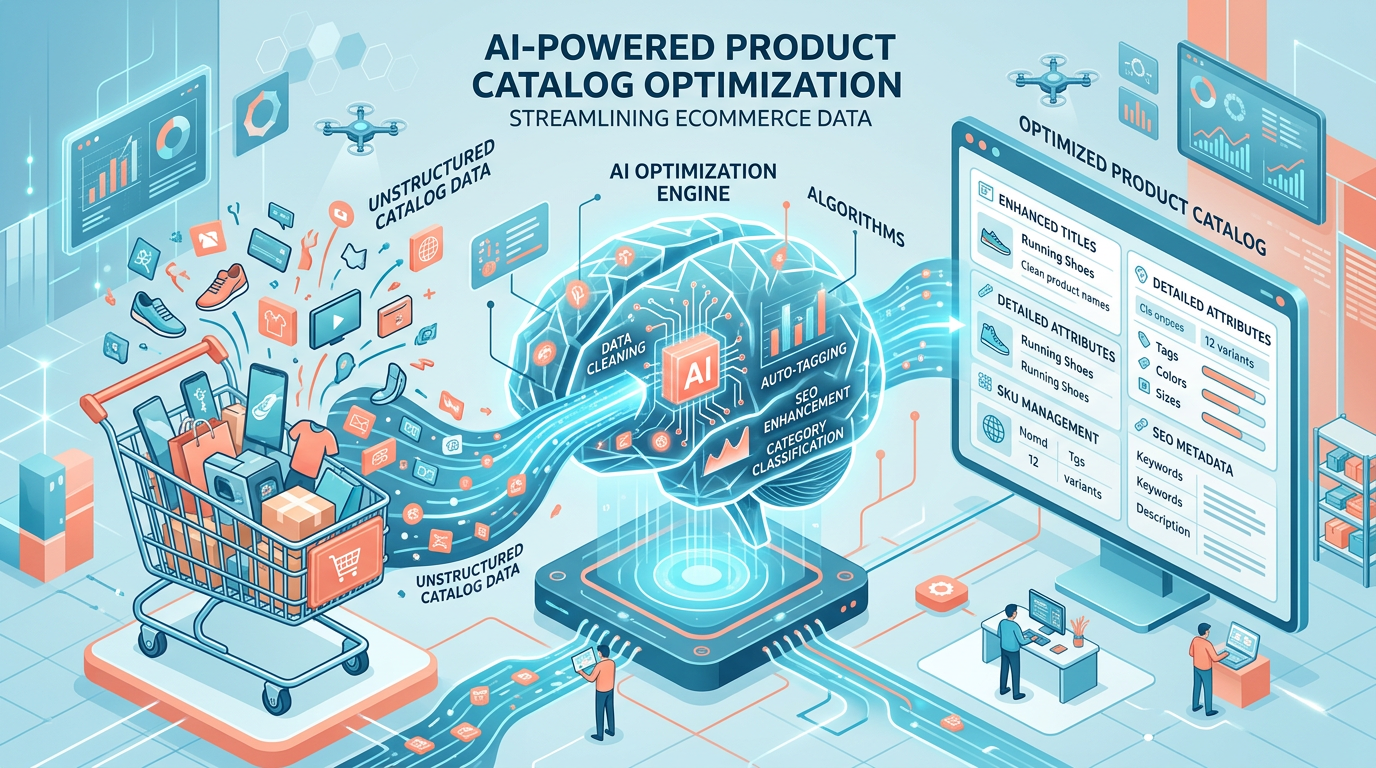
The way consumers shop online is undergoing a seismic shift. We are moving from "search and scroll" to "ask and buy."
When a user asks ChatGPT, "What are the best waterproof hiking boots under $200 for wide feet?", the AI doesn't browse a website like a human does. It scans its training data and real-time indices for structured information that matches these specific criteria: waterproof, hiking, under $200, wide fit.
If your product catalog doesn't explicitly speak this language, your products are invisible to the AI. This guide will show you how to optimize your product catalog for the era of Agentic Commerce, ensuring your brand gets recommended when it matters most.
The New Shelf Space: AI Context Windows
In traditional ecommerce SEO, you optimized for keywords like "hiking boots." In GEO (Generative Engine Optimization), you optimize for attributes and relationships.
AI models function as semantic matchmakers. They look for products that best fit a user's complex, natural language query. Your goal is to provide enough structured context so the AI can confidently say, "This is exactly what the user is looking for."
Step 1: Master Structured Data (The Language of AI)
Structured data (Schema.org) is no longer just for rich snippets; it is the primary way AI understands your products.