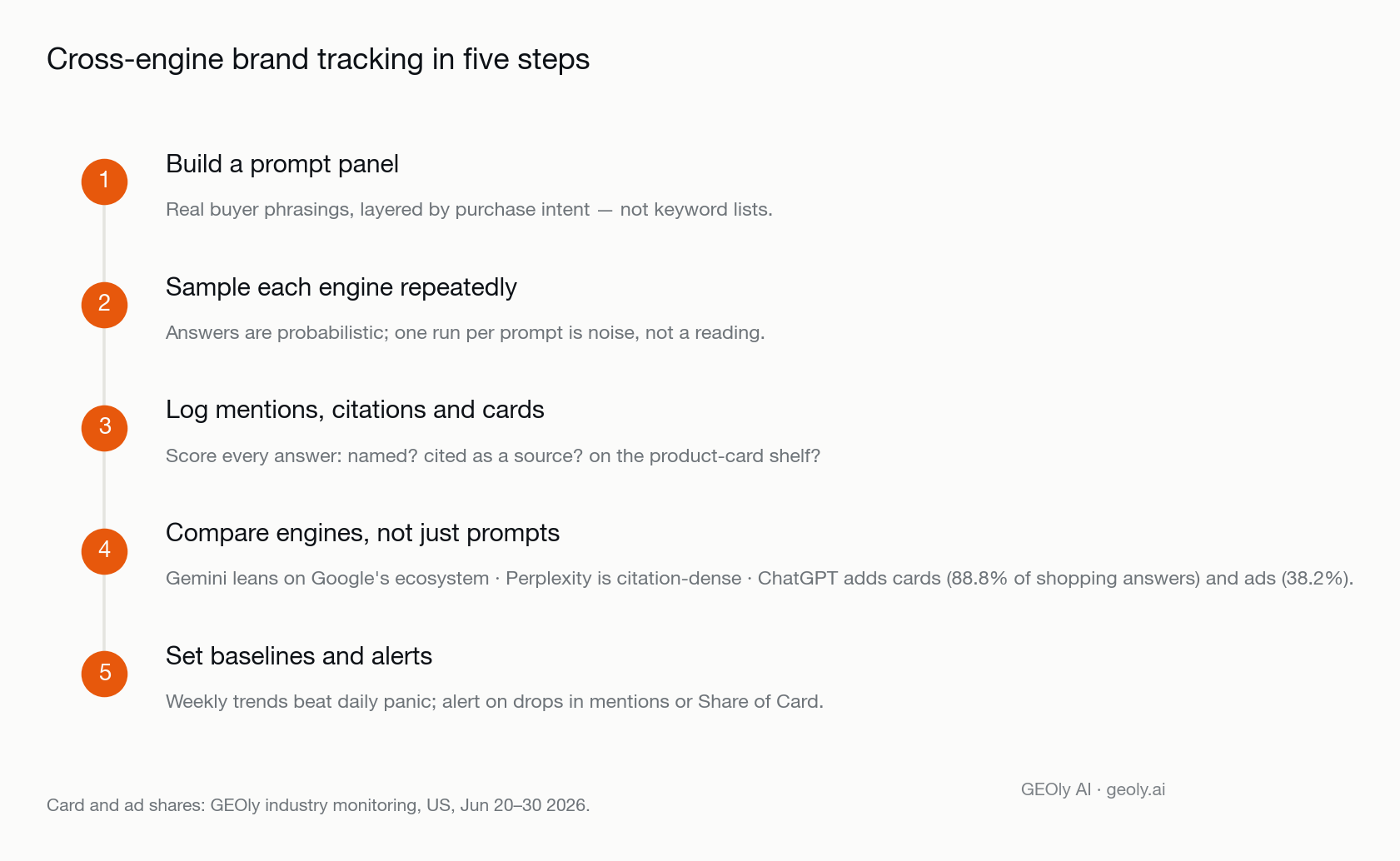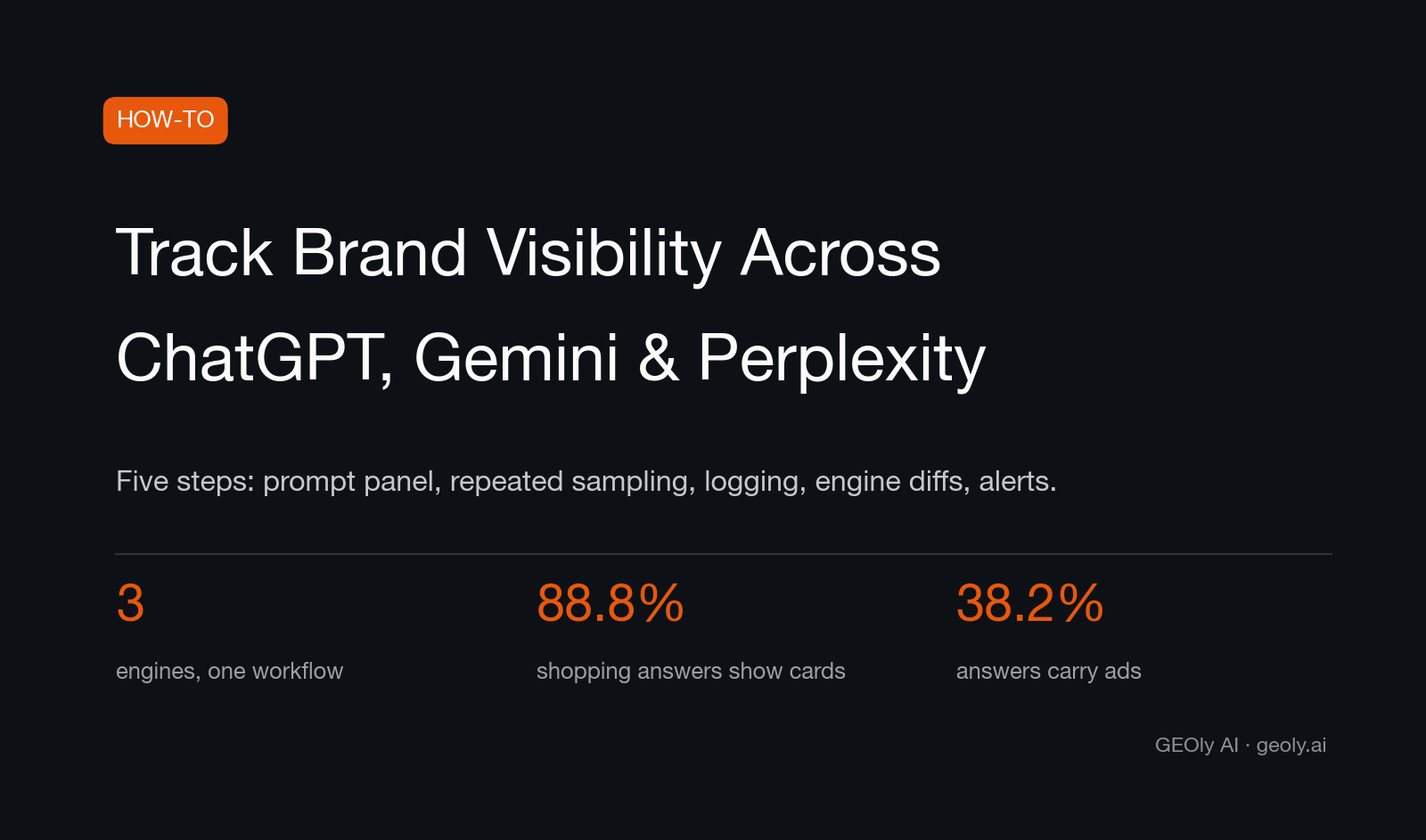
Tracking brand visibility across ChatGPT, Gemini and Perplexity comes down to five steps: build a prompt panel from real buyer language, sample each engine repeatedly, record mentions, citations and product cards as separate signals, read each engine on its own terms, then set baselines and alerts. The effort pays for itself faster than most channels — Similarweb puts ChatGPT referral conversion at 7.1%, second only to paid search at 7.8%. Here is the workflow I run for commerce brands, one step at a time.
Key takeaways
- AI answers are probabilistic. The same prompt returns different brand lists on different runs, so a one-off screenshot is an anecdote; repeated sampling over days is measurement.
- Track three signals per answer, not one: text mentions, citations of your domain, and product cards. In GEOly's US monitoring (June 20–30, 2026), 88.8% of ChatGPT shopping answers carried product cards.
- Each engine needs its own read. Gemini leans on Google's ecosystem, Perplexity is citation-dense, and ChatGPT adds a shopping shelf plus ads — 38.2% of shopping answers carried ads in June 2026.
- Absolute numbers matter less than direction and gaps. Set a baseline in week one, then alert on drops, competitor entries and disappearing cards.
Step 1: Build a prompt panel from real buyer language
Everything downstream depends on asking the questions your buyers actually ask, phrased the way they phrase them. Pull 20 to 50 prompts from support tickets, product reviews, sales calls and community threads — Reddit is worth mining specifically, since it drew 5.5M citations as the top source AI engines lean on for brand decisions.
Layer the panel by purchase intent. Category prompts ("best wireless earbuds under $100") show whether you exist in the consideration set. Comparison prompts ("Brand X vs Brand Y") show how engines frame you against rivals. Brand-direct prompts ("is Brand X any good") show what the model believes about you. Once the panel is set, freeze it. If you keep swapping prompts, your trend line measures your edits, not your visibility.
Step 2: Sample repeatedly — answers are probabilistic
Ask ChatGPT the same shopping question twice and you will often get two different brand lists. That is not a bug; generative answers are sampled, and the retrieval behind them shifts. So a single check tells you almost nothing.