このガイドでは、2026年にMedusaストアに実際に適合するGEO/AEOツールをランク付けし、選び方を説明します。ここで重要な指標はセッション数やランキングではありません。それはAIGVR(AI生成可視性率)、エンジン全体でのShare of Voice、そして特にコマースにおけるShare-of-Card、つまりAIショッピングカードで製品がどのくらい頻繁に選ばれるかです。
MedusaはAIの開発者サイドで非常に優れたポジションにあります。独自のドキュメントには「Build with AI Assistants and LLMs」ガイドが含まれており、プラットフォームのアーキテクチャとカスタマイズ性がAIアシスタントやLLM駆動のワークフローに適していると位置付けられています。モジュラーでオープンソースのコマーススタックとして、カスタムエージェントやツールレイヤーを構築するための自然な基盤となっています。そのため、LLMおよびエージェント対応力はどちらも高く評価されています。
エージェントコマースに関しては、姿勢はより慎重です。Medusaは、OpenAI commerce and agentic checkout workのような新しい標準を実装するためのオープンでヘッドレスな基盤を提供しますが、公式のACPまたはUCPネイティブサポートの発表はなく、エージェントチェックアウトの道筋はチームが設計して出荷するものとなります。言い換えれば、Medusaはロックされたプラットフォームよりも早くエージェント対応を可能にする自由を提供しますが、AIエンジンが実際に結果を読み取ることを証明する責任も負わせます。この検証のギャップこそが、GEOツールが埋めるものです。
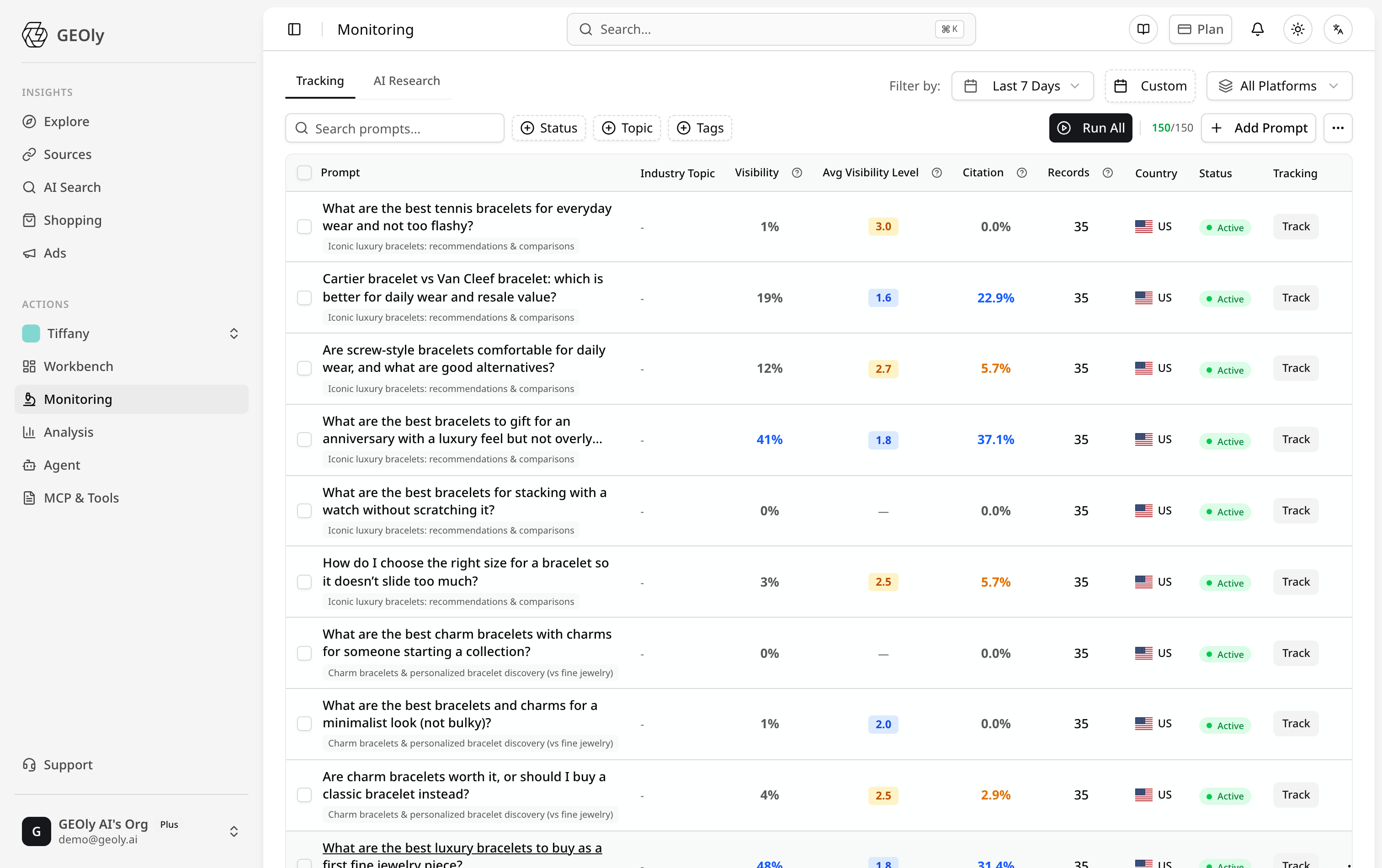
GEOly monitoring dashboard tracking brand visibility and citations across prompts and AI models — Source: app.geoly.ai
GEOly AI visibility dashboard showing AIGVR, Share of Voice and competitor ranking across ChatGPT, Gemini and Perplexity — source: app.geoly.ai
まずは「Brand Visibility Tracking: AIGVR, Share of Voice, and Share of Model per engine, so you see precisely where ChatGPT recommends a rival and Perplexity recommends you. Because a Medusa storefront is bespoke, this signal is outside-in and storefront-independent, which means your engineers get a measurable answer to "is what we shipped legible to AI" without instrumenting the frontend themselves.
The commerce depth is where it separates from the field. AI Shopping Monitoring shows which of your products land in AI shopping cards, ranked, against the buyer prompts that trigger them, so you see Share-of-Card by SKU rather than a single brand score.
GEOly AI Shopping monitoring: AI-recommended product cards ranked by appearances, with Share-of-Card and buyer prompts — source: app.geoly.ai
For a developer-led team, the delivery matters as much as the data. GEOly exposes an MCP server and an AI Agent Team, so engineers can pull citation, visibility, and Share-of-Card data through MCP and the API straight into their own dashboards, tests, and CI, rather than logging into yet another tool. The 29-point GEO Audit maps directly to the headless problem: it pinpoints which parts of your custom frontend AI engines cannot read, so a sprint gets a prioritized work list. Pair it with Query Fan-out to see the real shopper queries and Demand Themes feeding AI answers, and Competitor Analysis to benchmark Share-of-Card against the brands winning your category.
Crucially, GEOly ties AI visibility back to real orders through data connections rather than leaving you with a vanity metric, and it is timed for agentic commerce so the product feed and schema themselves get optimized as AI shopping agents roll out. GEOly tracks ChatGPT, Gemini, Google AI Mode, Perplexity, Grok, and Copilot, with Reddit and YouTube as sources. See the ecommerce brands solution and the platform overview for the full picture, and the Medusa GEO page for how it maps to a headless stack.
Strengths and best-for:
Best for: Medusa and other developer-led, headless stores that need product-level AI visibility they can wire into their own workflow.
Product and SKU-level tracking plus Share-of-Card, with MCP and API access for engineers.
A 29-point audit that flags exactly which parts of a custom frontend AI cannot read.
2. Profound
Profound is the enterprise AEO leader, tracking visibility, citations, sentiment, and Share of Voice across 10+ engines, with a Conversation Explorer for digging into how AI describes you. It is a strong, credible platform for large brands, with pricing self-serve from around $99/mo, Growth at $399, and enterprise into the $2k–5k+ range, per Profound's pricing. The limit for a Medusa store is scope: Profound tracks at the brand and domain level, so it answers "how visible is our brand" better than "which SKUs win the AI shopping card." For a custom catalog whose value is product granularity, that is the wrong altitude.
3. Peec AI
Peec AI is a modern mid-market GEO analytics tool covering visibility, average position, citation share, sentiment, and competitor benchmarking, with MCP support and unlimited users. Pricing is Starter $95, Pro $245, and Advanced $495, per Peec's pricing. Its MCP support makes it a reasonable pick for a technical marketing team that wants engine visibility without heavy setup. It is not e-commerce or product-level, though, so a Medusa store gets brand-level trends rather than the SKU and Share-of-Card view that drives merchandising.
4. Otterly.ai
Otterly.ai is the budget entry point, starting at $29 for the Lite tier, with prompt research, a brand visibility index, and citation tracking across ChatGPT, AI Overviews, Perplexity, Gemini, and Copilot, plus MCP and API access, per Otterly's pricing. For a solo developer or a small team validating whether AI search matters, it is a sensible low-cost start with the API hooks engineers like. It stays shallow on commerce, so a growing Medusa catalog will outgrow it and never get product-level or AI-shopping data from it.
Medusa GEO checklist
Server-render Product, Offer, and AggregateRating schema on every storefront route, so AI crawlers read the same data your API serves, not just the client-side render.
Ship an llms.txt and confirm key product and category routes are reachable and crawlable, including any headless app that renders separately.
Expose prices, availability, and core attributes in the rendered HTML, not only behind an API call the crawler never makes.
Standardize product attributes (material, size, use case, price) so the structured data AI agents query is complete and comparable across SKUs.
Surface reviews and ratings as structured data, since AI shopping answers lean heavily on social proof.
Wire GEOly's MCP server into your workflow so citation and Share-of-Card data lands in the dashboards and tests your engineers already use.
Run a GEO Audit to find which parts of the custom frontend AI cannot read, then fix the highest-revenue gaps first.
FAQ
Is GEOly better than Profound for Medusa stores?
For a Medusa store, yes, on fit. Profound is the stronger enterprise brand-tracking platform across the widest engine set. GEOly wins for developer-led commerce because it tracks at the product and SKU level, reports Share-of-Card, and exposes MCP and an API so engineers can wire it into their own stack. If your goal is knowing which products AI recommends, GEOly is the closer match.
Do I need a GEO tool if I built my Medusa storefront myself?
More so, not less. A custom headless frontend means AI visibility depends entirely on what you rendered, and gaps hide easily behind a storefront that looks fine to humans. An outside-in tool that reads what actually surfaces in AI answers is the only reliable way to verify your build is legible to engines.
Can I access GEOly through an API or MCP?
Yes. GEOly exposes an MCP server and API、そのため、Medusaチームは可視性、引用、Share-of-Cardデータを独自のダッシュボード、テスト、CIに取り込むことができ、別のUI内でのみ作業する必要がなくなります。
GEOlyはどのAIエンジンを追跡していますか?
GEOlyはChatGPT、Gemini、Google AI Mode、Perplexity、Grok、Copilotを追跡し、RedditやYouTubeのようなソースを使用します。カバレッジは、現在お客様が商品を推薦してもらうために利用しているエンジンを網羅しています。