Brand AI visibility is how present your brand is in what AI engines say, show and sell: text answers, the shopping shelf of product cards, and paid ad slots. It is concrete and measurable. In GEOly's US monitoring of ChatGPT shopping answers (June 20–30, 2026), 88.8% carried product cards, and 14% of brand mentions had no buyable card attached — visible in words, invisible on the shelf. Measuring it means tracking four metric layers, from mention rate up through Share of Model and citation share to Share of Card, across a fixed panel of prompts sampled repeatedly on each engine.
Key takeaways
- Brand AI visibility covers three surfaces: what engines say about you (answers), what they sell around you (product cards), and what they are paid to show (ads — 38.2% of ChatGPT shopping answers now carry them).
- Four metric layers, ordered by commercial intent: mention rate, Share of Model, citation share, Share of Card.
- Being mentioned is not being buyable: 14% of brand mentions in ChatGPT shopping answers have no product card attached.
- AI answers are probabilistic, so one-off spot checks mislead. Measure by repeat sampling on a fixed prompt panel.
- Start manual with a spreadsheet and 20 prompts; automate when the panel outgrows you. Tools run from $0 to $199+/month.
Three surfaces, not one
Most teams picture AI visibility as "does ChatGPT mention us." That was the whole game in 2024; it is a third of it now. The first surface is still the text answer — mentions, recommendations, the sentiment around them. The second is the shopping shelf: for buying-intent prompts, engines compose rows of product cards with price, reviews and a purchase path, and 88.8% of ChatGPT shopping answers include them. The third is paid: 38.2% of ChatGPT shopping answers carried ads in GEOly's June 2026 GEM sample, with 3,042 brands already actively advertising. A brand can win one surface and lose the other two without noticing, which is why measurement has to span all three — the same logic behind tracking brand mentions in AI search as an ongoing program rather than a one-time audit.
The four-layer metric stack
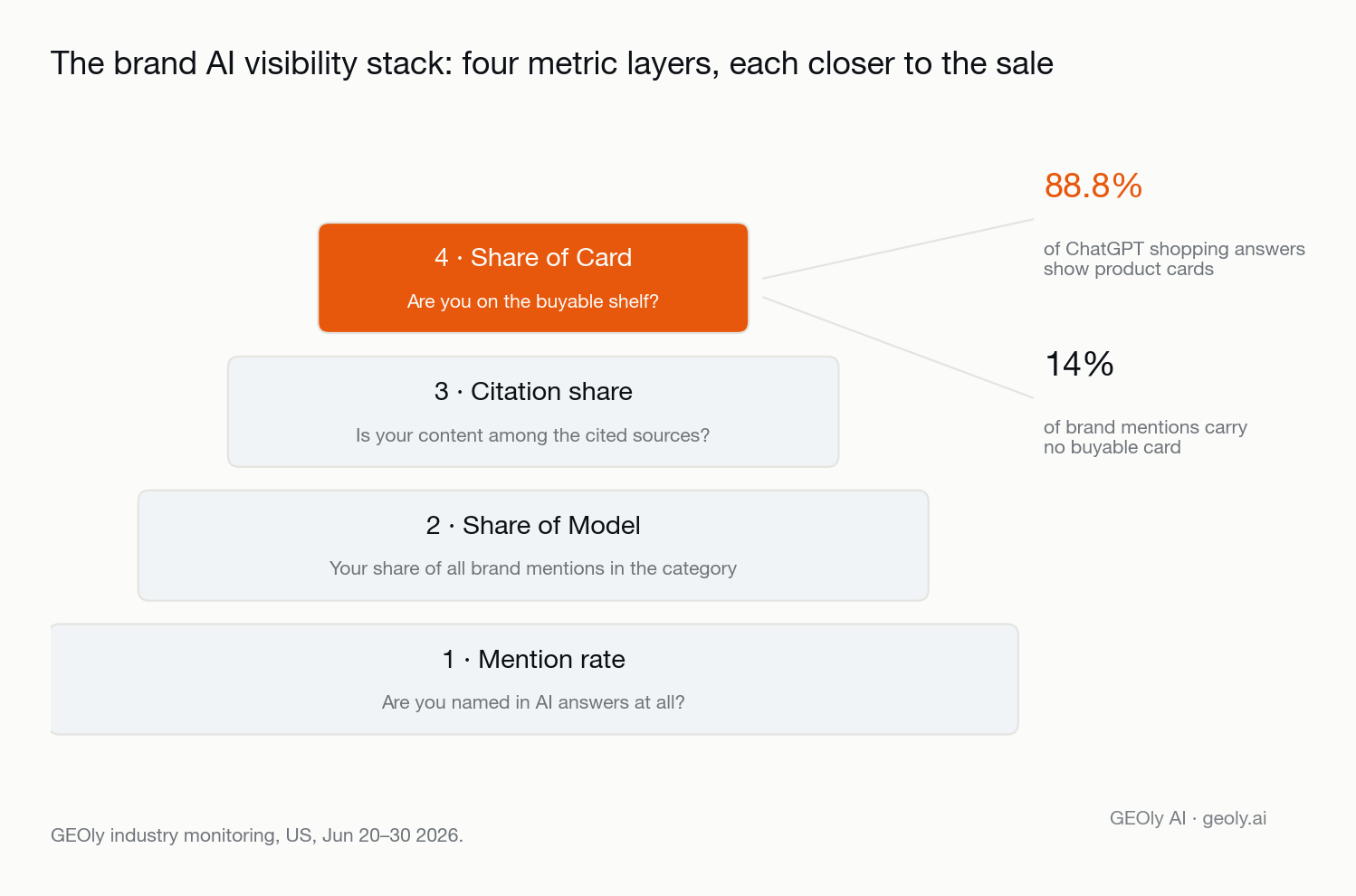
Each layer answers a different question, and each sits closer to revenue than the one below it.
Layer 1: Mention rate
The share of your tracked prompts where the brand appears at all. It is the cheapest metric to collect and the right one to start with, because a near-zero mention rate makes every other layer moot. Its limit: it says nothing about who else is in the answer.
Layer 2: Share of Model
Your mentions as a share of all brand mentions across the same prompts — visibility made competitive. Two brands can both show a 60% mention rate while one dominates every answer and the other trails in fourth position. Share of Model, cut per engine, is the KPI most teams end up reporting; our guide to AI search visibility metrics and KPIs covers how to set targets for it.
Layer 3: Citation share
Which sources the engine cited to build the answer, and how often those sources carry you. This layer explains the two above it. Citation gravity is heavily concentrated: Reddit alone draws 5.5M citations, the largest single source in AI brand-decision answers. If the engines' favorite sources never discuss you, your mention rate has a ceiling no amount of on-site optimization will lift.
Layer 4: Share of Card
The shelf layer: how often your product card appears in shopping answers versus competitors'. It is where visibility turns into transactions, and gaps here are invisible from the text layer — that 14% of mentions with no card attached is exactly this failure. Real benchmark from the audio category, June 2026: Sony leads ChatGPT's shelf at 13.5%, JBL takes 11.2%, Soundcore 10.2%, while on Google AI Mode Soundcore leads at 10.9%. The full metric is unpacked in our Share of Card explainer.
How to measure it: five steps
First, build a prompt panel. Collect 20 to 50 questions your customers actually ask, phrased their way, and tag each by intent — research, comparison, purchase. The panel is your instrument; a vague panel produces vague data.
Second, sample across engines. ChatGPT, Gemini, Perplexity and Google AI Overviews retrieve differently and cite different sources, so single-engine numbers generalize badly.
Third, repeat the sampling. The same prompt on the same engine can produce different answers an hour apart. Run each prompt multiple times per period and work with rates, not single observations.
Fourth, record all four layers per run: mentioned or not, share versus competitors, sources cited, card shown or absent. Sentiment is worth a column too — a mention that calls you overpriced is not a win.
Fifth, set a baseline and a cadence. Take your first full read as week zero, trend weekly, and alert on drops rather than admiring dashboards. Visibility that is not trended is trivia.
Tools that automate the panel
A spreadsheet carries you surprisingly far, but repeat sampling across four engines gets tedious around week three. Disclosure: GEOly is our product — GEOly is free to start and is the only tool tracking Share of Card alongside Share of Model and citation sources; honest limitation: it is not a classic SEO suite (no rankings or backlink index), so it pairs with Semrush or Ahrefs rather than replacing them. Otterly.AI automates daily prompt reruns from $29/month. The Semrush AI Visibility Toolkit at $99/month suits teams already in that suite, and Ahrefs Brand Radar models visibility from a 260M+ monthly prompt corpus at $199 per AI index. A monitoring-only shortlist lives in best AI search monitoring tools, and the GEOly AI team keeps the AI visibility tag stocked with deeper dives.
FAQ
What is a good brand AI visibility score?
Es gibt keinen universellen Maßstab — Sichtbarkeit ist relativ zu Ihrer Kategorie und Ihren Wettbewerbern. Im Audio-Bereich hält der ChatGPT-Regalführer 13,5 % Share of Card (Sony), was zeigt, wie fragmentiert selbst eine "dominante" Position ist. Das praktische Ziel: Übertreffen Sie jeden Monat Ihre eigene Basislinie und schließen Sie die Lücke zum Kategorieführer bei Ihren höchstintensiven Suchanfragen.
Wie oft sollte ich die AI-Sichtbarkeit messen?
Wöchentliche Trends sind der praktikable Standard. AI-Antworten ändern sich mit Modell-Updates und neuen Quellen, sodass monatliche Analysen Schwankungen verpassen, während tägliche manuelle Überprüfungen jedes Team ausbrennen. Automatisierte Tools nehmen tägliche Stichproben und berichten wöchentlich, was den Ausgleich darstellt, auf den sich die meisten Programme einpendeln.
Kann ich die Marken-AI-Sichtbarkeit kostenlos messen?
Ja. Ein 20-Prompt-Panel, das manuell über ChatGPT, Gemini und Perplexity ausgeführt wird, kostet nur Zeit, und die kostenlose Version von GEOly (app.geoly.ai) automatisiert die Verfolgung von Erwähnungen, Zitierungen und Karten ohne Kosten — Hinweis: GEOly ist unser Produkt. Kostenpflichtige Versionen und Tools werden wichtig, sobald Ihr Panel über das hinauswächst, was Ihre Geduld abdecken kann.
Ist AI-Sichtbarkeit dasselbe wie Share of Voice?
Sie ähneln sich, sind aber unterschiedlich. Klassisches Share of Voice misst die Präsenz in Medien oder Werbeimpressionen, die deterministisch gezählt werden können. AI-Sichtbarkeit ist probabilistisch — dieselbe Frage erzeugt unterschiedliche Antworten — und umfasst Oberflächen, die Share of Voice nie hatte, wie Zitierungsquellen und Produktkarten. Share of Model ist das nächste Äquivalent im AI-Zeitalter.
