A captured ChatGPT ad object is not an impression count. Before using an ads dataset, define what each row represents: returned advertising data, a visible card at capture time, a platform-reported event or a business outcome. The same word can hide different methods across vendors.
This GEOly AI measurement framework was reviewed on November 14, 2026. It complements how ChatGPT ads work and our existing ad intelligence vs ROI guide. The framework is an editorial recommendation, not an OpenAI billing specification.
Key Takeaways
- Store raw source terminology and an explicit definition for each evidence field.
- Separate complete observations from collection failures and unknown states.
- Use the right denominator for an observation rate and disclose the sample design.
- Reconcile campaign reporting with its attribution settings before comparing periods.
Define what each evidence type supports
Evidence | A defensible statement | What it does not establish |
|---|---|---|
An ad object in a response | Advertising data was returned by this source | That the card was visible |
A vendor rendering flag | The vendor's rendering criterion was satisfied | OpenAI's billing treatment |
A screenshot with a sponsored card | The placement appears in this captured view | Human attention or viewing duration |
A first-party campaign report | The platform reports activity under its metric definitions | A competitor's total spend |
A confirmed order | A transaction exists in the business system | That an ad caused an incremental purchase |
DataForSEO, for example, defines its is_rendered field using a visible element in the response DOM at capture time. That is a provider-specific observation rule. Keep it attached to the data rather than silently relabelling the field as a billable impression.
If a source uses “served,” ask for the documented event behind the label. A name alone does not tell an analyst whether the source observed selection, a handoff, display or acknowledgement. Preserve the original record when mapping it into your own reporting categories.
Build an observation ledger
GEOly recommends one record per collection attempt, with a stable identifier and links to its artifacts. Record the timestamp and timezone, platform surface, question sequence, geography if known, collection success, returned ad data, rendering evidence and the capture's scope.
Keep unknown values explicit. “No ad observed in a complete capture” differs from “capture did not complete.” Neither should become a claim about the entire advertising market. Where the user account or eligibility conditions are unavailable, state that limitation instead of filling in a likely value.
Retain changes to your collection method. A larger viewport, longer collection window or different vendor can change what you observe. If the method changes between reporting periods, label the break before presenting a trend.
An example with an honest denominator
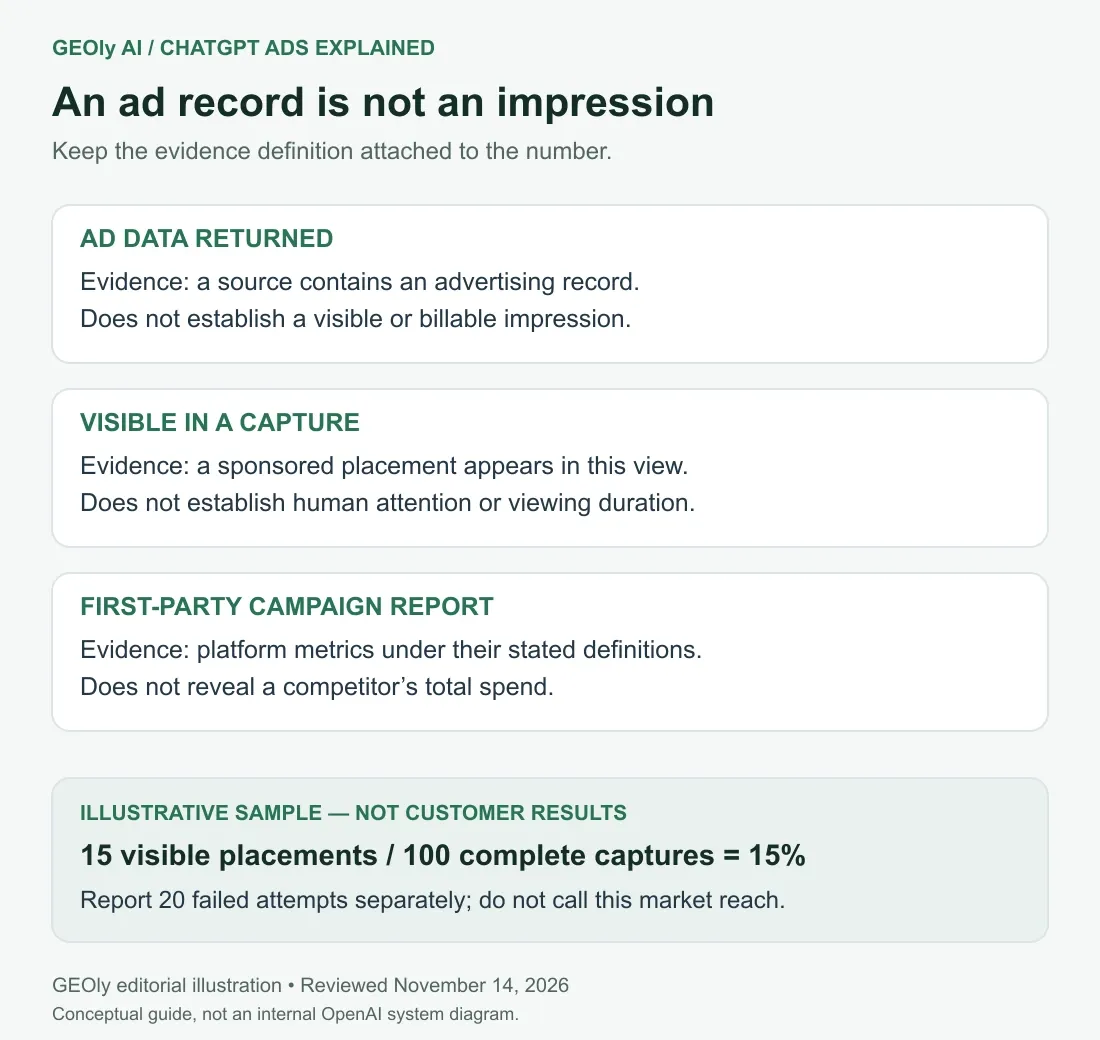
Consider an illustrative dataset, not GEOly customer results: a team schedules 120 collection attempts. Twenty fail to produce usable captures. Of the 100 completed observations, 15 contain a visibly captured sponsored placement; another 10 contain advertising data without confirmed rendering.
The observed visible-placement rate is 15 divided by 100, or 15%, for completed observations under this collection method. The collection completion rate is 100 divided by 120, or about 83.3%. Report both.
Do not report 25 impressions by adding the 15 confirmed views and 10 unconfirmed records. Do not use 120 as the denominator while implying every attempt was observable. Do not extrapolate the 15% sample rate to all ChatGPT users without a sampling basis.
Define the unit as well: per turn, per conversation or per completed capture. If a capture contains multiple turns, a per-capture rate cannot be casually compared with a per-turn rate. Avoid summing advertiser presence percentages as though every observation were mutually exclusive unless your design makes that true.
Reconcile platform reporting separately
OpenAI's reporting documentation currently describes default attribution of 30-day click and 1-day view using ad-event time when those settings are omitted. It distinguishes goal conversions from other attributed events and warns that conversion results can update after daily processing. Match date range, time basis and windows when comparing reports.
Save those settings with each export. A graph should not mix two attribution definitions without a visible note. Where a business asks for profitable growth, add its own order quality, cancellations, refunds and margin analysis. Attributed revenue is not automatically incremental revenue or profit.
OpenAI's conversion-tracking guide also distinguishes receiving an event from configuring it as a campaign conversion. Browser and server copies of the same event need coordinated identifiers for deduplication. Validate instrumentation before interpreting a sudden rise as business growth.
Use observations to choose a test
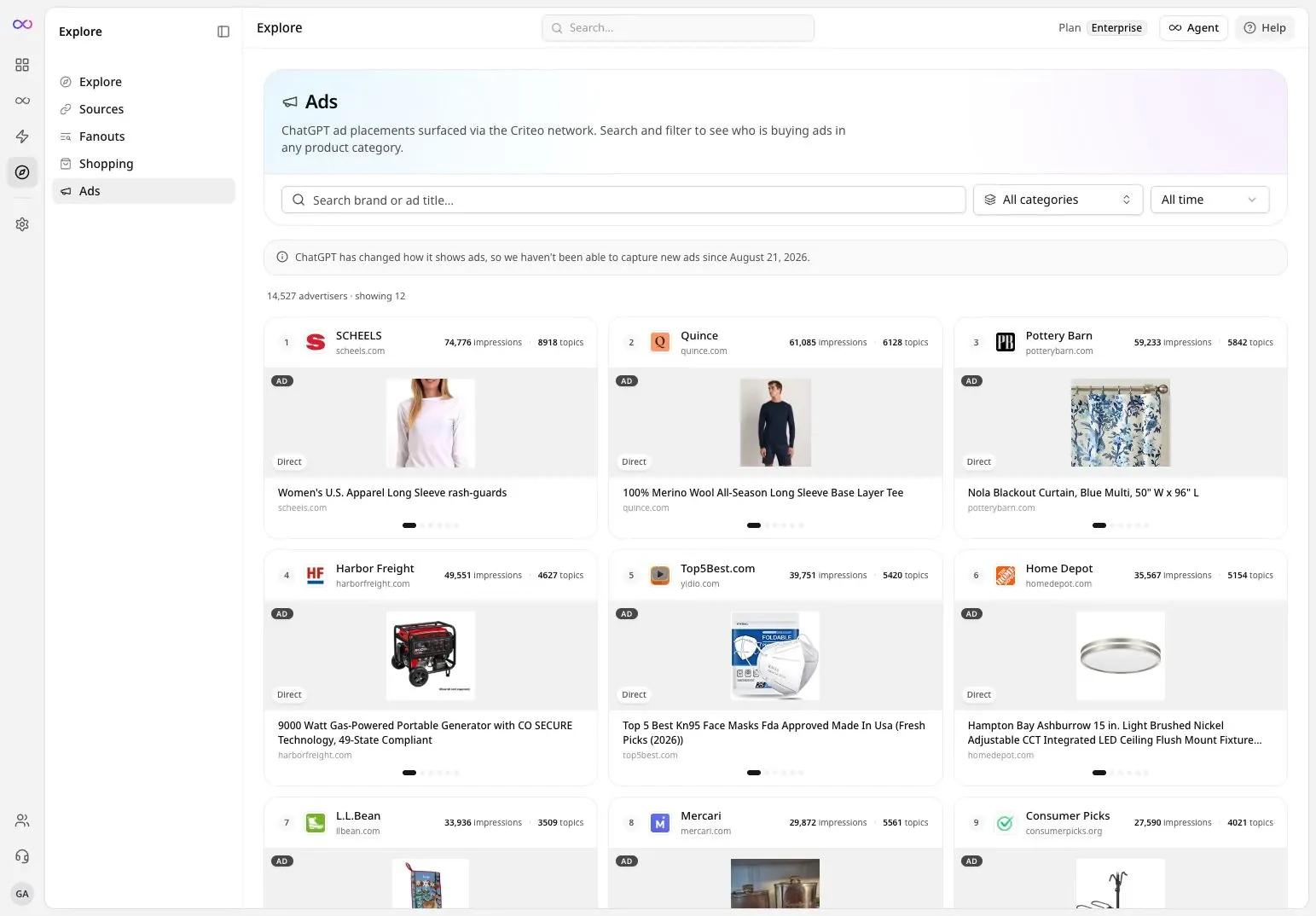
An observed competitor creative can suggest a message worth reviewing. Its destination can reveal how that advertiser presents a product. Neither proves that the campaign is profitable. Use the sample to write a hypothesis, then evaluate your own campaign with your own cost and outcome data.
The GEOly Ads Library supports research into observed placements. Pair that research with a first-party reporting workflow and keep organic visibility in a separate section. The Ads vs GEO guide describes that division of responsibilities.
Frequently asked questions
Does a screenshot prove someone saw the ad?
It proves what is visible in the captured view. It does not demonstrate a person's attention, viewing duration or the platform's billing decision.
How should we label missing data?
Use separate values for a completed observation without a visible ad, unconfirmed rendering and collection failure. Publish the definitions alongside the report.
What if our capture and screenshot disagree?
Keep both artifacts and investigate the same session and turn. Follow the missing-ads diagnostic guide before assigning a cause.
Written by the GEOly AI editorial team. Return to the series overview or browse ChatGPT Ads research.