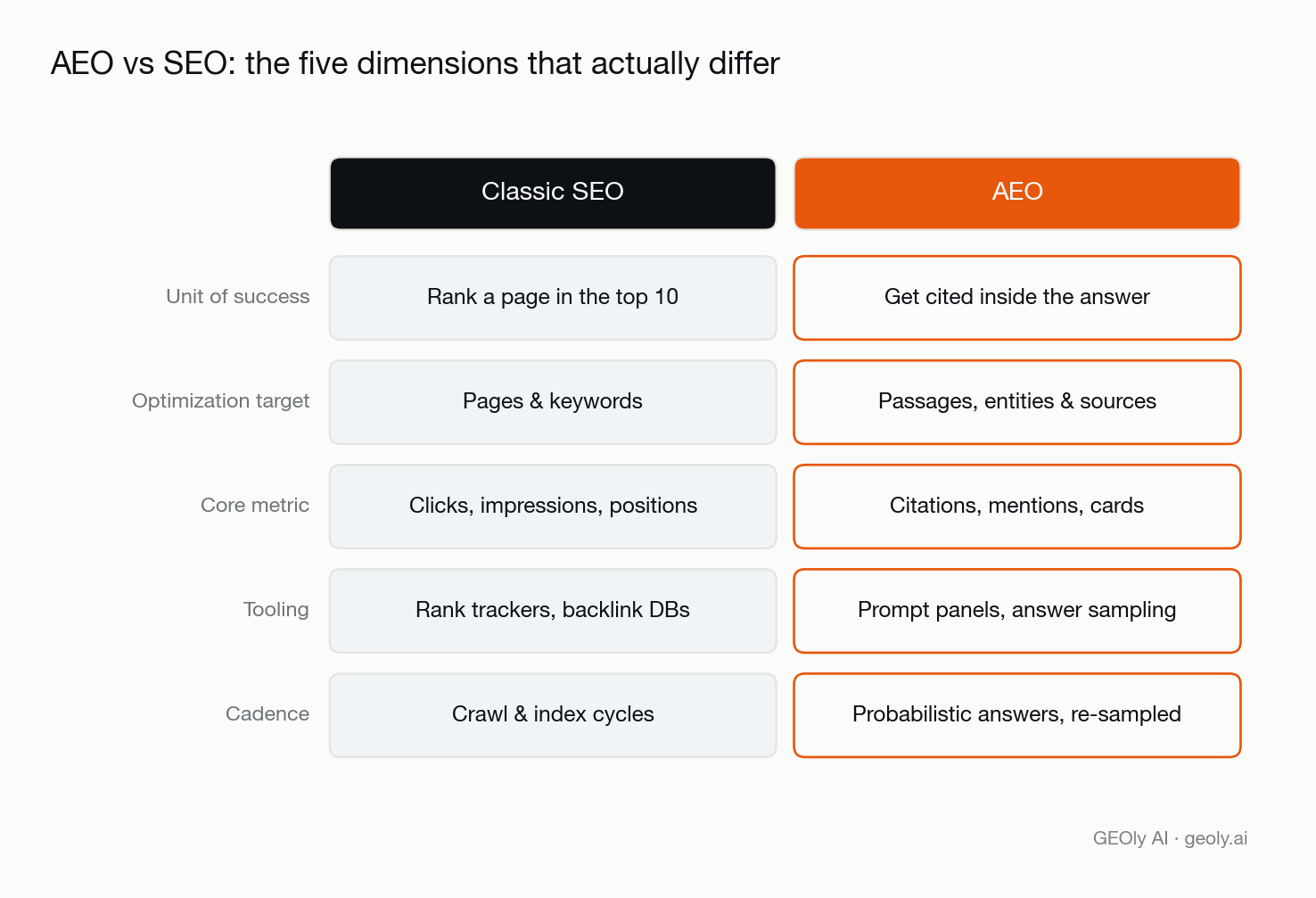
AEO — answer engine optimization — is the practice of structuring content so that answer engines like ChatGPT, Perplexity and Google AI Overviews quote it as the answer, instead of listing it as a link someone might click. It differs from SEO on five dimensions: what you win (a citation, not a ranking), what carries the win (a passage or entity, not a page), how you measure (mentions and citations, not clicks), the tooling, and the cadence. The stakes are already commercial: ChatGPT referral traffic converts at 7.1%, just behind paid search at 7.8%, per Similarweb.
Key takeaways
- AEO optimizes for being quoted inside an AI-generated answer; SEO optimizes for ranking in a list of links. Same web, different scoreboard.
- The unit of AEO success is the citation — Jake Ward's framing is get cited, not clicked — and citations concentrate hard: Reddit alone draws 5.5M, the top source in AI brand-decision answers.
- Engines lift passages and entities, not pages. A 3,000-word post with the answer buried in paragraph twelve loses to a page that states it in two clean sentences.
- Measurement flips from deterministic to probabilistic: rank positions are checkable once a day; AI answers must be sampled repeatedly because they change between runs.
- AEO does not replace SEO. Engines still retrieve web pages, so crawlability and authority remain the raw material — you add a layer, you don't swap one.
What AEO means
The name says it plainly: answer engines are systems that respond to a question with a composed answer rather than a ranked list. When Perplexity answers "is a standing desk worth it," it writes three paragraphs, cites five sources, and most users never click any of them. AEO is the discipline of making your content one of those five sources — and of making sure that when the engine names brands, yours is named accurately and favorably.
That reframes the job. SEO asks "how do we rank for this keyword?" AEO asks "when the engine assembles an answer to this question, what would it need from us to include us?" Usually the honest answer is: a directly quotable statement, structured data around it, and third-party corroboration on the sources the engine already trusts.