7つのKPI—言及率、Share of Model、引用元、回答位置、感情、Share of Card、AIリファラートラフィック—は、AI検索で測定すべきすべてを網羅しており、ほとんどのチームはそのうち3つだけで始めることができます。
2026/07/05
8 分で読む
更新日 2026/07/13
AI search visibility metrics fall into three layers: presence (does the AI mention you), quality (are you cited, how early, and how accurately), and business impact (do you show up on the shopping shelf, and does any of it turn into traffic and revenue). Seven KPIs cover those layers — mention rate, Share of Model, citation rate and citation sources, average answer position, sentiment and accuracy, Share of Card, and AI referral traffic. If you can only measure three, start with mention rate on a fixed prompt set, your category's top citation sources, and one named competitor's numbers next to yours.
Key takeaways
Seven metrics cover AI search measurement end to end: AI visibility rate (mention rate), Share of Model, citation rate and citation sources, average answer position, sentiment and accuracy, Share of Card, and AI referral traffic.
Share of Model is the closest thing AI search has to market share: your percentage of all brand mentions in AI answers across a fixed prompt set, versus competitors.
Citation sources are the highest-leverage leading indicator. AI engines pull from a small, identifiable set of domains per category, and you can systematically earn presence on that list.
AI-referred traffic to US retail sites grew 138% year over year as of May 2026, per Adobe — the channel now carries real money, so lagging revenue KPIs belong on the board too.
Universal benchmarks ("a good mention rate is X%") are mostly noise in 2026. Benchmark against named competitors in your own category instead.
Why AI search needs its own scoreboard
The audience moved first. ChatGPT passed 800 million weekly users in October 2025, and Google's AI Overviews reach more than 2 billion people a month. None of that activity shows up in a rank tracker, because there is nothing to rank: an AI engine synthesizes one answer, attaches a handful of citations, and — for shopping queries — renders a shelf of product cards. Three different surfaces, three different measurement problems.
There is a second, less obvious reason: variance. Ask ChatGPT the same question five times and you can get five differently worded answers with different brands in them. Sound measurement has to be sampled and probabilistic. You run a fixed prompt set repeatedly, on a schedule, and report rates and trends — not a binary "we show up" checked once in a browser tab.
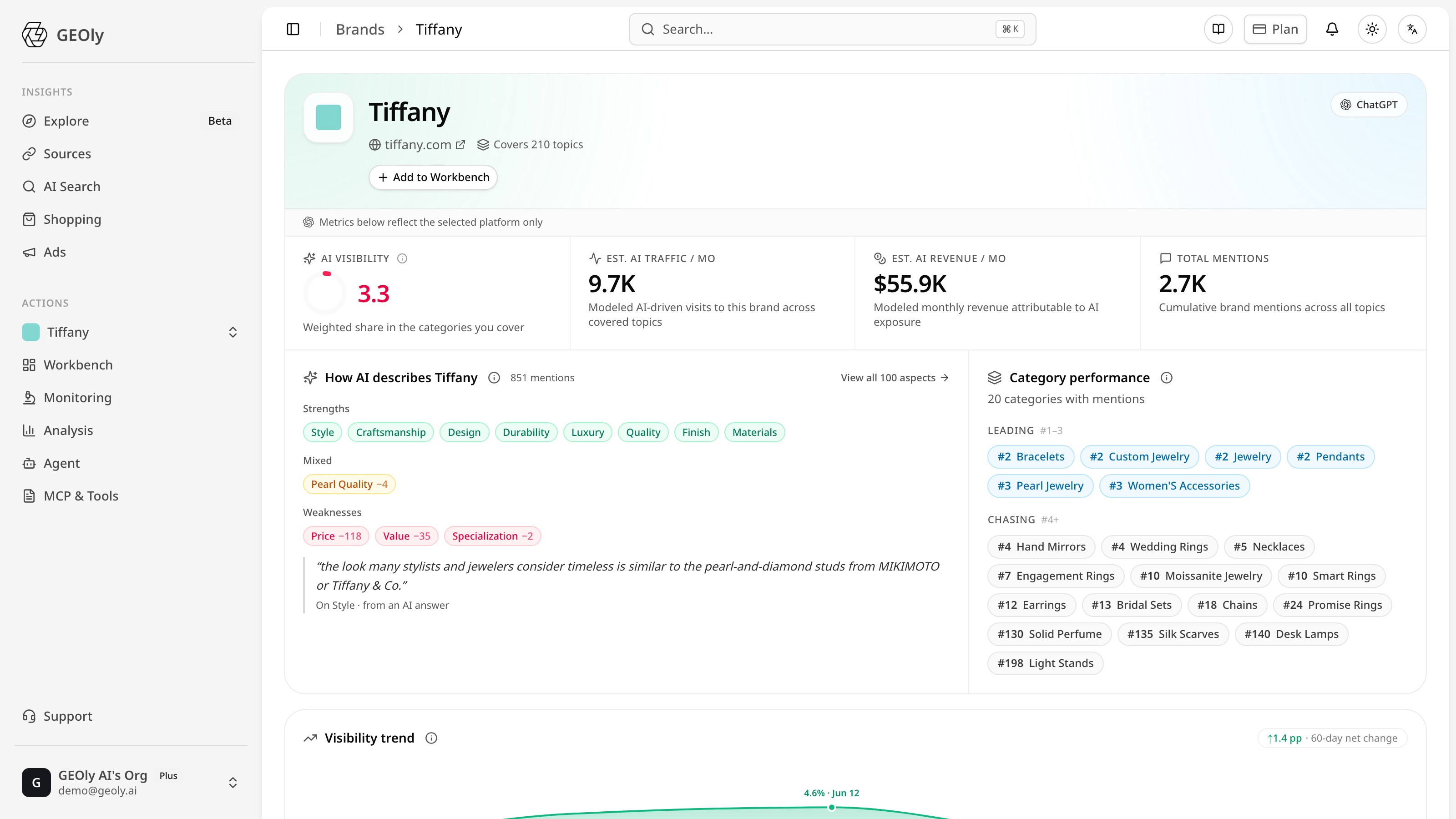
A brand's AI visibility scoreboard in GEOly Explore: AI visibility score, estimated monthly AI traffic and AI revenue, total mentions, and how AI describes the brand — Source: GEOly AI (app.geoly.ai)
The percentage of tracked prompts where your brand appears anywhere in the AI answer. This is the foundation metric — every other KPI in this guide is computed on top of the same prompt runs.
Three decisions make it meaningful. First, the prompt set: 50–200 buyer-intent prompts, phrased the way customers actually ask ("best cordless vacuum for pet hair under $300"), not the way you write keywords. Second, fan-out coverage: engines like Gemini and ChatGPT quietly decompose one prompt into several sub-queries, and you can be invisible in exactly the sub-query that decides the answer. Third, per-engine splits: your mention rate on Perplexity says nothing about Gemini. For the mechanics, see our guide to tracking brand mentions in AI search.
2. Share of Model
Your share of all brand mentions across your tracked prompt set, versus competitors — share of voice, rebuilt for AI answers. If engines mention brands 1,000 times across your category prompts and 180 of those mentions are yours, your Share of Model is 18%.
This is the KPI for the monthly deck, because it self-corrects for two problems that plague raw mention rate: category-wide swings (a model update that names more brands lifts everyone) and false comfort (your mention rate climbs while a competitor's climbs faster). Movement in Share of Model is almost always real signal.
Share of Model in practice: a competitive peers battleboard comparing visibility scores and topic-level wins across Cartier, Mejuri, Blue Nile and other jewelry brands — Source: GEOly AI (app.geoly.ai)
3. Citation rate and citation sources
Two related numbers. Citation rate: how often your own domain appears as a linked source in AI answers. Citation source analysis: which third-party domains — Reddit threads, review sites, publishers, YouTube — the engines cite when answering your category's prompts.
The second is the more actionable of the pair. As Jake Ward argues, the goal in AI search is to get cited, not clicked: if the engines answering your buyers' questions consistently cite five review sites and two Reddit communities, that list is your earned-media roadmap. Citation source share is the best leading indicator in the whole stack, because it is the one you can directly influence this quarter.
4. Average answer position
Where you appear within the answer — first brand named, third, or a footnote. First position carries outsized weight: in voice interfaces and agent workflows, the first recommendation is often the only one acted on.
One caveat: position is noisier than mention rate, because answer structure changes run to run. Track it as a rolling average over dozens of runs, and treat single-week jumps with suspicion.
5. Sentiment and accuracy of AI descriptions
What the AI actually says about you when it mentions you. Two components: sentiment (recommended enthusiastically, listed neutrally, or flagged with caveats) and factual accuracy (does it state your current pricing, features and positioning, or a hallucinated 2023 version of them?).
Treat this as a QA metric: percentage of mentions containing a factual error, plus a sentiment trend. A brand that is mentioned often but described wrongly has a different problem — and a different fix — than a brand that is not mentioned at all.
6. Share of Card (AI shopping shelf presence)
商業ブランドにとって、棚は利益の源です。ChatGPT ShoppingやGoogle AI Modeは、単に製品について記述するだけでなく、エージェントが操作可能な製品カード(画像、価格、販売者)を生成します。Share of Cardは、関連するショッピングプロンプトで製品がその棚に表示される割合を示します。これはテキストでの言及とは異なり、フィードの品質、構造化データ、販売者の記録に依存し、コンテンツだけでは決まりません。Share of Card指標とその詳細な内訳、AI棚で勝つためのプレイブック.
Share of Card metrics for one brand: AI-recommended products, share of shopping, distinct products and top channels on the AI shopping shelf — Source: GEOly AI (app.geoly.ai)
Industry-level AI search data for the US jewelry category: 41 topics, 1,551 tracked brands, monthly AI traffic and estimated AI revenue, plus the competitive landscape ranked by Share of Model — Source: GEOly AI (app.geoly.ai)
確立されたSEOまたはコンテンツチーム:競合セット全体でのShare of Model、月次の感情と正確性の監査、平均回答位置、GA4でのAIリファラーチャネルグループを追加します。この段階では、GEOが「オーガニック」に隠れるのではなく、レポート内で独自の行を持つようになります。
商業ブランド、またはすでに良いランキングを持つブランド:Share of Card、エンジンごとの内訳(GeminiはChatGPTとは非常に異なる動作をします)、ファンアウトクエリカバレッジ、AIリファラーに対する収益帰属を追加します。この段階では、興味深い質問は棚に関するものです。
これを計測する方法
正直な選択肢は3つです。スプレッドシートと手動プロンプトは1週間は機能しますが、その後崩壊します—サンプリングなし、ファンアウト可視性なし、一貫したスコアリングなし。SemrushやAhrefsのような一般的なSEOスイートは現在AI可視性モジュールを提供しており、すでに支払っている場合は便利ですが、ショッピング棚のカバレッジは薄いです。専用のGEOプラットフォームはスタック全体を継続的に追跡します。開示:GEOlyは私たちの製品で、無料で開始でき、上記の7つの指標すべてをカバーしています(一般的なツールではほとんどカバーされていないShare of Cardを含む)。この分野の公平な比較については、最高のAI検索モニタリングツール.
FAQ
AI検索で追跡すべきKPIは何ですか?
7つを追跡してください:AI可視性率(言及率)、Share of Model、引用率と引用元、平均回答位置、AI説明の感情と正確性、製品を販売している場合はShare of Card、AIリファラルトラフィック。ゼロから始める場合、3つで十分です:言及率、引用元、1つの競合ベンチマーク。
AI検索可視性をどのように測定しますか?
固定された50〜200の購入意図プロンプトセットを定義し、それを重要なエンジン(ChatGPT、Gemini、Perplexity、Google AI Overviews)でスケジュールに従って実行し、ブランドが言及されているか、引用されているか、どの位置にあるか、どのような感情であるかを記録します。AI回答は実行ごとに変動するため、一度きりのチェックではなく、多くの実行にわたる率を報告してください。GEOlyのようなプラットフォームはサンプリングとスコアリングを自動化します。
Share of Modelとは何ですか?
Share of Modelは、追跡されたプロンプトセット全体でAI回答におけるブランド言及の割合を示します—AI検索におけるシェアオブボイスのようなものです。エンジンがカテゴリーのプロンプト全体でブランドを1,000回言及し、そのうち180回が自社の言及である場合、Share of Modelは18%です。これにより、カテゴリー全体の変動が正規化され、競争ポジションを示す最良の単一KPIとなります。
AI検索におけるキーワードランキングの同等物はありますか?
最も近い同等物は平均回答位置です—ブランドが合成された回答や推奨リスト内でどの位置に表示されるかを示します。SERPランクよりもノイズが多いため、ローリング平均として扱い、主要な存在感指標として言及率とShare of Modelに依存してください。