Help ecommerce operations teams turn product data into AI-ready recommendation inventory
If products are not entering AI recommendations, the problem usually lives in the product data layer. GEOly helps operations teams see which attributes, schema, pricing, availability, proof, and shopping prompts are blocking product inclusion before traffic or conversions drop.
Which running shoes under $150 are best for long-distance beginners?
AI shopping systems usually need clean attributes, price and availability signals, trustworthy review proof, and crawlable product context before a SKU can enter the recommendation set with confidence.
Materials, fit, and use-case fields are missing on many SKUs.
Offer and availability values are updating consistently.
Ratings exist, but comparison-ready review summaries are limited.
The product is visible in text mentions but not in shopping-card style answers.
Products do not enter AI recommendations because the catalog is not legible enough for shopping answers
AI shopping recommendations are closer to structured buying comparisons than classic search results. If your catalog is thin, inconsistent, or missing proof, the product might still rank on the web while failing to make the recommendation layer.
AI needs product facts, not only product copy
Titles and marketing descriptions help, but recommendation systems also depend on attributes, variants, sizes, materials, pricing, stock signals, and use-case clarity.
Operations issues often look invisible from traffic reports alone
A SKU can disappear from AI shopping results because of stale availability, thin schema, weak review coverage, or missing comparison context long before the team sees the impact in revenue dashboards.
Most teams still fix product visibility one page at a time
The real problem usually spans the feed, the PDP, structured data, merchant signals, review layers, and the shopping prompts that trigger recommendations.
The optimization target is the product data model AI actually reads
This page is not about generic SEO hygiene. It is about making product entities easier to compare, trust, and recommend inside AI-led shopping journeys.
Entity clarity
Make the product unambiguous through title structure, attributes, variants, dimensions, materials, and intended use cases.
Offer reliability
Keep price, availability, shipping, returns, and merchant policy signals accurate enough that AI can trust the product is buyable.
Proof density
Turn ratings, reviews, FAQs, comparisons, and third-party references into a stronger evidence layer for recommendation answers.
Prompt fit
Map products to the shopping questions buyers actually ask so the catalog aligns with scenario, budget, and comparison prompts.
Operations teams need an optimization board, not just a generic dashboard
The practical question is simple: which products are missing from AI shopping answers, and which part of the product data stack is causing it?
Missing attribute board
Surface which SKUs still lack attributes AI depends on to compare options, such as fit, material, size, compatibility, or use-case.
Offer quality board
Review whether price, stock, shipping, and return signals are current enough to support recommendation confidence.
Proof board
Identify products with weak FAQ, review summaries, or comparison context that make them harder for AI to cite and shortlist.
Shopping board
See which prompts generate shopping cards, which products appear, and where text mentions still fail to convert into higher-intent recommendation surfaces.
From product-data cleanup to recommendation lift
This workflow fits ecommerce operations teams that need a practical sequence: connect catalog data, diagnose what is thin, repair what blocks inclusion, then monitor shopping surfaces over time.
Connect the product universe
Start from titles, variants, attributes, pricing, availability, review signals, and the prompts buyers use to ask for recommendations.
Find the blocked recommendation set
Identify the SKUs, categories, and shopping prompts where products are absent, buried, or only mentioned in low-intent text answers.
Repair the product data layer
Prioritize missing attributes, thin schema, weak FAQ, shallow proof, and merchant-policy gaps that make the product hard to trust or compare.
Track prompt-to-shopping movement
Monitor how products move from plain mentions into shopping cards, richer answer modules, and recommendation shortlists over time.
Understand which individual products are blocked and why, instead of only reading brand-level summaries.
Convert missing fields, schema gaps, proof issues, and prompt mismatches into one prioritized operations queue.
Measure whether fixes improve recommendation-style exposure instead of only increasing plain-text mentions.
The AI shelf, SKU by SKU
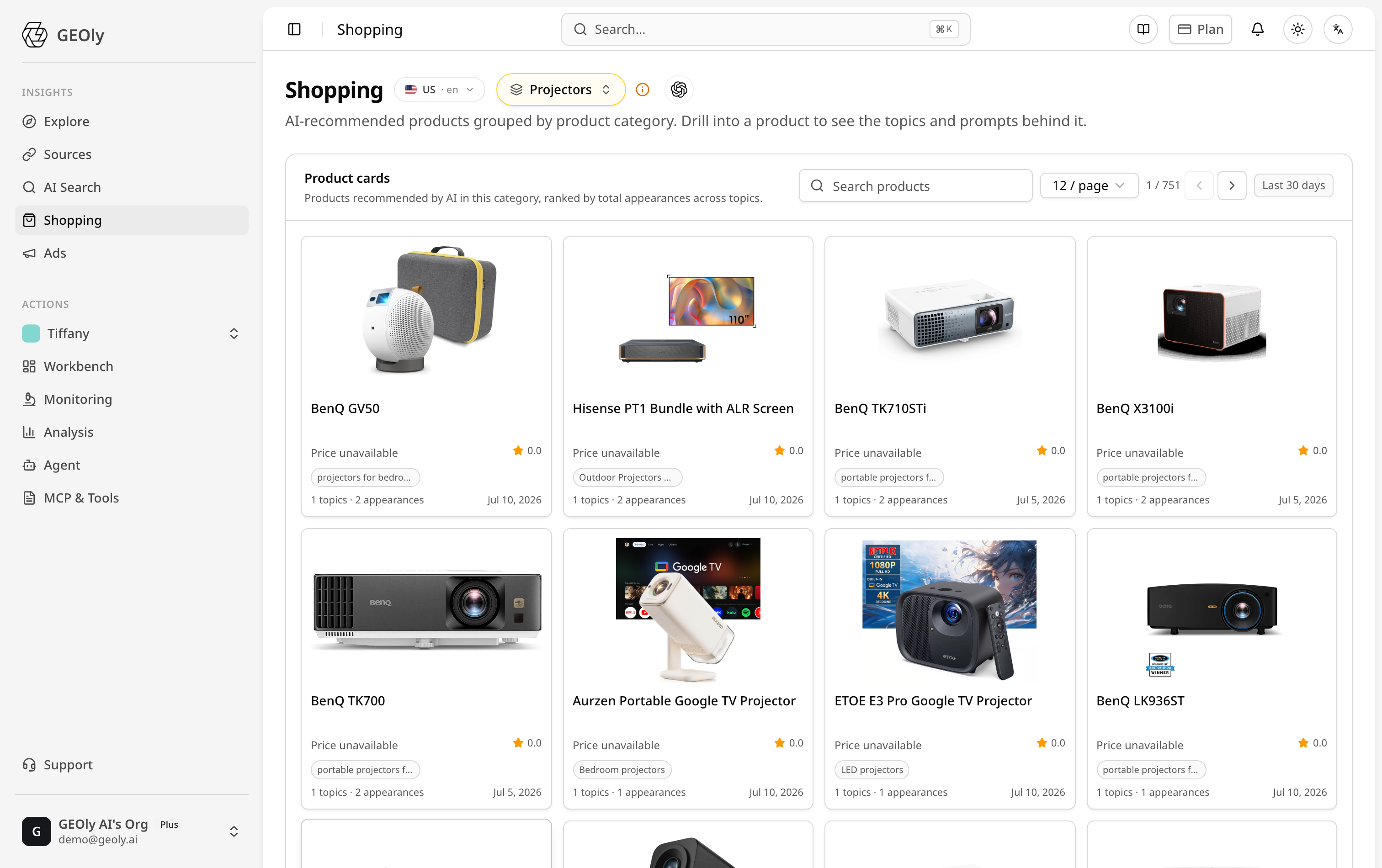
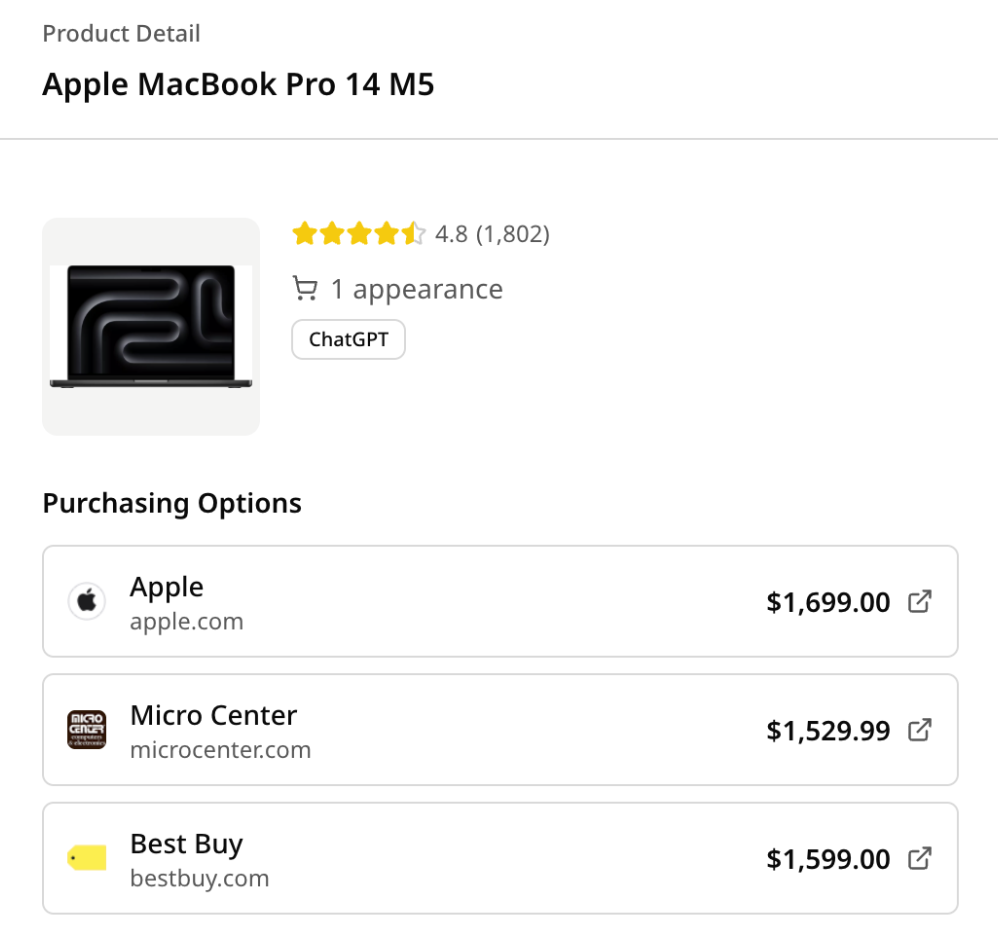
AI shopping answers are assembled from product cards. GEOly monitors which of your SKUs get a card, at what price, from which seller—and flags the "recommended, but no official buy option" gaps where the sale leaks to a reseller.
Shopping Rate per query
See which buying questions trigger a shopping panel, which products fill it, and how often your catalog shows up versus the category leader.
Official-store availability
AI shelf channels show where the buy option points—official store, retailer, or marketplace—and list every product recommended without an official buy option.
The paid shelf, included
The ChatGPT Ads Library (360k+ ad cards, 5,000+ advertisers) shows who is buying the shelf you are trying to earn organically.
Adjacent plays for commerce teams
Product-card optimization compounds with the category shelf view and brand-level tracking.
GEOly capabilities behind this solution
AI shopping optimization sits on top of shopping visibility data, product diagnostics, and recommendation-focused prompt monitoring.
AI Shopping Monitoring
Track product appearances, shopping-card prevalence, and recommendation context across AI surfaces.
ExploreGEO Audit
Find schema, crawl, page-structure, and evidence gaps that make products harder for AI systems to parse.
ExploreCompetitor Analysis
Compare which rival products keep winning recommendation share and what proof signals they carry.
ExploreBrand Visibility Tracking
Connect product-level recommendation issues back to broader brand presence and prompt movement.
ExploreFrequently asked questions about this solution
Turn product data cleanup into recommendation lift, not just catalog maintenance
If products are still missing from AI shopping journeys, the next step is to make the catalog easier to compare, trust, and retrieve. Start by tracking shopping outcomes, then repair the product data layer behind them.