Keep tracking where AI mentions your brand, and why it suddenly stops
This is not just a visibility score page. It is a working path for monitoring brand mentions, answer placement, citation sources, competitor overlap, and unusual movement so teams can understand whether AI still mentions the brand, what is supporting that mention, and where change started.
What are the best luggage brands for frequent business travelers?
A brand can still be mentioned while only appearing reliably in certain prompts, on certain platforms, or behind weak citations. The real goal is not just to catch a few mentions, but to measure mention share, answer placement, supporting sources, and whether competitors are replacing you.
The brand appears in some commercial comparison prompts, but its answer position is unstable.
The brand can appear in category-style questions, but the citation set is still too scattered.
Third-party reviews and community references are too thin, making competitor replacement easier.
High-intent recommendation questions still need a stable benchmark and monitoring history.
Most teams know AI matters, but still do not know how to monitor brand mentions properly
The hard part is not taking an occasional screenshot of an AI answer. The hard part is knowing which questions still mention you, on which platforms, why that changed, and whether the cause is content coverage, source quality, or stronger competitor coverage.
Mentions drop, but no one knows which prompt set dropped first
Many teams only see traffic movement at the reporting layer. They cannot tell which questions, comparison contexts, or platforms were the first to remove them from the answer.
Being mentioned is not the same as being preferred
A brand can appear in the answer while still sitting too low, backed by weak citations, or described vaguely enough that competitors hold the stronger buying position.
Teams need a diagnostic path, not more screenshots
Brand mention shifts need to be broken down across platform behavior, prompt sets, site pages, third-party sources, and competitor coverage, otherwise they do not turn into action.
First break brand mentions into a monitoring map the team can actually operate
Brand mention monitoring should cover the question set, platform differences, evidence sources, and competitor relationships at the same time. That is how teams tell whether they are simply missing from answers or being mentioned without trust.
Prompt set
Build a stable monitoring set across branded, category, comparison, use-case, and high-intent buying questions.
Platform coverage
Keep separate baselines for ChatGPT, Gemini, Perplexity, and Google AI instead of flattening them into one blended score.
Citation and evidence layer
Monitor whether owned pages, media reviews, communities, and third-party lists are supporting the current mention pattern.
Competitor overlap
Track who appears beside you and which brands are more consistently preferred in the same prompt set.
Useful monitoring is not a score. It is a set of views that explain movement
Brand, growth, and PR teams usually look at the same problem from different angles. A strong mention-monitoring page should answer trend, cause, source quality, and competitor pressure at the same time.
Track mention share by platform, prompt set, and time window to locate where movement began.
Break visibility drops into individual prompts, answer content, and supporting citations to separate coverage problems from evidence problems.
See whether AI relies on site pages, media, forums, or reviews when it mentions the brand, and whether that source mix is too weak.
Identify which competitors are mentioned more consistently in the same question set and which comparison prompts are already being lost.
Turn brand mention tracking into a repeatable operating workflow
This path works for teams that already know the exact job they need done: define the monitoring set, build the mention baseline, diagnose the cause, and route fixes back to content, SEO, PR, and growth owners.
Define the monitoring question set
Group branded, category, comparison, scenario, and high-intent buying prompts into a set the team can track continuously.
Build a platform-level mention baseline
Measure whether the brand is mentioned, where it appears, and which competitors co-appear across each major AI platform.
Diagnose the cause of loss or replacement
Decide whether the issue comes from prompt coverage, thin owned content, weak third-party proof, or stronger competitor coverage.
Route the fix back to execution teams
Send the issue to content, SEO, PR, brand, or merchandising owners, then use the next monitoring cycle to confirm recovery.
What daily mention tracking actually looks like
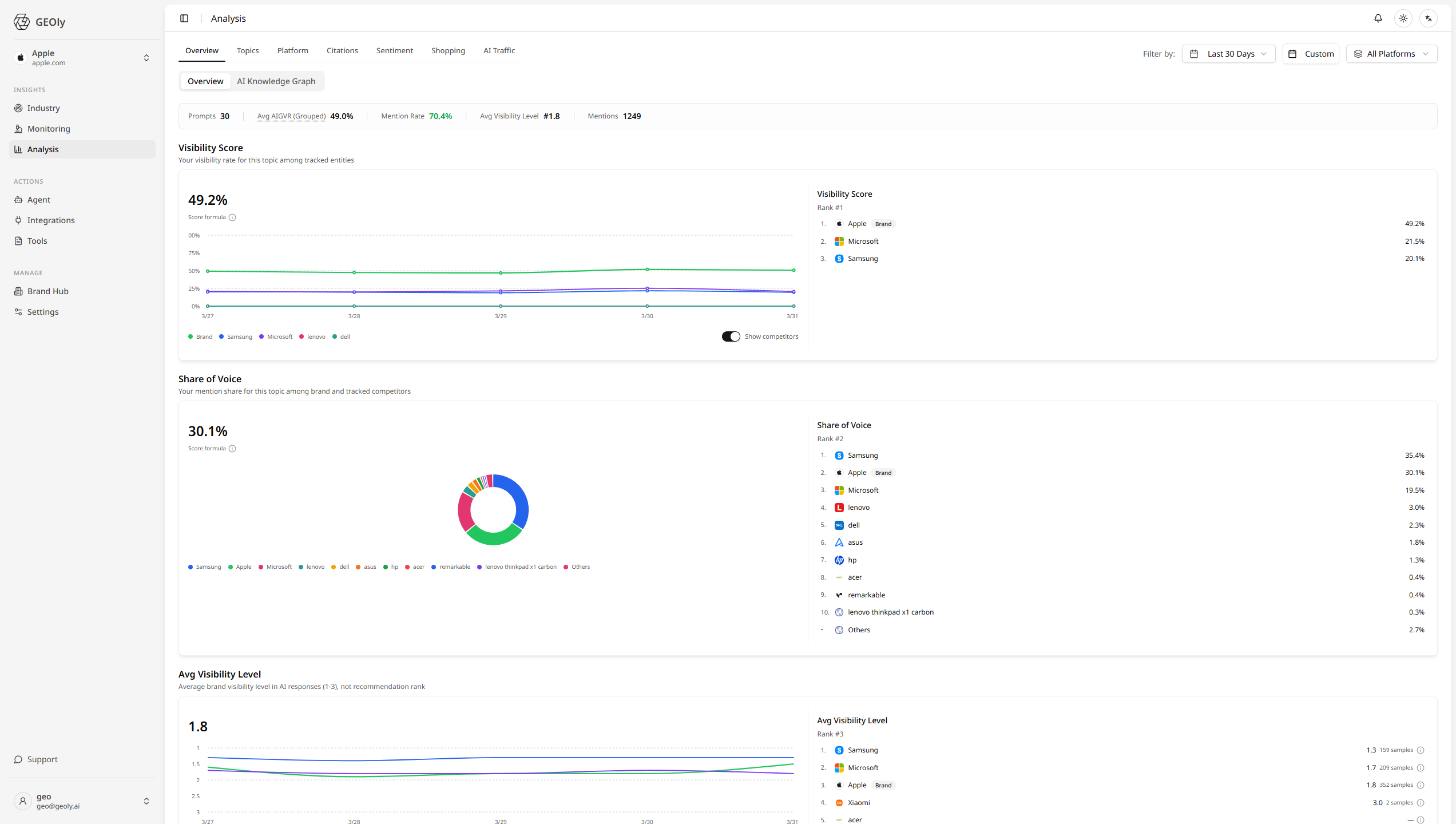
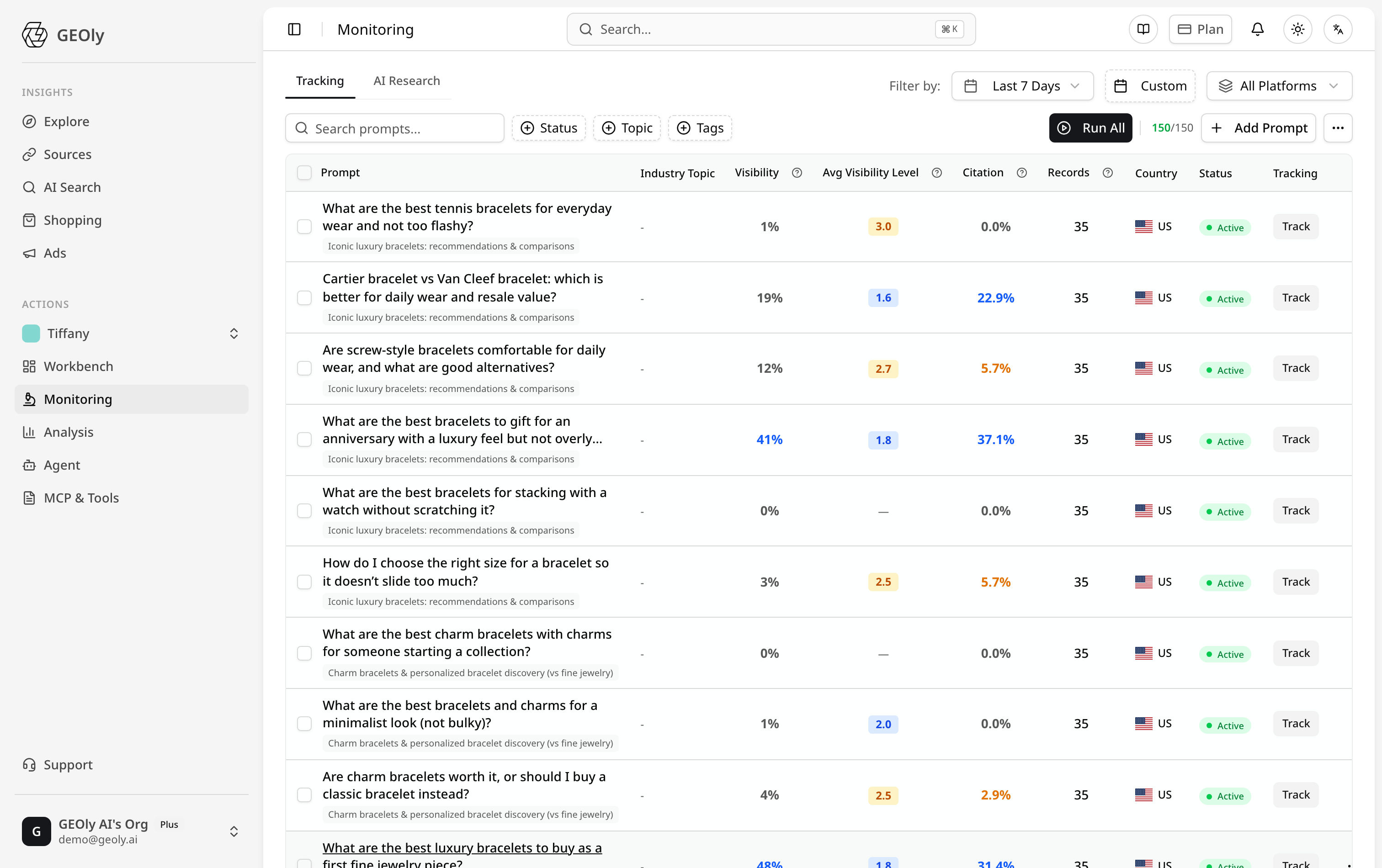
Mentions are the entry point, not the endpoint. GEOly turns every tracked prompt into a daily record per engine: whether you were named, at what position, with which citation, and in what sentiment—then rolls it up into AIGVR and Share of Model so leadership sees one number move.
A score, not a screenshot folder
AIGVR weighs position (40%), frequency (25%), and citations (25%) into one 0–100 score; Share of Model benchmarks it against the competitors you name.
Six engines, daily
Active prompts are queried every day across ChatGPT, Google AI Mode, Google AI Overviews, Perplexity, Gemini, and Copilot, with a cross-platform matrix that shows where each engine tells a different story about you.
Evidence behind every number
AI Perception separates what AI praises from what it criticizes—aspect by aspect, each claim traceable to the exact quoted answer and source.
Where teams usually go next
Mention tracking is the foundation layer. These are the adjacent plays teams add once the baseline is live.
The GEOly capabilities most often paired with this use case
Tracking AI brand mentions is the task entry point. In practice, teams usually continue into brand visibility tracking, competitor analysis, GEO audit, and sentiment analysis to explain and act on the change.
Frequently asked questions about tracking AI brand mentions
Do not wait for the traffic report to tell you AI already replaced your brand
Start by monitoring the mention layer continuously, then decide whether the right next move is content repair, source building, PR, or a better prompt coverage map.
Do not stop at a brand-level visibility number. Drill into individual questions, platforms, and answers.
Compare the same question across ChatGPT, Gemini, Perplexity, and Google AI instead of treating AI as one channel.
Separate whether the brand is losing because of content gaps, citation weakness, structural issues, or stronger competitors.