LogoGEOly
  • Pricing
Log inSign up
Blog›Amazon's AI Doesn't Read the Rankings: The Third Shelf Is Forming
amazon-alexa-ai-recommendations-third-shelf-cover.png

Amazon's AI Doesn't Read the Rankings: The Third Shelf Is Forming

Summary

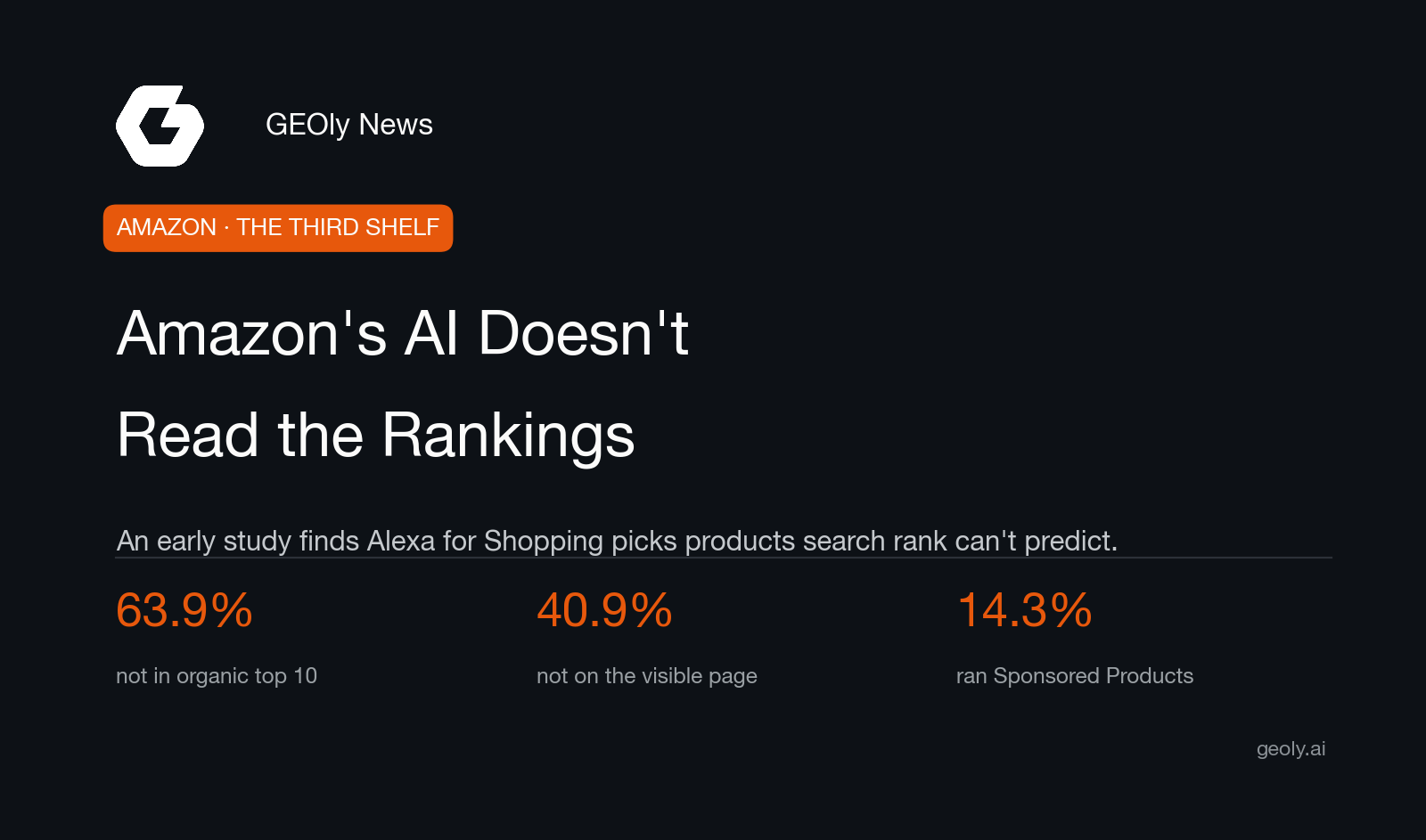
An early study of Alexa for Shopping found 63.9% of AI recommendations were not in the organic top 10 — a sign the AI shelf is separating from search rank.

GNGEOly NewsGEOly Daily AI Commerce Briefing
2026/07/17
5 min read
#AI Commerce News#AI Search#Amazon#Product GEO#Alexa#Ecommerce

For two decades, Amazon strategy has run on one assumption: win the search page and you win the sale. Rank in the organic top 10, layer on Sponsored Products, and visibility follows. A new dataset suggests that assumption breaks the moment a shopper asks Alexa to just pick something.

Marketplace Pulse, citing a study of Alexa for Shopping run by Autopilotbrand.com, reports that a large share of the products Amazon's assistant recommends are nowhere near the top of the corresponding search results — and a meaningful chunk aren't on the visible results page at all. Read carefully, it points to something bigger than a quirk: a third shelf is forming, and it doesn't inherit its picks from the search shelf.

Key takeaways

  • 63.9% of Alexa for Shopping recommendations were not in the corresponding organic top 10, and 40.9% were not even on the visible results page, per the Marketplace Pulse write-up of the study.
  • Only 14.3% of recommended products were running Sponsored Products on the matching search page — so ad coverage is not buying the AI pick either.
  • The AI recommendation is behaving like a third shelf, currently decoupled in part from the traditional organic-plus-paid search shelf.
  • You can no longer use Amazon top-10 rank or Sponsored coverage as a proxy for Alexa recommendation visibility; the two are measuring different surfaces.
  • This is a single-vendor, single-account early snapshot — directional evidence, not an Amazon ranking rule.

What the numbers actually say

The sample is specific enough to be useful and small enough to be careful with. Per Marketplace Pulse, the study covered 1,963 non-brand queries and 12,810 recommendations, collected across May and June 2026. Non-brand queries matter here: these are the discovery moments ("a good travel adapter") where the assistant, not the shopper, is choosing.

Two headline gaps stand out. First, 63.9% of recommendations were outside the organic top 10 for the matching query, and 40.9% weren't on the first visible results page at all. Second, only 14.3% of recommended products were running Sponsored Products on that page — and of that slice, 83% already held an organic ranking anyway. In other words, the ad wasn't the thing that surfaced them.

alexa-for-shopping-recommendation-vs-search-ranking.png

The study's own framing is that "ranking and ads don't yet determine the AI recommendation." That is a conclusion drawn from this sample, not a rule Amazon has published. The more defensible reading is narrower and more durable: the AI shelf is being assembled by a different process than the search shelf, and right now the two only partly overlap.

The third shelf, and why it's separate

Think of Amazon discovery as three shelves that used to be two. The organic search shelf ranks on relevance and sales velocity. The paid shelf is bought. The new AI recommendation shelf — what Alexa reads back when it picks for you — appears to weigh product semantics, use-case fit, attributes and evidence like reviews, and it does not simply copy the top of page one.

amazon-three-shelves-organic-paid-ai.png

If those three are governed by different signals, they have to be monitored as three independent surfaces. A brand can sit at rank 1 with heavy Sponsored coverage and still be invisible to the assistant — or, more encouragingly, get picked by Alexa while sitting on page two. This is the same structural shift showing up across AI commerce, from the Shopify Product-GEO surge in AI-referral orders to Google's AI Mode cart handoff to Instacart: the model, not the ranked list, is the buyer's first filter.

What to do on Monday

The practical move is to stop treating one number as a stand-in for another. Build three monitors, not one: organic rank, paid coverage, and AI recommendation presence — tracked separately, per query, over time. Watching your AI recommendation shelf apart from rank and ads is exactly the visibility gap tools like GEOly are built to close.

  • Instrument the third shelf. Sample the same non-brand queries repeatedly and record what the assistant recommends, independent of where those products rank.
  • Optimize for semantics, not density. Feed the model scenario attributes, comparison info, compatibility, review text and clean product facts — the evidence a recommendation engine reasons over, not just keywords.
  • Stop reporting rank as reach. If a deck claims "AI visibility" using top-10 share or ad coverage, it's measuring the wrong shelf.

Read it with the caveats attached

One dataset should not become a site-wide law. The vendor behind the study, Autopilotbrand.com, is an AI-optimization service, so read the framing with that interest in mind. It is a single US account, an early snapshot, and region, account history, category and the exact prompts will all move the results. The 63.9% figure is a signal that the shelves diverge — not a fixed proportion to quote as if Amazon confirmed it.

FAQ

Does Amazon search rank still matter for AI recommendations?

It matters, but it is no longer a reliable proxy. In this study 63.9% of Alexa recommendations sat outside the organic top 10, so ranking well doesn't guarantee the assistant picks you, and ranking outside the top 10 doesn't rule you out. Treat rank and AI recommendation as two different surfaces.

Can I buy my way onto the AI shelf with Sponsored Products?

The evidence says not directly. Only 14.3% of recommended products were running ads on the matching page, and most of those already ranked organically. Sponsored coverage is worth monitoring on its own, but it isn't a lever for the recommendation shelf on this data.

How reliable is this study?

Treat it as directional. It is a single-vendor, single-account snapshot from May–June 2026, run by an AI-optimization service, so it shows that the shelves can diverge — not a precise, Amazon-endorsed percentage. Validate against your own queries before you rebuild strategy on it.


Related reading: Shopify's 13x AI-referral orders and Product GEO, Google AI Mode's Instacart cart handoff, and the AI Commerce News hub. Published by GEOly News — see more from this desk.

Latest Posts

reddit-ai-search-citations-community-signals-cover.png

Reddit Is Now ~1 in 5 Off-Site AI-Search Citations. Here's the Honest Play

An industry session claims Reddit accounts for roughly one in five off-site AI-search citations, up ~30% year over year — a directional signal that GEO is widening from owned sites to community discussion, not a license to astroturf.

#AI Commerce News#AI Search#Reddit
GEOly News
5212026/07/17
chatgpt-referral-lead-rate-conversion-invoca-cover.png

ChatGPT Sends Better Leads — But Not Better Closes

Invoca found ChatGPT-referred calls became sales leads 49% of the time, ~10 points above the channel average — yet closed at just 40%, below the 42% all-channel norm.

#AI Commerce News#AI Search#GEO Measurement
GEOly News
7082026/07/17
hsbc-visa-live-agentic-payment-controls-cover.png

HSBC UK and Visa Just Ran a Live Agentic Payment. Now Build the Controls.

On 16 July 2026, an HSBC UK card completed an AI-agent-initiated purchase on a real merchant site over Visa's existing rails — turning agentic-payment liability from theory into a checklist you need now.

#AI Commerce News#AI Search#Agentic Payments
GEOly News
2922026/07/17
All Posts
GEOly

See your brand in AI search

GEOly tracks how ChatGPT, Gemini and Perplexity mention, cite and recommend your brand — and helps you win the AI shelf.

Start Free Trial

Free to start · No credit card required

GNGEOly NewsGEOly Daily AI Commerce Briefing
2026/07/17
5 min read
#AI Commerce News#AI Search#Amazon#Product GEO#Alexa#Ecommerce
GEOly

See your brand in AI search

GEOly tracks how ChatGPT, Gemini and Perplexity mention, cite and recommend your brand — and helps you win the AI shelf.

Start Free Trial

Free to start · No credit card required

Trusted by leading consumer brands

Anker SOLIX
eufy
soundcore
PLAUD
xTool
Ulike
Jackery
Roborock
Dreame
EcoFlow
Insta360
TCL
Beatbot
CASETiFY
Creality
Shokz
Segway
realme

12,000+ brands track & win AI search with GEOly

From Anker SOLIX to xTool — the brands above already see how ChatGPT, Gemini and Perplexity mention, cite and recommend them. Your brand is being talked about in AI right now. See it.

See Your Brand in AI — Free

Free to start · No credit card required

LogoGEOly

GEOly. The GEO data platform for DTC brands — GEO, made easy and agent-friendly.

GitHub
GitHub
YouTube
YouTube
Email
PRODUCT
  • Overview
  • Brand Visibility
  • AI Agent
  • Integrations
RESOURCES
  • Docs
  • Blog
  • Changelog
  • FAQ
  • Learn
  • Alternatives
ECOSYSTEM
  • RIJOY
  • Sectionly
  • ShopifySkills
COMPANY
  • About Us
  • Contact
  • Partner Program
  • Partner Directory
POLICY
  • Privacy Policy
  • Terms of Service
© 2026 GEOly Inc.
Privacy PolicyTerms of Service
Built for AI Visibility