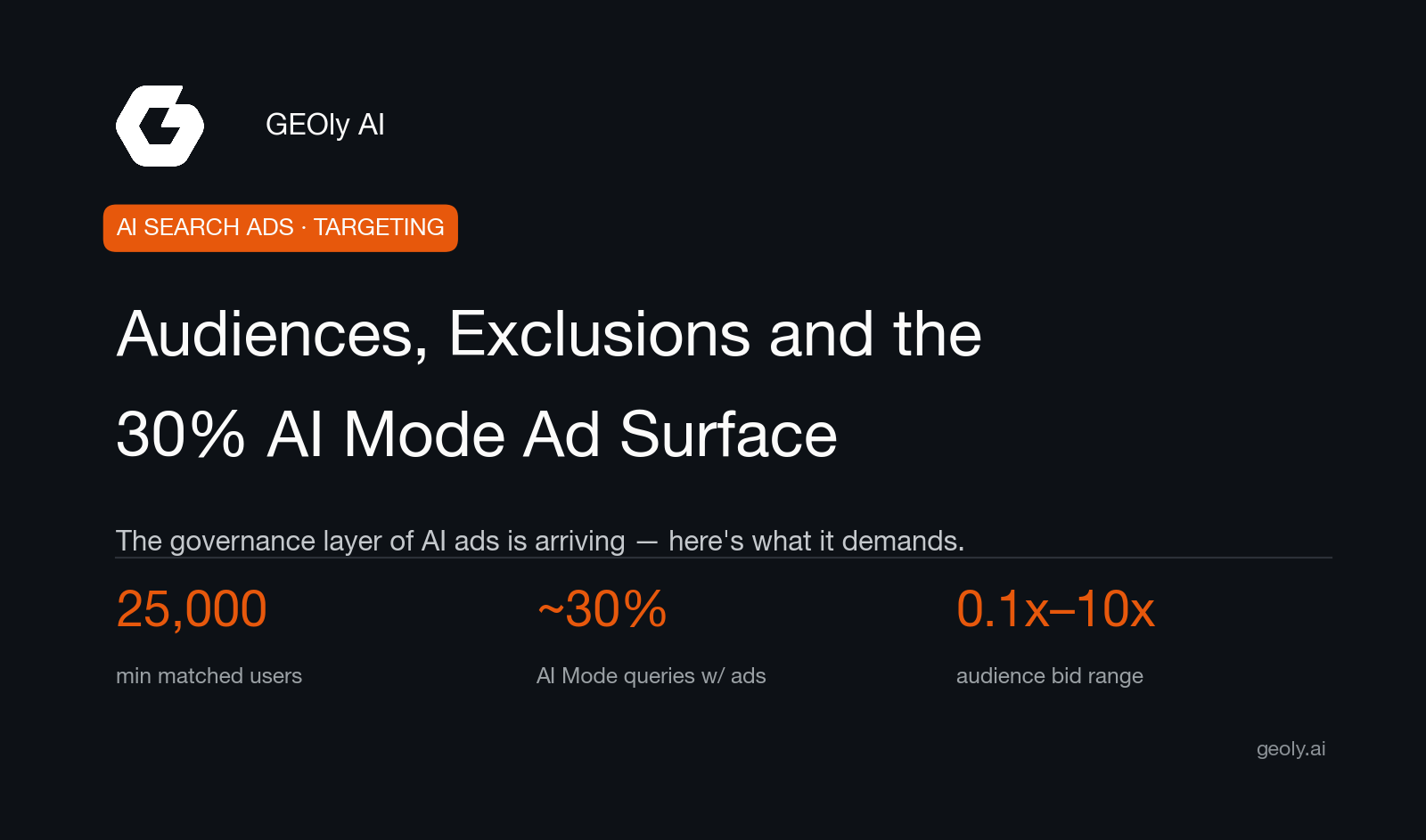
The interesting news in AI advertising this month was not another format — it was governance. OpenAI's targeting rules for ChatGPT ads became concrete, exclusion controls surfaced in the Ads Manager, and an external study put a number on how much of Google's AI Mode already carries ads. Together they show AI ad platforms growing the boring, necessary machinery of audiences and controls.
Key takeaways
- ChatGPT Ads Custom Audiences require at least 25,000 matched users; files accept up to 5 million identifiers and processing runs about 20–30 minutes.
- Usability depends on matched count, not rows uploaded — small local merchants are effectively shut out of deterministic remarketing.
- The Ads Manager was reported to add geo exclusion and first-party audience exclusion — the basics of cross-market ad governance.
- A third-party study says ads appear on close to 30% of Google AI Mode queries; treat this as a signal of fast-forming inventory, not an official coverage figure.
- AI Mode reshapes organic (GEO) and paid visibility at once, so brands need a query panel that logs both.
The 25,000-user floor, and who it excludes
PPC Land, reading OpenAI's Help Center documentation, reported that ChatGPT Ads Custom Audiences need a minimum of 25,000 matched users before an audience becomes usable. Lists accept up to 5 million identifiers, support hashed email and phone via SHA-256, and typically process in 20–30 minutes; per-ad-group audience bid multipliers range from 0.1x to 10x. Crucially, availability depends on the matched count after processing — not how many rows you uploaded.

That floor is a real strategy input. A small or local merchant with a modest CRM list will not clear 25,000 matches, which pushes deterministic remarketing out of reach and raises the value of clean, deduplicated, consented first-party data. If you are near the threshold, don't stake key budget on an audience that may not activate. Smaller markets are often better served by winning content and product visibility first — the organic side of the AI answer surface — while the list matures.
Exclusions: the governance layer arrives
Separately, Search Engine Roundtable reported that the ChatGPT Ads Manager gained the ability to exclude specific geographies and to upload a first-party customer list to avoid targeting certain people. OpenAI's public Help Center confirms the Ads Manager Beta exists but doesn't itemize every control on its basics page, so match rates, retention limits and consent boundaries still need verification.
For a global brand these are foundational, not fancy. Geo exclusion and customer-list exclusion are how you avoid duplicate reach, cross-market misfires and exposure to sensitive audiences. Build an exclusion matrix by country, customer lifecycle stage and high-risk segment before you scale spend — and read the uploadable list as a compliance control, not permission to target chat history.
Google AI Mode: ads on roughly 30% of queries
Search Engine Land reported a study finding that ads appear on close to 30% of Google AI Mode queries. This is a third-party sample, not Google's official coverage claim across all users, countries and query types — but it suggests AI-search ad inventory is forming faster than many expected. Ad triggering, the sponsored label and the position of ads within answers will all keep shifting as Google experiments.

The practical move: stand up an AI Mode query panel. For a representative set of shopping-intent prompts, log whether an ad appeared, whether the sponsored label was clear, and whether the answer's citations and the landing page tell a consistent story. Compare that against a traditional search control so you can see how much AI Mode reshapes both Google merchant ads and your organic pickup.
What advertisers should do now
- Estimate match size early. Model your matched-audience count before committing budget; standardize on UTF-8, E.164 and SHA-256 and record consent source and retention.
- Build the exclusion matrix. Country, lifecycle and sensitive-segment exclusions belong in the plan from day one, not after an incident.
- Instrument AI Mode. Sample queries weekly; track ad presence, label clarity and answer-to-landing-page consistency.
- Keep paid and organic on one view. Ad placements and natural citations move together in AI answers; measure them side by side.
Because AI Mode blurs organic and paid, the useful dashboard is one that shows both. GEOly's monitoring tracks where your brand appears across ChatGPT and Google AI Mode answers — cited, carded or sponsored — which is the baseline you need before reading any exclusion or audience test. See our breakdown of GEO across the major AI engines for how the organic side fits in.
FAQ
How many matched users does a ChatGPT Ads Custom Audience need?
At least 25,000 matched users after processing. Lists can hold up to 5 million identifiers, but it is the post-match count — not the number of rows uploaded — that determines whether the audience can be used.
Can ChatGPT Ads exclude locations and specific customers?
Reporting indicates the Ads Manager Beta added geo exclusion and first-party customer-list exclusion. Treat an uploadable exclusion list as a compliance and frequency control, not as permission to target based on conversation history.
Does Google AI Mode really show ads on 30% of queries?
A third-party study cited by Search Engine Land found ads on close to 30% of sampled AI Mode queries. It is a research signal about inventory growth, not an official Google coverage figure, and it will vary by market and query type.
Related reading: how ChatGPT Ads became a performance channel · more ChatGPT Ads coverage · GEO across ChatGPT, Gemini, Perplexity and AI Mode. Published by GEOly AI GEM — see more from this desk.
