Agentic Commerce Now Needs an Eligibility Stack
The latest agentic commerce news is easy to misread as a stream of isolated launches: a ChatGPT Ads partner here, a shopping integration there, a payment card, a hotel app, a Google AI Mode study.
The stronger pattern is that AI commerce is becoming an eligibility problem.
An AI system does not simply decide which brand to mention. It has to decide which product data is trustworthy enough to show, which app can perform the next step, which offer is allowed to appear, which payment credential can be used and which source should be cited when the answer becomes commercial.
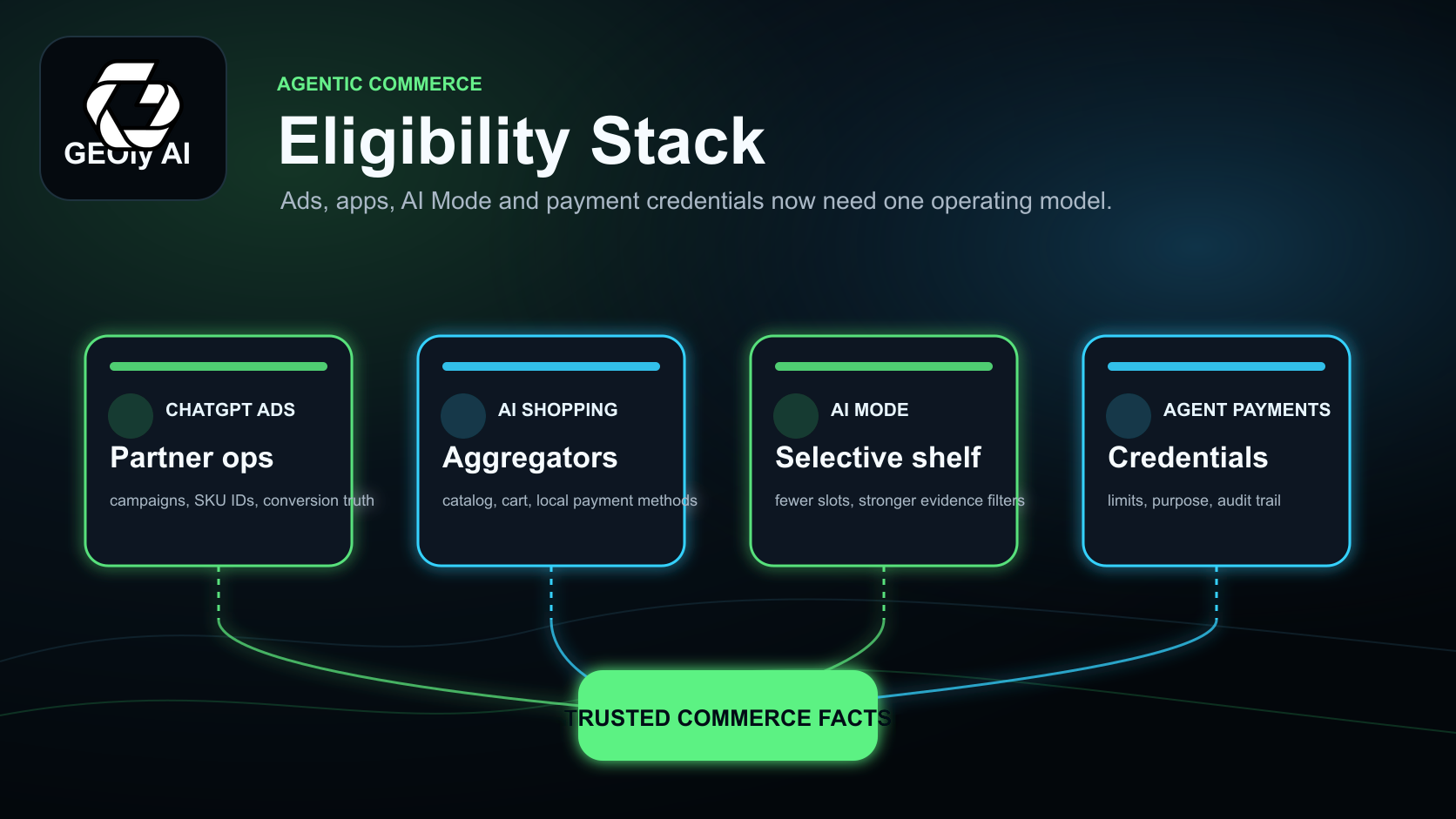
That means brands need more than GEO content. They need an eligibility stack: the operational layer that proves a brand, product or offer is safe, current, measurable and actionable enough for AI systems to recommend or route demand toward it.
The channel is splitting into four operating rails
The first rail is paid AI search. Pattern announced that it is supporting ChatGPT Ads as a technology partner and positioning ChatGPT Ads alongside Google, Meta, Snap, TikTok and commerce media in its cross-platform advertising system. That matters because a serious ads channel does not scale through a few manual tests. It scales through account access, catalog mapping, campaign controls, conversion feedback and agency workflows.
For brands, the point is not simply "try ChatGPT Ads." It is to make sure ChatGPT Ads can plug into the same governance that already controls spend, SKU naming, creative review, conversion IDs and refund-adjusted reporting. GEOly's ChatGPT Ads Library is useful here because paid exposure needs to be watched separately from natural AI visibility. Blending the two will make the channel look cleaner than it is.
The second rail is commerce aggregation. GoKwik and PayU say they have enabled multi-brand D2C shopping inside ChatGPT for Indian consumers, covering discovery, comparison, cart and payment across local methods such as UPI, cards, net banking and wallets. If this model works, regional commerce enablers may become the bridge between AI platforms and long-tail merchants that cannot each build their own ChatGPT app.
The third rail is first-party brand experience. Radisson launched a ChatGPT app for hotel discovery with live inventory, rates, amenities and booking handoff. IHG is testing its own conversational hotel search while industry coverage points to its participation in Google Direct Offers. The strategic lesson is simple: strong brands will not depend on one AI platform surface. They will expose the same trusted facts through their own AI search, official AI apps, Google surfaces and paid offers.
The fourth rail is payment credentials. MoonPay's PayBox and Corpay's Agent Card point to two versions of the same control problem. Consumer agents need user-approved wallets, spending limits and confirmation flows. Enterprise agents need purpose-bound virtual cards, vendor controls, category restrictions and audit trails. In both cases, the hard question is not whether an AI can click "buy." It is whether the business can prove the agent had the right identity, permission, budget and scope.
Product visibility is getting scarcer, not broader
The Productrise study on Google AI Mode is the useful counterweight to all the launch excitement. Productrise reported that, in its U.S. and U.K. shopping query sample, traditional Google Search showed product listings far more often than AI Mode, and that the overlap between products shown in both interfaces was extremely low.
That study should not be treated as a universal traffic forecast. It is not Google data, it covers a specific query set and it measures listing visibility rather than clicks or revenue. But the directional signal is still important: AI shopping surfaces may compress product visibility into fewer, more selective positions.
Traditional search taught teams to fight for rank. AI commerce adds a harder filter: eligibility. A product may be indexed, technically valid and available in a feed, yet still fail to appear because the AI surface has fewer slots, different evidence preferences or a stronger confidence signal for a competitor.
This is why ecommerce teams should not rely on aggregate traffic reports. They need prompt-level monitoring: which brands appear for high-intent unbranded questions, which SKUs appear in product cards, which sources are cited, which attributes influence comparison and where the answer sends the user next. GEOly's AI Shopping Monitoring and Brand Knowledge Graph are built around that difference between "indexed somewhere" and "trusted in the answer."
What belongs in an eligibility stack
An eligibility stack is not a new CMS or a new ad account. It is a set of controls that make a business legible to AI systems and accountable to humans.
Start with a product and brand truth layer. Product names, variants, prices, availability, returns, warranty, ratings, store locations, service areas and official URLs need to match across the product page, structured data, Merchant Center, app APIs, partner feeds and sales systems. If an AI answer has to reconcile five versions of the same product, the brand has already lost confidence before the recommendation happens.
Then define channel ownership. Natural AI answers, ChatGPT Ads, Google AI Mode, brand apps, regional aggregators and payment agents should not all report to the same vague "AI growth" bucket. Each needs a named owner, data source, risk policy, conversion event and fallback path.
Next, separate visibility from action. Visibility asks whether the brand appears and is cited. Action asks whether the user can compare, add to cart, book, pay, modify or cancel. A page optimized for citations can still fail as an action endpoint if inventory is stale, tax logic is unclear or checkout cannot accept the payment rail the agent is allowed to use.
Finally, add authorization rules before the channel grows. For consumer agents, use step-up confirmation for high-value, non-refundable, subscription or regulated purchases. For enterprise agents, prefer one-time or purpose-bound credentials with merchant, category, amount, geography and expiry limits. Every agentic transaction should leave a record of the user instruction, the tool called, the credential used and the business rule applied.
The measurement model has to change
Agentic commerce will create attribution arguments faster than it creates clean dashboards.
A ChatGPT Ads partner may report conversions. A regional aggregator may keep part of the checkout path. A hotel app may hand users to the brand site. Google Direct Offers may appear inside AI-assisted planning. A payment credential may complete a transaction without looking like a normal browser session.
Brands should expect disagreement between platform reporting, analytics, order systems and finance. The fix is not one more blended ROAS number. The fix is an event model that distinguishes:
- Natural AI answer inclusion.
- Sponsored AI exposure.
- App invocation.
- Product comparison.
- Cart creation.
- Checkout handoff.
- Authorized agent payment.
- Completed order, cancellation, refund and dispute.
Each event needs stable IDs: prompt cluster, brand, SKU, offer, channel, campaign, partner, order and credential. Without that, teams will not know whether AI commerce is creating incremental demand or merely shifting credit between surfaces.
For many ecommerce brands, this is where the work becomes cross-functional. Marketing owns spend and messaging. Product data owns facts. Commerce owns checkout. Finance owns payment controls. Legal owns disclosure and liability. GEO owns what AI systems say, cite and recommend. GEOly's ecommerce brand workflow and AI Shopping Optimization are designed to connect those layers rather than treating AI visibility as a content-only problem.
A practical 30-day plan
For the next month, do not start with a broad "AI commerce strategy" deck. Start with a controlled eligibility audit.
Choose 50 high-margin or strategically important products, services or locations. For each one, document the canonical name, variant structure, price logic, availability, return policy, proof points, preferred URL and disallowed claims. Check whether that truth is consistent across the website, schema, feeds, shopping platforms, AI app endpoints and partner data.
Run 100 unbranded buying prompts across the AI surfaces that matter to your market. Record whether your brand appears, which competitors appear, what sources are cited, what product attributes are used and whether the answer can move toward action. Save raw answers, not only scores.
Map every AI commerce rail you are considering: ChatGPT Ads, Google AI Mode, brand app, regional aggregator, agent payment wallet, enterprise virtual card. For each rail, specify owner, launch criteria, budget limit, data export, fallback path and stop condition.
Build a least-privilege payment policy before any autonomous flow goes live. Default to "always ask" for high-risk actions. Only low-value, reversible and pre-approved purchases should receive autonomous permission. Treat prompt injection, duplicate orders, stale prices and refund disputes as design requirements, not edge cases.
GEOly AI's role
The brands that win in agentic commerce will not be the ones that publish the most AI-search content. They will be the ones that can show AI systems a coherent truth layer, prove demand sources, separate paid and natural visibility and put real controls around action.
GEOly AI helps teams monitor exactly that operating surface: how brands appear across AI engines, which sources are cited, where competitors win recommendations, how AI shopping surfaces handle product facts and where ChatGPT Ads signals should be separated from organic GEO. Through MCP-based workflows, GEOly can also connect monitoring evidence to the internal systems teams use to fix the facts behind the answer.
Agentic commerce is still early. But the entry requirements are already getting more precise. The brands that build the eligibility stack now will be easier for AI systems to trust, easier for users to act on and easier for teams to measure when the channel becomes material.
Sources
- Pattern announcement on ChatGPT Ads support
- GoKwik and PayU D2C shopping on ChatGPT
- Business Today coverage of GoKwik and PayU ChatGPT shopping
- MoonPay PayBox coverage from The Block
- Corpay Agent Card official announcement
- Productrise study on Google AI Mode shopping listings
- PPC Land analysis of the Productrise AI Mode study
- Radisson and Accenture ChatGPT app announcement
- IHG conversational search beta coverage
- Google Direct Offers product page


