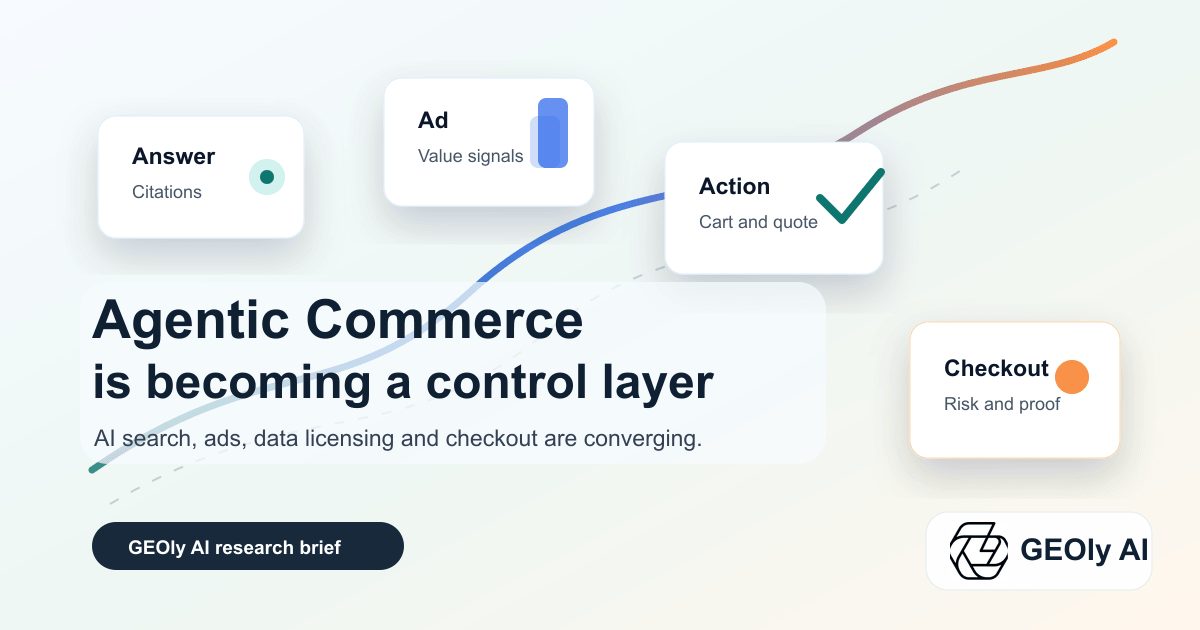
# Agentic Commerce Is Becoming a Control Layer, Not Just a Search Channel
The most important AI commerce signal this week was not one product launch. It was the pattern across several launches.
OpenAI Ads has moved deeper into performance infrastructure. Google AI Mode is connecting third-party apps and shopping actions. Yelp is licensing local business data into ChatGPT. ESW is packaging AI discovery with checkout and cross-border commerce infrastructure. European regulators are making clear that search self-preferencing, anti-steering and answer transparency will not stay "old search" issues forever.
That combination changes the job for brands. AI visibility is no longer only about whether a model mentions you in an answer. It is becoming a control layer that decides which facts are trusted, which offers are eligible, which ads are measurable, which checkout path is allowed and which party carries risk when the user acts.
For ecommerce teams, the question is no longer "How do we rank in AI search?" The better question is: "Can an AI system safely understand, recommend, attribute and transact with our business?"
The new stack: answer, ad, action, transaction
Traditional search optimization separated the world cleanly. Organic pages lived in one bucket. Paid search lived in another. Product feeds, local listings, checkout, refunds and CRM attribution sat in their own operational systems.
AI search is folding those layers together.
OpenAI's Ads documentation now describes a maturing ad platform, including Pixel, Conversions API, Advertiser API, conversion-optimized campaigns and campaign management workflows. Industry reporting around the Ads Manager interface also points to conversion value, click-through attribution and view-through attribution surfacing in advertiser views. Even if availability is still phased, the direction is plain: ChatGPT Ads is being built to compete for performance budgets, not just novelty media tests.
At the same time, Google AI Mode's connected apps show how search can become a task router. Google described early integrations with Instacart, Canva and YouTube Music, including the ability to move from a conversational request into a third-party app action. The key point is not that every checkout happens inside Google today. It is that the search session can now shape the task before the user reaches a merchant-controlled surface.
Then the local data layer shifted. Yelp's agreement to make reviews, ratings, photos and business information available to OpenAI, with attribution back to Yelp and a planned Request a Quote flow, shows how a local answer can become a lead path. A restaurant, contractor or service provider does not only need a web page. It needs accurate, licensed, machine-readable business facts in the places models trust.
Finally, ESW's Agentic Commerce announcement frames checkout as infrastructure. Its pitch is not "we built a chatbot." It is "we connect AI-driven discovery to checkout, payment, cross-border operations and the merchant's existing ecommerce stack." That is the more serious category. The winner in agentic commerce may be the layer that normalizes catalog, price, tax, payment, returns and order status across AI agents.
This is why GEOly treats AI shopping as a full-funnel system. Our AI Shopping Optimization and AI Shopping Monitoring work is built around the gap between being mentioned and being correctly transacted.
Why "more GEO content" is too small a response
There is still a role for content. But a lot of GEO advice remains trapped in an old model: publish more pages, add more FAQs, insert more entities, wait for citations.
That misses the new failure modes.
An AI assistant can cite your brand and still recommend the wrong product. It can recommend the right product and still send the user to an unavailable variant. It can trigger a lead and still over-credit an ad view that had no incremental effect. It can prepare a cart and still fail because price, shipping, tax or return rules are not deterministic.
The practical readiness checklist is much less glamorous:
- Product titles and variants must be unambiguous.
- GTIN, brand, category, image, price, inventory and availability fields must match across product page, feed and structured data.
- Shipping time, return window, warranty and market eligibility must be visible in machine-readable form.
- Local business name, address, category, service area, hours, photos and reviews must be consistent across trusted directories.
- Ads events need server-side deduplication, order IDs, currency, consent state and refund awareness.
- Agent actions need authorization limits, idempotency keys, audit logs and human takeover paths.
That is not content marketing as usual. It is commercial systems work.
For ecommerce brands, the starting point is a machine-readable product truth layer. GEOly's ecommerce brand workflow is designed around exactly that: aligning brand facts, catalog facts, competitive visibility and AI answer evidence before teams start scaling content or spend.
Regulation will shape the commercial interface
The European Commission's July 23, 2026 DMA decisions against Google matter beyond the specific Search and Play cases. The Commission said Google breached the Digital Markets Act through Search self-preferencing and Google Play anti-steering restrictions. Those issues map directly onto AI commerce design.
If an AI search experience favors its own shopping module, suppresses comparison services, blurs sponsored and organic answers or makes external checkout harder than platform checkout, regulators will have a familiar lens. The interface may be new. The market power questions are not.
This matters for brands because the rules will affect both distribution and measurement. If platforms must preserve fair external paths, brands should maintain strong owned checkout, deep links and independent measurement. If AI answers must expose sources more clearly, brands need evidence pages that are accurate, current and easy to cite. If ad and organic surfaces sit close together, teams need clean separation between natural AI visibility and paid AI exposure.
This is one reason GEOly's ChatGPT Ads Library and Brand Knowledge Graph are strategically connected. Ads monitoring without entity and citation monitoring is blind to what the model already believes. Entity monitoring without paid exposure data is blind to how platforms commercialize the answer.
Attribution will be the next argument
Google says AI Mode has reached massive scale, with AI search features driving query growth and sending large volumes of clicks to the web. OpenAI Ads is adding performance plumbing. Third-party partners are starting to manage ChatGPT ad campaigns for local businesses. At the same time, publishers, merchants and analysts continue to question whether AI answers reduce click-through, shift value to platforms or inflate self-attribution.
All of these can be true at once.
AI search can increase total query volume and reduce clicks on some tasks. A ChatGPT ad can assist a purchase without deserving full credit. A local Yelp-powered answer can create a lead without behaving like a conventional search referral. A view-through conversion can be useful for diagnosis and dangerous as a budget allocator.
Brands should not wait for platforms to settle the attribution debate. They should build their own test design:
- Use separate UTMs and landing pages for AI ads, AI organic links and partner referrals.
- Store order ID, event timestamp, currency, item IDs and customer consent state.
- Compare markets or query clusters with holdout groups.
- Split assisted exposure, clicked exposure, branded search lift, direct traffic lift and completed revenue.
- Track refund, cancellation, chargeback and support cost, not only gross sales.
The most useful KPI is not "AI visibility." It is profitable, explainable, repeatable AI-assisted demand.
What to do now
There are three concrete moves worth making before the AI commerce layer hardens.
First, audit the facts that agents need to act. For the top 100 products or services, check whether a machine can read what the product is, who it is for, where it is available, what it costs, when it ships, how it returns and what evidence supports the claim. If a human has to visually inspect the page to answer those questions, an agent will eventually get something wrong.
Second, separate natural AI visibility from paid AI exposure. ChatGPT Ads, AI Mode ads, local lead surfaces and organic answers may appear in one user journey, but they should not share one KPI bucket. Natural answer inclusion, citation source, ad impression, click, lead, cart, checkout and refund need separate event names.
Third, prepare action interfaces before agents demand them. If agents will add to cart, request quotes, compare products or trigger checkout, the business needs deterministic APIs, rate limits, authorization scopes and recovery paths. The safest public content in the world cannot compensate for a brittle transaction layer.
GEOly AI is built for this shift. It tracks how brands appear across AI engines, which sources models cite, how competitors are framed and where AI shopping recommendations create or miss revenue opportunities. It also helps teams connect monitoring to action through structured brand facts, AI shopping visibility, ChatGPT ads intelligence and MCP-based workflows for agents. If your team is moving from "we need to be mentioned" to "we need AI systems to recommend and route demand correctly," start with the evidence layer, then connect it to commerce controls.
The window is still early enough to shape the system. But it is no longer early enough to treat agentic commerce as a content experiment.
Sources
- OpenAI Ads developer documentation
- OpenAI conversion-optimized campaigns documentation
- Google AI Mode connected apps announcement
- European Commission DMA decisions and Google fines
- Yelp and OpenAI local data licensing report via Yahoo Finance
- The Verge coverage of ChatGPT using Yelp reviews
- ESW Agentic Commerce announcement via PR Newswire
- Alphabet Q2 2026 CEO earnings remarks
- Shopify guidance on agentic search visibility


