Agentic Commerce Has a Checkout Problem Before It Has a Search Problem
The useful question for AI commerce teams is no longer whether a model can find a product. It can. The sharper question is whether the AI system can safely identify the right merchant, access the right inventory, respect the buyer's authorization, explain why it recommended the option, and complete checkout without creating a dispute.
This week’s signals point in the same direction. Indian payment executives told Business Standard that ecommerce platforms are not rushing to open checkout to shopping agents. A Google AI Overview reportedly confused two similarly named bakeries and told users a still-open Canadian business was closing. MoonPay is pushing PayBox toward consumer-facing agent payments. In Washington, lawmakers are debating whether agents that shop or invest for consumers need a "best interest" obligation. OpenAI's ChatGPT Ads budget change is also a reminder that the paid layer around AI answers is becoming operational, not theoretical.
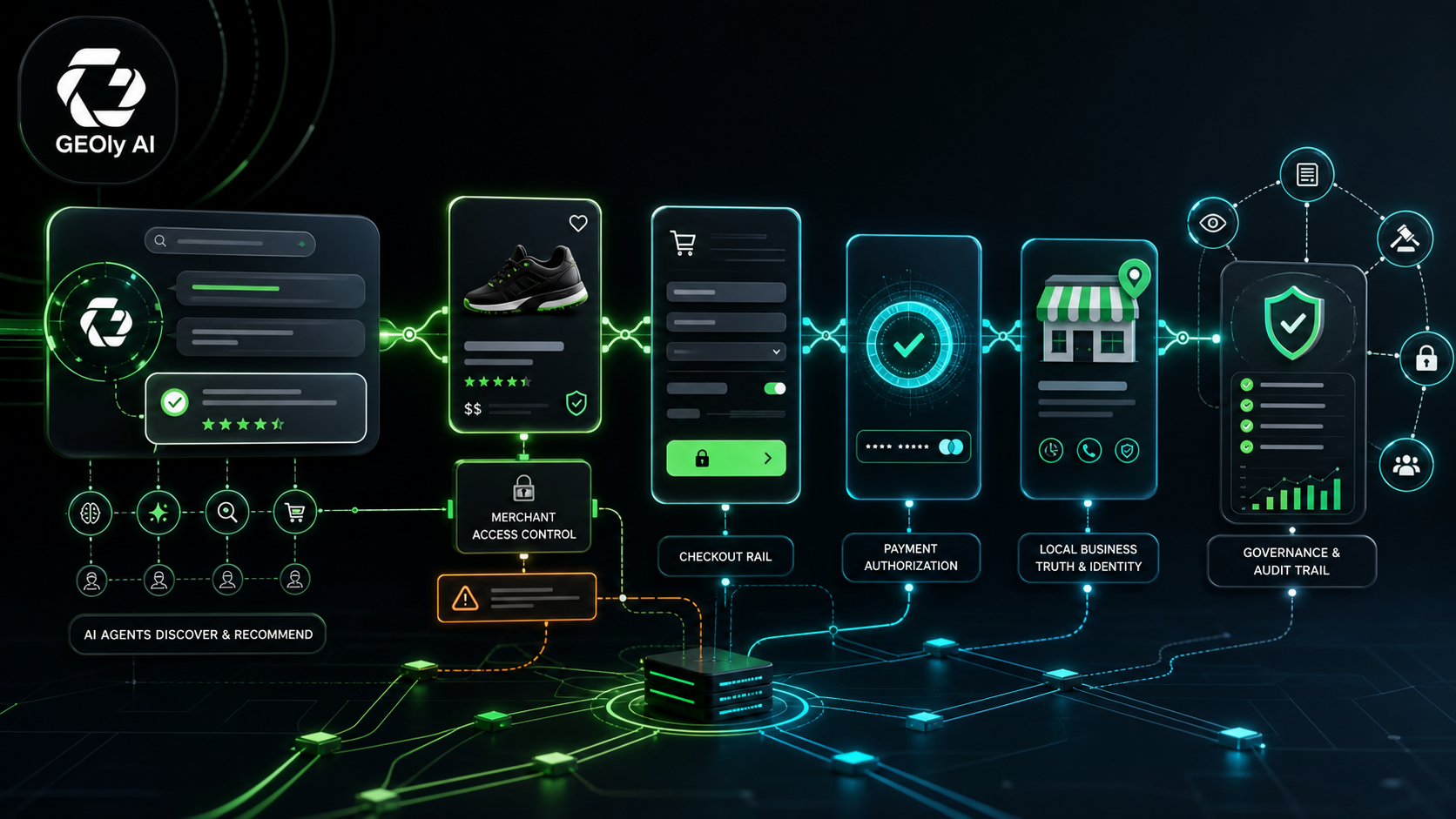
Taken together, this is not a story about more GEO content. It is a story about a new trust layer between AI discovery and commercial execution.
Discovery is getting easier. Trust is not.
Most early agentic-commerce discussion treated product discovery as the core unlock: the agent asks follow-up questions, compares options, summarizes reviews and sends the user to buy. That is a real user experience shift, but it is not the hardest system problem.
The harder part starts when the agent has to act. Business Standard's reporting on India is useful because it separates payment infrastructure from platform incentives. Payment companies can build rails for delegated transactions, but marketplaces and ecommerce platforms still have reasons to protect their own discovery, recommendation, advertising and checkout surfaces. If a third-party agent owns the customer conversation, the platform may lose margin, data and ranking control.
That means many near-term "agentic commerce" flows will not be fully autonomous. The more realistic path is a mix of in-platform assistants, agent-readable product data, deep links into merchant checkout, explicit user confirmation, and selective integrations where the merchant can verify price, inventory, taxes, returns and order status.
For brands, the implication is concrete: do not prepare only for AI answers. Prepare for AI systems that need permissioned commercial facts.
The entity layer can break before the checkout layer
The Anna Mae's Bakery case is a small business story with large enterprise implications. According to CBC News and PPC Land, Google AI Overview mixed up an Ontario bakery with a similarly named U.S. business and surfaced a false closing claim. For a local merchant, "open or closed" is not a low-stakes hallucination. It can affect calls, store visits, reviews and revenue.
The same class of error matters in ecommerce. An AI system that confuses a brand, authorized reseller, discontinued product, recalled item, regional return policy or store location can create a bad recommendation before payment ever starts.
This is why the brand knowledge layer deserves more attention than generic prompt optimization. A business needs machine-readable, consistently published facts about legal entity, brand names, locations, product identifiers, authorized sellers, warranty terms, return windows, pricing conditions and operating status. It also needs monitoring for high-risk prompts such as "is this store closed," "is this product safe," "where should I buy," "which seller is authorized," and "does this brand ship to my country."
GEOly's Brand Knowledge Graph is built around that problem: making the facts that models rely on visible, structured and testable.
Payment agents need boring controls
MoonPay's PayBox concept, as reported by Fortune via Yahoo Finance, is important because it moves agent payments from developer talk into a consumer wallet pattern. The interesting features are not flashy. They are limits, confirmations, wallet funding, transaction scope and merchant compatibility.
That is where the operating model for AI shopping becomes clearer. A useful shopping agent should not simply "buy the best option." It should operate within a bounded mandate:
- maximum spend per item and per day
- allowed merchant categories or blocked merchants
- human confirmation for high-value, subscription, regulated or non-refundable purchases
- idempotent checkout requests so retries do not create duplicate orders
- visible order logs, refund paths and authorization records
- separate tracking for recommendation, ad exposure, cart, payment and return events
These controls sound mundane because commerce is mundane at the moment money moves. The winning agentic-commerce stack may be the one that makes delegated buying auditable enough for consumers, merchants, payment networks and regulators.
Ads make the governance problem sharper
OpenAI's Help Center says daily budgets for ChatGPT Ads are now interpreted as a seven-day average: a campaign can spend up to twice the daily budget on a given day while staying under the seven-day cap. That is a media-operations detail, but it belongs in the same conversation.
Once AI answers contain paid placements, product recommendations and possible checkout paths, the user experience compresses search, advertising, advice and transaction execution into one surface. A budget rule, a sponsored recommendation, a conversion model and an agent purchase can all influence the same decision.
That creates two requirements for brands and platforms. First, paid exposure must be measured separately from natural AI visibility. Second, recommendation logic must not hide commercial relationships when an agent is acting like an advisor. POLITICO's reporting on Senator Mark Warner's agentic AI framework points toward this policy direction: agents that act for consumers may face stronger expectations around best interest, conflicts and accountability.
This is why GEOly's ChatGPT Ads Library belongs next to AI Shopping Monitoring, not in a separate silo. Paid answer exposure, organic answer inclusion, product-card visibility and checkout routing are becoming parts of the same commercial surface.
What brands should do now
There is no need to wait for a fully autonomous shopping agent before changing the operating model. The early work is practical and testable.
- Audit high-risk facts. Test AI answers about closures, locations, authorized sellers, pricing, safety, returns and shipping by market and language.
- Build a product truth layer. Keep SKU, GTIN, variant, price, inventory, delivery, warranty and return data consistent across your site, feeds, marketplaces and structured data.
- Treat checkout access as a policy decision. Decide where agents may deep-link, where they may call APIs, and where human confirmation is mandatory.
- Separate metrics. Do not merge AI answer visibility, ad exposure, product-card appearance, checkout starts and completed orders into one "AI revenue" bucket.
- Keep evidence. Store prompt, answer, cited sources, product card, ad exposure, merchant route and transaction log when investigating performance or disputes.
GEOly's ecommerce brand workflow and AI Shopping Optimization are designed for this exact bridge: moving from "are we mentioned by AI?" to "can AI systems understand, recommend and route demand to us correctly?" The platform tracks AI visibility, citations, competitive framing, shopping surfaces and agent-ready workflows through MCP, so teams can connect monitoring to the operational work that actually changes outcomes.
Agentic commerce will not arrive as one clean launch. It will arrive as a series of partially connected systems: search answers, ads, product cards, wallets, marketplace controls, local-business data and regulatory rules. Brands that build the trust layer early will be easier for AI systems to choose, and safer for customers to buy from.
Sources
- Business Standard: checkout roadblocks for AI commerce in India
- CBC News: Google AI Overview mistake involving Anna Mae's Bakery
- PPC Land: Google AI Overview and the false bakery closing claim
- Yahoo Finance / Fortune: MoonPay PayBox and AI shopping agents
- POLITICO: Washington wants to have a word with your AI agent
- OpenAI Help Center: daily budgets for ChatGPT Ads


