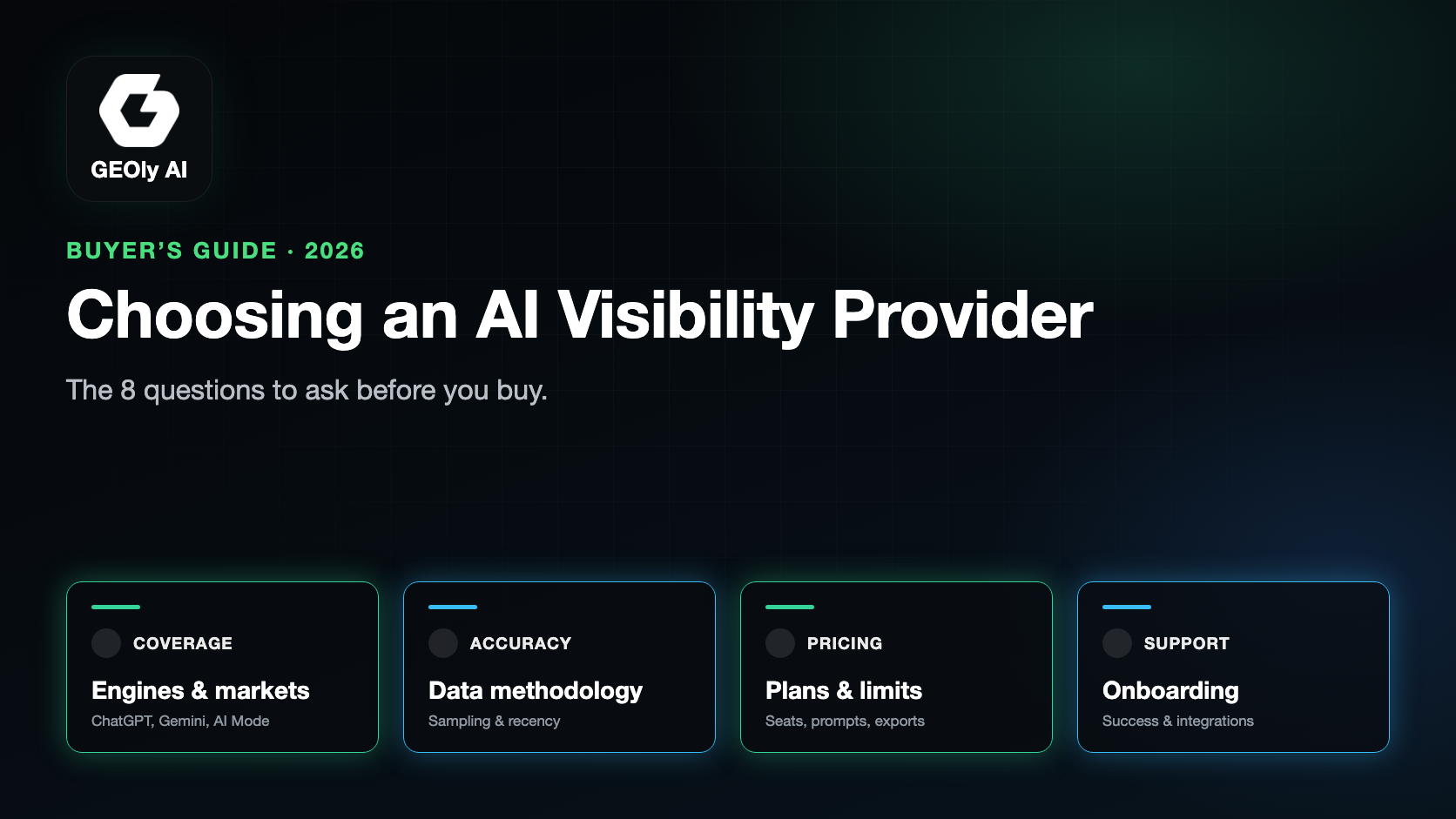
"AI visibility" went from a niche phrase to a line item in marketing budgets in about eighteen months, and the tool market grew just as fast. By mid-2026 there are dozens of platforms promising to show you how ChatGPT, Gemini, Perplexity, and Google's AI Overviews talk about your brand — and most of them look identical from the pricing page. This guide is a structured way to tell them apart before you sign a contract, not a ranked list of vendors.
Key Takeaways
- An AI visibility provider needs to do four things well: cover the engines that matter to your buyers, measure visibility with a real methodology (not just a mention count), turn findings into fixes, and prove its numbers with citations you can check.
- Pricing models differ more than feature lists do — flat per-seat pricing, credit pools shared across unrelated workflows, and per-prompt/per-engine add-ons produce very different real-world costs for the same usage.
- Ask about engine coverage, methodology, and implementation support before demos, not after — vendors optimize demos for the questions they expect.
- GEOly is one option in this category — see how it stacks up on the best AI visibility tools comparison and the alternatives hub.
What an AI visibility provider actually needs to do
Strip away the marketing language and every AI-visibility platform is trying to answer the same four questions for you:
- Where does my brand show up? Which AI engines, in which query types, in which countries or languages.
- How am I doing relative to competitors? A number or ranking that's stable enough to track week over week.
- Why am I showing up (or not)? The content, citations, and structured-data signals driving the result.
- What do I fix first? A prioritized list of actions, not just a dashboard of red and green.
Most vendors are strong on #1 and weak on #4 — good monitoring, thin recommendations. When you evaluate a shortlist, spend more time on how a tool answers "why" and "what next" than on how many charts it has.
8 questions to ask before you buy
Question | Why it matters |
|---|---|
Which AI engines are included at my plan tier, and which are paid add-ons? | Engine coverage is the single biggest driver of hidden cost. Several platforms bundle ChatGPT and Perplexity at entry but gate Google AI Mode, Gemini, or Claude behind higher tiers. |
Is the visibility score proprietary and documented, or just a mention count? | A documented methodology lets you defend the number to your CMO and compare it across tools. A raw mention count is easy to game and hard to trust. |
How is pricing metered — flat, per-seat, per-prompt, or credit pool? | Credit-pooled plans that share allowance across tracking, content generation, and audits can run out mid-month during a launch, when you need the data most. |
Does the tool recommend fixes, or only report gaps? | Reporting-only tools still require your team (or an agency) to translate findings into shipped changes — budget for that separately if the tool doesn't do it. |
Can I see historical trend data, or only current snapshots? | Newer platforms often lack multi-month trend lines, which matters if your CMO wants to see quarter-over-quarter movement. |
Does it cover AI shopping/product-visibility, or only informational queries? | If you sell physical products, visibility inside ChatGPT Shopping, AI Overviews shopping panels, and similar surfaces is a separate tracking problem most general AI-visibility tools don't cover. |
What's the real onboarding time to first usable report? | Ask for a specific number of days, not "it's fast." Multi-engine crawls and prompt-set calibration can take longer than a sales demo implies. |
Is there an API or MCP integration, or is data locked to the dashboard? | If you want visibility data inside your own BI stack or an AI agent workflow, dashboard-only tools create a manual export step every time. |
Buyer's checklist by team type
Team | Priority | What to weight most |
|---|---|---|
Agency managing multiple client brands | Unlimited or high client/seat limits, white-label reporting | Per-client cost at scale, not the sticker price for one brand |
DTC / ecommerce brand | AI-shopping and product-visibility coverage, Shopify-native integration | Whether the tool tracks product-card and shopping-surface visibility, not just informational answers |
Enterprise brand or PR team | Sentiment tracking, historical trend data, multi-market/multi-language coverage | Data depth and export/API access for board-level reporting |
SEO/content team folding AEO into an existing workflow | Actionable content and schema recommendations, not just scores |
How pricing models actually differ
Three pricing structures dominate this category, and the differences matter more than the sticker price:
- Flat plan pricing. A fixed monthly fee covers a defined engine set and usage volume. Predictable, easy to budget, but can feel expensive if you only need one or two engines.
- Credit-pooled pricing. One allowance is shared across tracking, content creation, audits, and other workflows. This can be efficient for teams using every feature, but heavy AI-visibility monitoring during a product launch can compete with — and lose to — a content-generation sprint drawing from the same pool.
- Per-engine or per-prompt add-ons. A lower headline price with individual AI engines, prompt volumes, or markets priced separately. Read the fine print here specifically: the "starting at" number on the pricing page is rarely what a multi-engine, multi-market brand actually pays.
None of these is inherently wrong, but you should know which one you're buying before you compare a $49/mo number to a $399/mo number — they may not be measuring the same thing.
Red flags to watch for
- No documented methodology. If a vendor can't explain in plain language how their visibility score is calculated, you can't defend it internally or trust it over time.
- Engine coverage that shrinks after the demo. Sales demos sometimes show engines that are add-ons on your actual plan tier — confirm coverage against the pricing page, not the pitch deck.
- No historical data in the free trial. A short trial with only current-snapshot data makes it hard to judge whether the tool's trend tracking is actually reliable.
- Weaknesses buried in review sites, not disclosed by the vendor. Cross-check G2, Capterra, and Reddit threads — a platform's own alternatives comparison pages and independent reviews should roughly agree.
Where GEOly fits
GEOly is built for teams who want AI-visibility monitoring and AI-shopping tracking in one platform rather than bolting shopping visibility onto a general monitoring tool. A few specifics relevant to the checklist above:
- All six major AI engines (ChatGPT, Perplexity, Gemini, Grok, Copilot, Google AI Mode) are included from the entry Starter plan — not gated behind add-ons.
- Visibility is quantified with a documented, patented AIGVR score and Share of Model, not a raw mention count.
- Plans are flat and predictable — monitoring usage doesn't compete with content-generation credits for the same allowance.
- A 7-agent GEO team and a 4D×5L audit frameworks turns findings into shipped fixes (schema, content, technical) rather than a report you still have to action manually.
- AI-shopping and Share-of-Card monitoring is native, which matters specifically for the DTC/ecommerce row in the checklist above.
See the full breakdown against specific competitors on the alternatives hub, or compare feature-by-feature on GEOly vs Profound.
FAQ
How much should I expect to pay for an AI visibility tool? Entry-level plans for a single brand typically range from $29–$99/mo; multi-client agency platforms run $99–$399/mo; enterprise deployments with multi-market coverage and dedicated support start around $500/mo and up. The number that matters is cost per engine per brand, not the headline "starting at" price.
Do I need a dedicated AI-visibility tool, or can my existing SEO platform cover this? Some SEO suites have added AI-search tracking as a bolt-on feature. That can work if AEO is a minor part of your workflow, but dedicated tools generally offer deeper engine coverage, a documented visibility methodology, and faster support for new AI surfaces as they launch — see AEO vs GEO for how the two disciplines and their tooling needs differ.
How is an AI visibility score different from a traditional SEO ranking? A ranking measures position in a list of blue links for a single query. An AI visibility score aggregates presence and citation frequency across many AI-generated answers, which don't have a single fixed "position" — see what is AEO for the full definition.
Can I switch AI visibility providers without losing historical data? Most platforms don't export raw historical trend data in a portable format, so switching effectively resets your baseline. Factor a short overlap period into any provider switch if historical comparison matters to your reporting.
Ready to see where your brand actually stands? Start a free GEOly account and get your AIGVR score across all six major AI engines.
