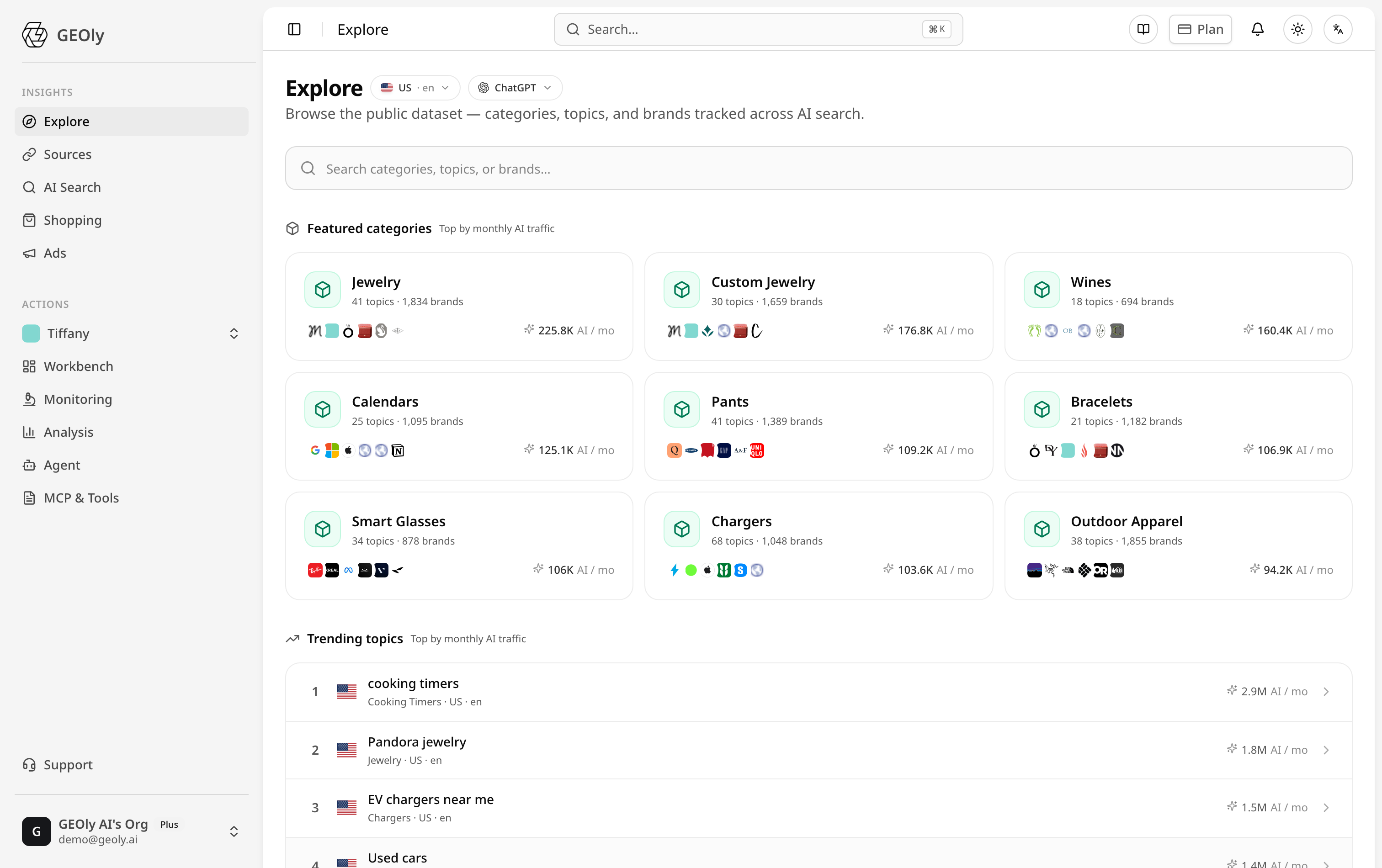
まずは可視性から始めましょう。GEOlyのブランド可視性追跡は、AIGVR(コアAI生成可視率)、Share of Voice、Share of Modelを主要なエンジンごとにレポートします。これにより、単に表示されているかどうかだけでなく、各モデル内で競合他社に対してどの位置にランクインしているかを確認できます。フロントエンドがどのようにページをレンダリングしたかに関係なく、これが可能です。
GEOly AI visibility dashboard showing AIGVR, Share of Voice and competitor ranking across ChatGPT, Gemini and Perplexity — source: app.geoly.ai
ProfoundはエンタープライズAEOのリーダーであり、大規模組織にとって非常に優れた製品です。10以上のエンジンにわたる可視性、引用、感情分析、Share of Voiceを追跡し、Conversation ExplorerはAIがカテゴリをどのように議論しているかを理解するのに優れています。価格はエンタープライズ向け(セルフサーブで約$99/月、Growthプラン$399、エンタープライズプラン$2k–5k+)です。Commerce Layerにおける課題は、Profoundがブランドおよびドメインレベルで追跡する点です。つまり、ブランドが言及されていることはわかりますが、どの製品がAIショッピングカードで勝利しているかをフロントエンドや市場ごとに特定することはできません。
Connect GA4 so you can tie AI visibility gains to actual orders and justify the engineering work.
Benchmark visibility per frontend and market with the 29-point GEO Audit to see exactly which pages AI engines cannot read.
FAQ
Is GEOly better than Profound for Commerce Layer?
For a Commerce Layer operation, on fit, yes. Profound is the stronger enterprise AEO suite with broader engine sprawl, but it tracks at the brand level. GEOly tracks at the product and Share-of-Card level across every frontend and market, which is what a headless multi-market catalog needs to know which experience is winning the recommendation.
Does an API-first, agent-ready platform mean I do not need a GEO tool?
No. Clean commerce APIs let an AI agent transact against your catalog once it already knows about you. They do nothing to make ChatGPT or Perplexity recommend your product in the first place. Discovery happens in the synthesized answer, upstream of the agent, and that is what a GEO tool measures.
What makes Commerce Layer GEO different from a hosted platform?
Headless rendering plus multi-market. Your product data lives in the API but is rendered into pages by many frontends, per region, and an AI engine may read the content while missing the API-injected price and availability. The main lever is making sure each frontend outputs clean, structured product data in every market, which is an engineering task, not a settings toggle.
Will AI engines see my prices if they are loaded from the API?
Only if that data ends up in readable HTML or structured data. If price and availability are fetched and injected client-side, an AI crawler may never see them. Server-side rendering or pre-rendering, plus complete JSON-LD, is what lets an AI engine trust and quote your listings, so audit each frontend to confirm.
How do I decide which products and markets to optimize first?
Start with demand, not the catalog. Identify the product needs AI shoppers are actually asking about in each region, then check which of your matching products are missing from AI answers there. GEOly's Demand Themes and 29-point GEO Audit give you that ordered list.
The bottom line
Commerce Layer gives teams the headless engine and the clean APIs to transact with AI across many markets. What it does not give you is a view of whether AI engines can see and recommend your products across the many frontends and regions that API feeds. That view is the difference between being agent-ready and being chosen. To see where your storefronts actually stand, run the free 29-point GEO Audit, start tracking Share-of-Card, and explore the Commerce Layer GEO detail page.
For more from the team behind this analysis, follow GEOly Platform.