Your customers are asking ChatGPT, Gemini, and Perplexity questions your brand used to answer through Google rankings — "best [category] for [use case]," "is [brand] worth it," "[brand] vs [competitor]." Whether your brand shows up in those answers, and how it's described when it does, is now a measurable, trackable metric. Here's how to actually track it, from a free manual method to a full automated framework.
Key Takeaways
- AI search visibility is measured through four core metrics: mention rate, citation rate, Share of Model (or Share of Voice), and sentiment — not a single "ranking."
- You can start tracking manually today with a spreadsheet and a fixed prompt set; it doesn't scale, but it tells you where you stand right now.
- A repeatable 5-step framework (define prompts → run across engines → log citations and sentiment → benchmark vs competitors → act on gaps) works whether you're doing it by hand or with a platform.
- Check AI visibility weekly at minimum — AI-generated answers shift faster than traditional search rankings, especially around product launches or PR events.
What "AI search visibility" actually measures
Unlike a traditional SEO ranking, there's no single "position" in an AI-generated answer. Instead, AI visibility is usually broken into four metrics:
- Mention rate — the percentage of relevant prompts where your brand is mentioned at all, across a defined prompt set.
- Citation rate — the percentage of prompts where a specific page of yours is cited as a source, distinct from just being named.
- Share of Model (or Share of Voice) — your mention/citation volume relative to competitors mentioned in the same answers, which tells you whether you're winning or losing category visibility, not just whether you exist in it.
- Sentiment — whether the AI's description of your brand is positive, neutral, or negative, and specifically whether it repeats outdated or inaccurate claims.
Tracking only "am I mentioned" misses the second half of the picture: a mention with negative sentiment, or a citation of an outdated product page, can be worse than no mention at all.
Method 1: Manual tracking (free, DIY)
You don't need a paid tool to get a first read on your AI visibility. The process:
- Build a prompt list. Write 15–30 prompts real customers would plausibly ask — category questions ("best [category] tools"), comparison questions ("[brand] vs [competitor]"), and direct questions ("is [brand] legit / worth it").
- Run each prompt across engines. At minimum, cover ChatGPT, Perplexity, Google AI Overviews, and Gemini — these have the highest combined query volume for most B2C and B2B categories.
- Log results in a spreadsheet. For each prompt/engine pair, record: mentioned (yes/no), cited with a specific URL (yes/no), sentiment (positive/neutral/negative), and which competitors appeared alongside you.
- Repeat on a fixed schedule. Weekly, using the same prompt wording — AI answers vary run to run, so consistency in your prompts matters more than exhaustive prompt coverage.
The limitations show up fast: no historical trend line, no scale beyond a few dozen prompts, and significant manual time cost every cycle. It's a good way to validate whether AI visibility is a real problem for your brand before you invest in tooling — not a long-term system.
Method 2: Automated tracking with a platform
Dedicated AI-visibility platforms solve the scale problem: hundreds of prompts, run daily or weekly, across every major engine, with historical trend lines and competitor benchmarking built in. See the best AI visibility tools comparison for how the major platforms differ, or the alternatives hub for head-to-head breakdowns against specific vendors. What to look for specifically for tracking (versus general feature comparison):
- Prompt-set customization — can you add your own category-specific prompts, or are you limited to a generic template?
- Citation-level detail — does it show which of your specific URLs got cited, not just that your brand was named?
- Historical trend data, not just a current snapshot — this is what lets you prove AEO work is moving the needle over a quarter.
- Competitor benchmarking in the same view, so Share of Model is visible without cross-referencing separate reports.
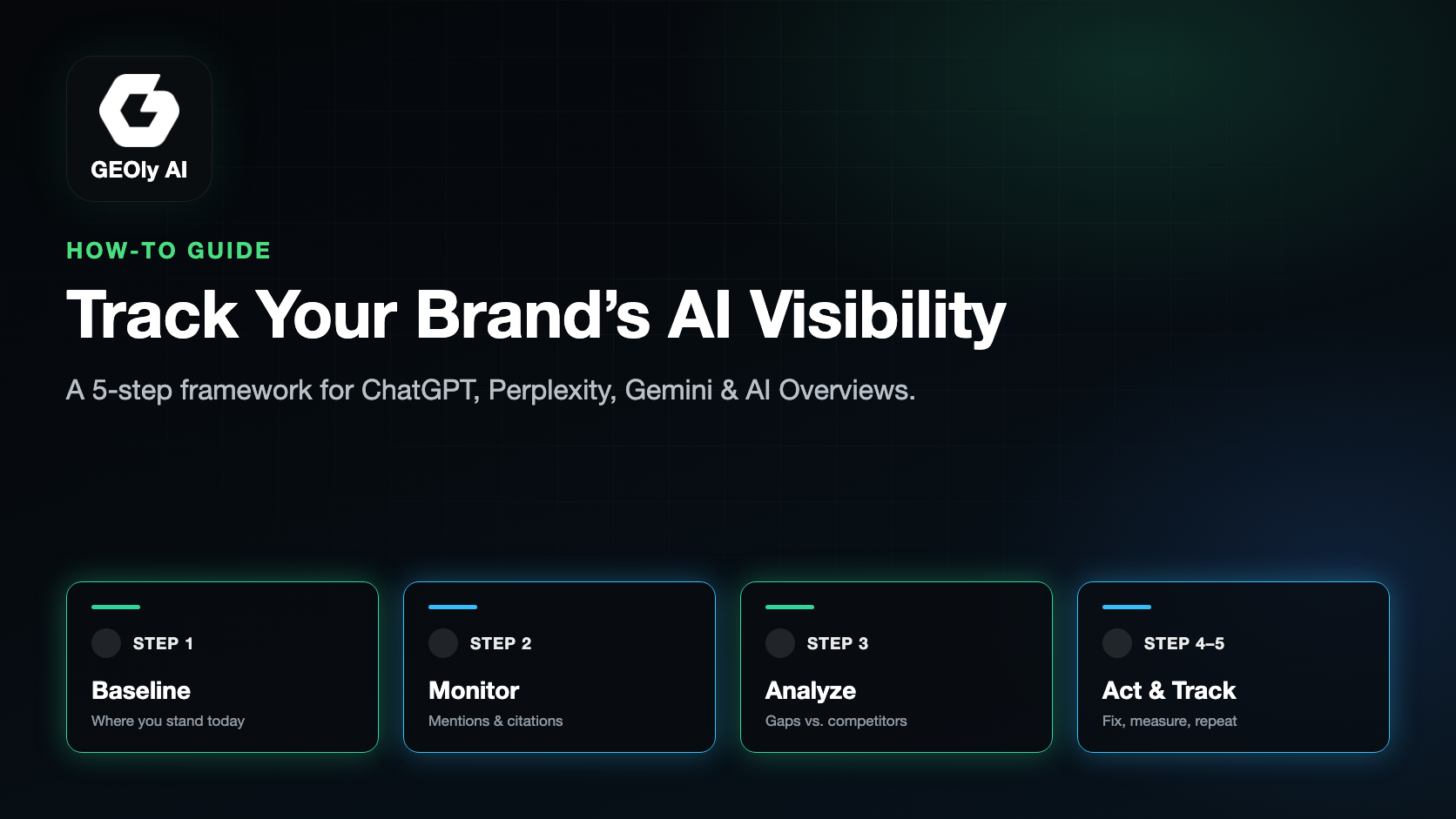
A 5-step tracking framework
This framework works whether you're doing it manually or with a platform — the steps are the same, only the effort per step changes.
- Define your prompt set. Anchor it to real customer research questions, not just your brand name. Include category, comparison, and "is it worth it" style prompts.
- Run across all relevant engines. Prioritize by where your buyers actually search — B2C categories skew toward ChatGPT and Google AI Overviews; technical/developer categories see more Perplexity and Claude usage.
- Log citations and sentiment, not just mentions. A mention with no citation and neutral sentiment is a different signal than a cited, positive mention — track them separately.
- Benchmark against named competitors. Note which competitors appear in the same answers and how often — Share of Model only means something relative to who else is showing up.
- Act on the gaps. Missing citations usually trace back to missing or outdated structured data, thin comparison content, or pages the AI's retrieval layer can't parse cleanly — see what is llms.txt for one structural fix, and what is AEO for the broader optimization playbook.
How often to check
Weekly is the practical minimum for most brands — AI-generated answers can shift faster than traditional search rankings, particularly around product launches, funding announcements, or negative press, any of which can change how an AI model describes your brand within days. Teams tracking a launch or actively fixing citation gaps often check daily during that window, then step back to weekly cadence once visibility stabilizes.
FAQ
What's the difference between mention rate and citation rate? Mention rate counts any prompt where your brand name appears in the AI's answer. Citation rate is narrower — it counts only cases where a specific page of yours is referenced as a source. A brand can have a high mention rate (the AI knows who you are) but a low citation rate (it isn't pulling information from your site specifically), which points to a content or structured-data gap rather than a brand-awareness gap.
Can I track AI visibility without a paid tool? Yes, using the manual method above — a fixed prompt set run by hand across the major engines on a weekly schedule. It won't scale past a few dozen prompts or give you historical trend lines, but it's a legitimate way to establish a baseline before evaluating platforms.
Why does my brand show up in ChatGPT but not Perplexity (or vice versa)? Each AI engine has a different retrieval and grounding process, draws from different source indexes, and weights recency and citation signals differently. It's normal for visibility to vary meaningfully by engine — which is why single-engine tracking gives an incomplete picture.
How is this different from tracking traditional SEO rankings? Traditional rankings measure position in a list of links for one query at one point in time. AI visibility aggregates presence and citation across many possible AI-generated answers to the same underlying question, and the "answer" itself can change wording between runs — see AEO vs GEO for how the measurement models differ.
Want the automated version of this framework running on your brand? Start a free GEOly account and track mention rate, citation rate, and Share of Model across all six major AI engines from day one.
