Give PR teams an AI citation source map and a brand impression dashboard before deciding what coverage to pitch, what proof to build, and what reputation to fix
PR teams do not just need more mentions. They need to see which media, reviews, communities, and owned materials AI systems keep citing, and what impression it forms from them — what reads as praise, what reads as criticism, and what reads as confusion, each backed by the original quote.
Is XX brand trustworthy? What do people actually say about it?
An AI answer to this does two things at once: it pulls evidence from trade coverage, review lists, community discussion (communities like Reddit are among the sources AI cites most), and owned brand materials, and it forms an impression from them — what is praise, what is criticism, what is confusion. PR teams need to see both who AI cites and the reputation narrative it tells as a result.
Trade coverage, news pages, and well-structured press-release destinations still anchor brand credibility in many answers.
Community discussion is among the sources AI cites most, and it is also where praise, criticism, and confusion concentrate.
Third-party reviews, rankings, and comparison pages often explain why a brand is being recommended.
The brand site, research, FAQs, and case studies appear, but not yet as stable citation anchors.
The PR problem is no longer just “where did we get coverage?” It is “which sources are teaching AI how to talk about us?”
Counting clips or mentions is not enough in an AI answer environment. PR teams need two layers of intelligence: source intelligence — which domains keep getting cited and what proof they carry; and impression intelligence — the praise, criticism, and confusion AI forms from them, with the original quote behind each one.
A mention does not automatically become a trusted AI source
Some coverage creates durable citation value. Other coverage disappears after one news cycle. PR teams need to know which sources are repeatedly being pulled into AI answers.
Most teams still track volume, not the impression AI forms
Share of voice and media volume matter, but they do not tell you whether AI is casting the brand as praise, criticism, or confusion when it answers important questions — nor can they trace the quotes behind those impressions.
PR planning breaks when the source graph and reputation evidence stay invisible
If the team cannot see which sources competitors dominate, which source types are missing, where owned proof is too weak, or which complaints and confusion AI is repeating, outreach, distribution, and reputation repair all turn into guesswork.
The useful PR view is a source-plus-impression map, not a generic coverage list
PR teams need a layered view of the evidence chain and reputation behind AI answers: which domains are cited, what source types they represent, what praise, criticism, and confusion AI forms from them, and whether each impression traces back to a specific quote.
Cited sources
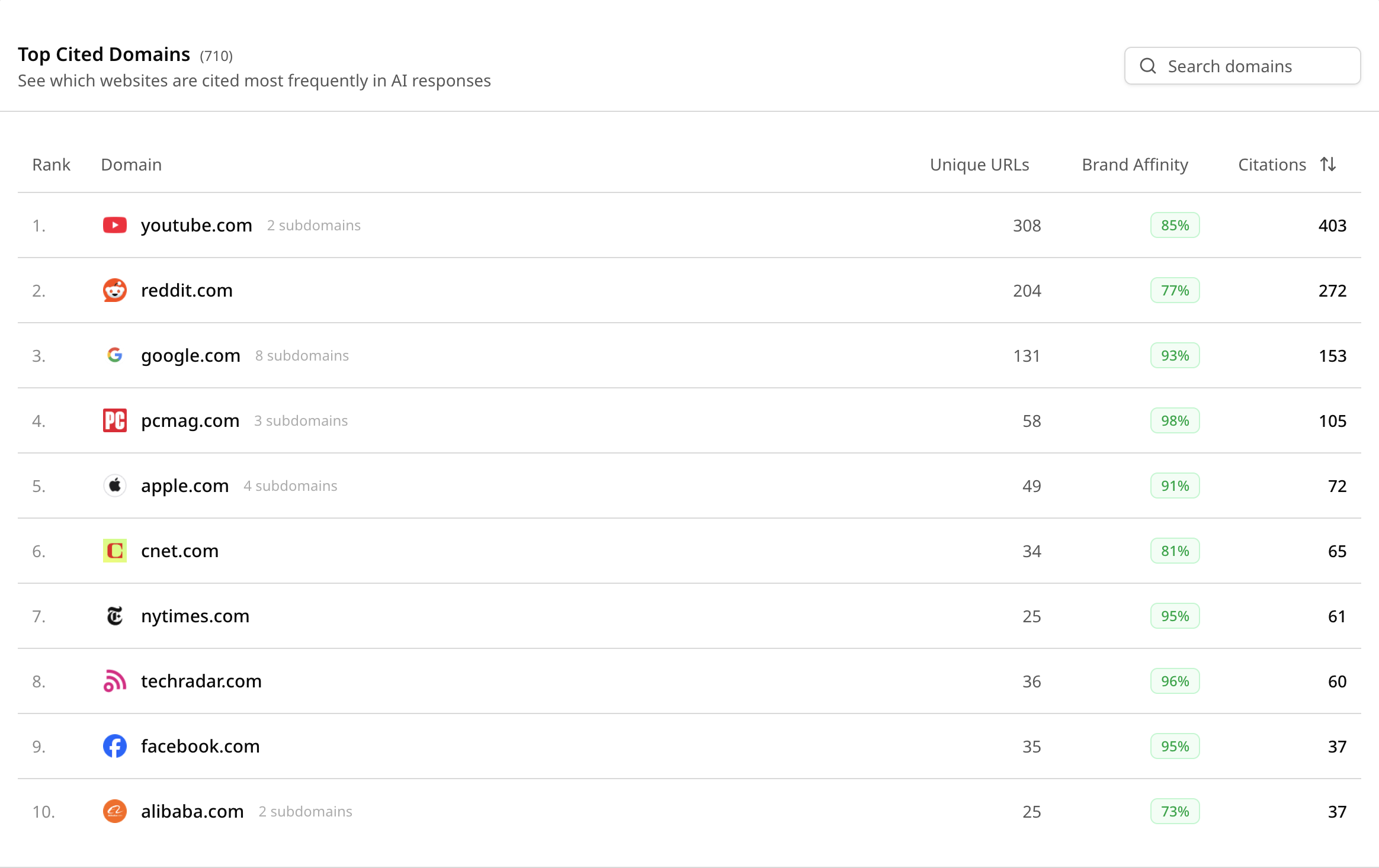
See which publishers, reviews, communities (including Reddit and others), and owned pages are repeatedly cited across the prompts that matter.
Source-type mix
Break out the share of trade media, mainstream media, reviews, community forums, and brand-owned proof so the team knows where authority is really coming from.
Brand impression dimensions
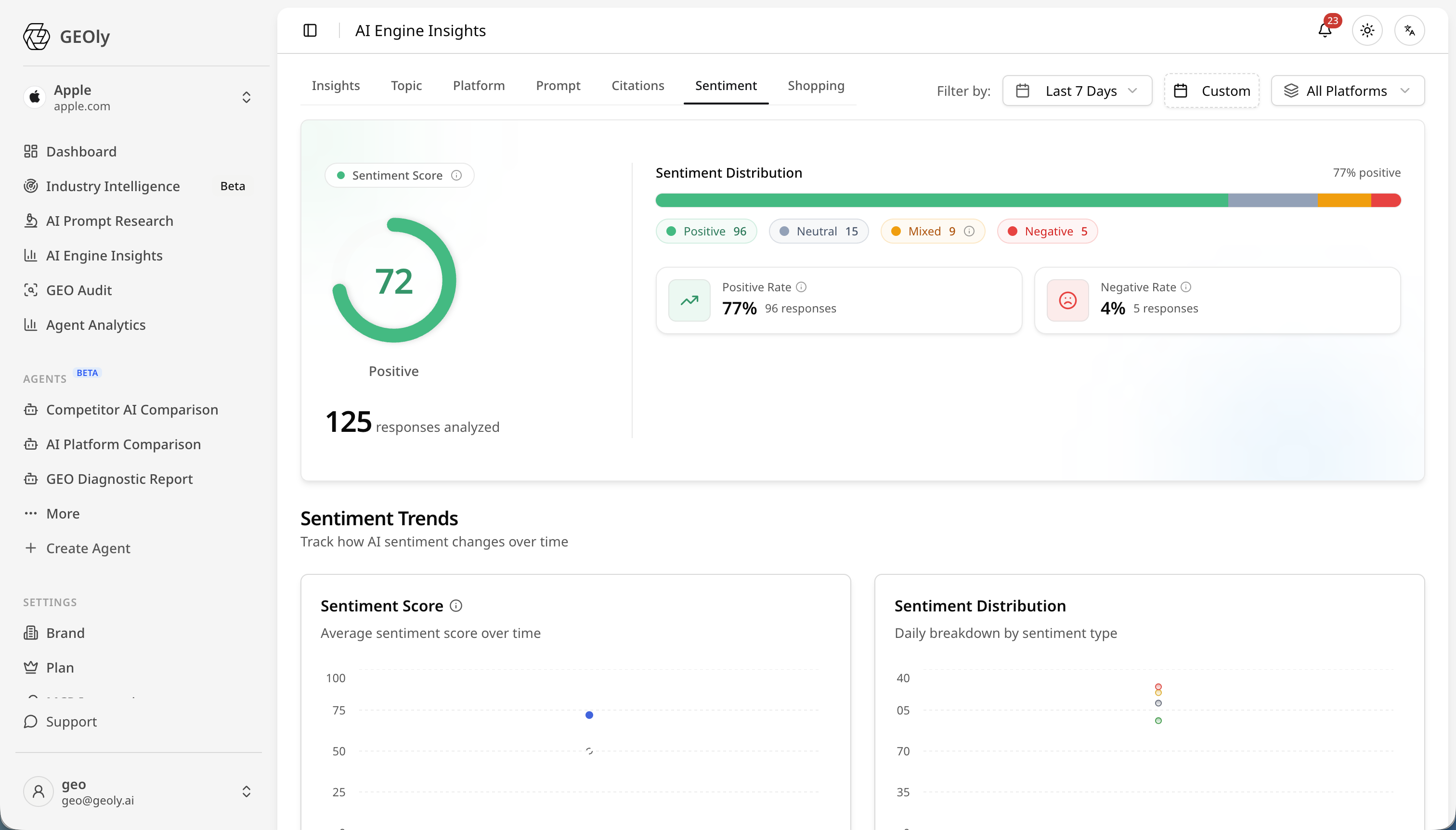
Split AI's impression of the brand into praise, criticism, and confusion, with each one traceable to a specific original quote and comparable by platform and time window.
Competitor source and reputation
See which competitor stories, reviews, and publications keep outranking your brand in AI citations, and how rivals frame themselves across comparable ad messaging (360K+ ad cards).
A practical PR page should show the daily source and reputation board the team actually needs
The point is not to drown PR teams in dashboards. It is to make the source and reputation environment legible enough that they can decide what to pitch, which proof to strengthen, and which criticism and confusion to fix next.
Citation source board
Track which trade outlets, news sites, review pages, and communities are repeatedly cited, and where the brand still has no source footprint.
Brand impression board
Track how AI's praise, criticism, and confusion about the brand shift over time, with each impression backed by original-quote evidence and split by platform and time window.
Brand evidence board
Check whether owned pages, research, FAQs, case studies, or brand documentation are strong enough to be cited reference material and to directly answer the confusion and criticism AI is repeating.
Priority board
Turn source gaps and reputation risks into a working PR queue: which sources to pursue, which criticism and confusion to fix, and which narratives need stronger third-party validation first.
From source and impression discovery to PR action
This workflow is built for PR teams that need to move from vague visibility and reputation concerns into concrete source-building, reputation-repair, and outreach decisions.
Map the answer- and reputation-critical prompts
Start with the category, comparison, reputation, and buyer-trust prompts where AI answers can reshape both perception and sentiment before a click.
Read the source graph and brand impression
See which domains, source types, and competitor references keep appearing, and what praise, criticism, and confusion AI forms about the brand from them.
Prioritize source and reputation gaps
Decide where the brand needs stronger reviews, media validation, and expert proof, or better owned materials that directly answer the confusion and criticism AI is repeating.
Turn intelligence into the PR queue
Translate recurring source gaps and high-risk reputation signals into concrete pitch lists, proof packages, briefing notes, and monitoring rules for the next cycle.
Position the brand's citations and reputation inside a source and topic system spanning 100K+ brands and 26K+ topics.
Every praise, criticism, and confusion signal traces back to a specific quote and source, split by platform and time window.
Turn source gaps and reputation risks into one PR action list instead of scattered monitoring notes.
Media relations, re-ranked by what AI actually cites
Your media list was built for human readers. GEOly rebuilds it for AI answers: every source domain scored with AI DA—the AI-era counterpart to domain authority—classified into 8 source types, and tied to the brands it funnels into answers.
AI DA for every domain
A 0–100 authority score built from citation authority, placement quality, and coverage breadth—so outreach effort follows citation power, not legacy prestige.
Source Lists as a workflow
Paste a client or campaign media list into Workbench: GEOly audits it against AI citation data and tracks pitching status, owner, and notes entry by entry.
Narrative monitoring with receipts
AI Perception splits what AI praises from what it criticizes, aspect by aspect—every quote traceable to the source answer for escalation or rebuttal.
The rest of the reputation loop
Citation-led PR compounds with community presence and daily mention tracking.
GEOly capabilities behind this PR path
PR teams need citation source analysis, brand impression monitoring, industry source landscape, and citation tracking working together — not isolated features.
AI Citation Analysis
See who AI cites: source-type mix, top cited domains, and the split across media, communities, and reviews.
ExploreBrand Impression Monitoring
Track the brand's praise, criticism, and confusion in AI answers, with original-quote evidence, split by platform and time window.
ExploreIndustry Intelligence
See the industry source landscape: which publishers, source types, and topics are shaping authority.
ExploreBrand Visibility Tracking
Track mentions, citations, and placement in AI answers, and how brand presence shifts over time.
ExploreFrequently asked questions about this solution
Stop treating AI visibility as a clip count problem. Start treating it as a source-graph and brand-impression problem.
If PR teams want to shape how AI talks about the brand, the next move is not just more outreach volume. It is understanding which sources matter, where authority is thin, which criticism and confusion AI is repeating, and how to build stronger evidence into the source graph behind the answer.